



Parliament’s Standing Committee on External Affairs will spend 2026-27 examining 18 subjects, from a frozen relationship with Pakistan to India’s long-stalled bid for a permanent seat on the UN Security Council. The Lok Sabha Secretariat published the list in a bulletin on Monday, November 16, 2026.
The committee is chaired by Congress MP Shashi Tharoor and drawn from both Houses. It met on October 29 to consider the memorandum on subject selection, after Speaker Om Birla reconstituted parliamentary panels earlier in October.
The agenda arrives at an unusual moment. In the past year India concluded a trade deal with the European Union, reset tariffs with Washington, saw its trade deficit with China hit a record, and is preparing to receive its first Pakistani federal minister since 2023. The sections below set each subject against what has actually happened.
The bulletin lists the subjects as:
- India-Europe relationship: opportunities and challenges
- Performance of the passport issuance system, including e-passports, and a review of the Passport Act and Rules
- Understanding India-China relations and the way forward
- Recent developments in India-Pakistan relations
- India-US relations, including the role of the Quad
- India’s relations with West Asia
- Reforming the UN and India’s bid for permanent UNSC membership
- Act East Policy and partnership with ASEAN
- India-Africa strategic partnership
- India’s engagement with BRICS
- Soft power and cultural diplomacy
- Functioning of Nalanda University and South Asian University
- Functioning of Indian missions abroad
- Emigration, mobility of skilled professionals and diaspora welfare
- India-Bhutan bilateral relations
- Strengthening the Indian Foreign Service
- Role of states and UTs in external engagement
- MEA engagement with think tanks and academic institutions
The agenda at a glance
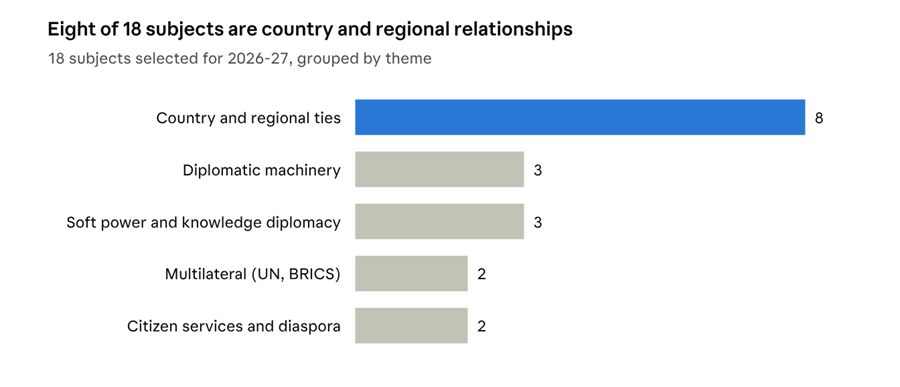
Lok Sabha bulletin, Nov 16, 2026 · grouping by this doc
Country relationships dominate: Europe, China, Pakistan, the US, West Asia, ASEAN, Africa and Bhutan. The rest splits evenly between how India runs its diplomacy and what it projects abroad.
India-Pakistan: a ceasefire that holds, ties that do not
Eighteen months after the four-day conflict of May 2025, relations remain frozen, but the first official thaw signal has just appeared. Pakistan’s Climate Change Minister Musadik Malik will attend the SCO Civilisational Dialogue in New Delhi on November 20-22, the first visit by a Pakistani federal minister since Bilawal Bhutto Zardari came to Goa in May 2023.
| Date | Event |
| Nov 20-22, 2026 | Pakistani minister due in New Delhi for an SCO meeting |
| Aug 2026 | Reports of at least four back-channel meetings since the conflict, in London, Muscat, Thailand and Doha (bdnews24) |
| May 10, 2025 | Ceasefire ends four days of missile and drone strikes |
| May 7, 2025 | India launches Operation Sindoor |
| Apr 2025 | Pahalgam attack kills 26; India holds the Indus Waters Treaty in abeyance; Pakistan shuts airspace, Wagah and trade (Al Jazeera via Daily Sun) |
The committee will be examining a relationship in which formal channels are largely closed. Former Pakistani diplomat Husain Haqqani told the BBC this is one of the longest periods of frozen ties. Yet trade is quietly creeping back: Pakistan’s imports from India have been rising again despite the official suspension, Al Jazeera reported this month.
Key questions for the panel: whether the Indus Waters Treaty stays in abeyance, how India keeps terrorism at the centre of multilateral debate (as its UN envoy recently did at the Security Council), and whether multilateral settings like the SCO become the only place the two sides meet.
India-US and the Quad: a trade reset, a summit still missing
Washington and New Delhi pulled back from a tariff war this year, but the Quad, which the committee is asked to assess, has lost momentum at leader level.
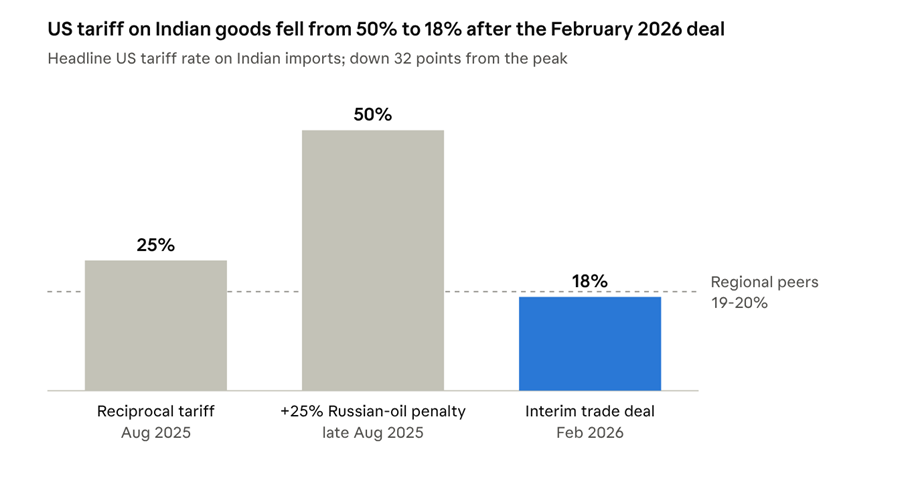
Down To Earth, India Briefing, The Quint (Feb 2026)
The interim framework announced on February 2-6, 2026 cut the US tariff to 18% and removed the additional 25% duty imposed over India’s Russian oil purchases. In return India was reported to commit to ending Russian crude imports and to a purchasing intent of up to $500 billion in American goods. India has since reassessed the deal after a US Supreme Court ruling on tariffs.
On the Quad, India held the chair in 2025 but no leaders’ summit took place. New Delhi instead hosted a foreign ministers’ meeting on May 26, 2026, where US Secretary of State Marco Rubio said he hoped to lay groundwork for a summit with President Trump.
India-China: a political thaw, a widening trade gap
Diplomatic ties have steadily normalised since the October 2024 border disengagement, but the economic imbalance has grown. China overtook the US as India’s largest trading partner in 2025-26, with two-way trade of $151.1 billion.
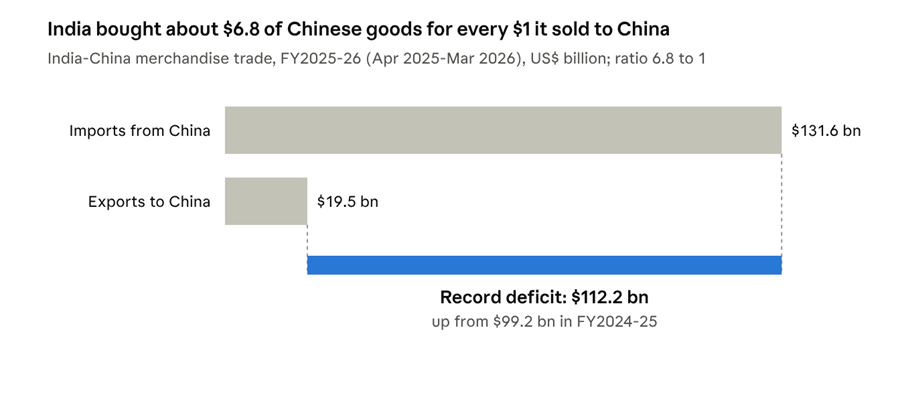
Ministry of Commerce data via The Bridge Chronicle and ThePrint (Apr 2026)
Exports to China grew 37%, but from a small base; imports grew 16% to $131.6 billion. Electrical and electronic equipment alone accounted for $43.1 billion of the gap. Calendar-2026 data point the same way: the deficit reached $105.9 billion in January-September, close to 2025’s record of $116.1 billion.
On the political side, the August 2025 Wang Yi-Doval talks agreed to resume direct flights, reopen border trade at three points and share hydrological data. Air China, China Eastern and IndiGo have since restored routes. The panel’s “way forward” will have to weigh this thaw against dependence on Chinese inputs and China’s alignment with Pakistan.
India-Europe: from negotiation to implementation
The committee’s first-listed subject follows India’s biggest trade agreement to date. India and the EU concluded their free trade agreement on January 27, 2026 at the 16th India-EU Summit in New Delhi, ending talks that began in 2007.
| Feature | Detail |
| Market covered | Nearly 2 billion people, about 25% of global GDP (The Quint) |
| Immediate duty-free access | 49.6% of tariff lines (India), 70.4% (EU) (India Briefing) |
| Headline cuts | Luxury car tariffs from 110% to 10%; wine duties to 20% (Outlook Business) |
| Biggest open risk | The EU’s carbon border tax on Indian exporters |
The challenges the panel is asked to weigh lie largely in implementation: legal scrubbing and formal signature, ratification in Europe, and compliance costs for Indian steel, aluminium and other carbon-intensive exports.
The multilateral track: UN reform, BRICS and the wider map
India’s UNSC campaign is stuck where it has been for 18 years: the G4 (India, Brazil, Germany, Japan) complain that the Intergovernmental Negotiations have produced no concrete outcome. In June 2026 India’s UN envoy Parvathaneni Harish rejected a co-chairs’ “Elements Paper” and called expansion of only non-permanent seats “bordering on failure”. In October he argued that new permanent members must not be second-class on the veto. The Uniting for Consensus group, which includes Pakistan, continues to block text-based negotiations.
| Subject | Where it stands, November 2026 |
| BRICS | India chaired in 2026, its fourth turn, and hosted the 18th summit in New Delhi on Sept 12-13; the 11 members adopted a 140-paragraph New Delhi Declaration |
| West Asia | Regional tensions drove a precautionary surge in remittances from the Gulf, and India got Iran, Saudi Arabia and the UAE to sign one BRICS text (Bower Group Asia); the 2026-27 budget made no allocation for Iran’s Chabahar port (The Wire) |
| Act East and ASEAN | Continuing priority; the panel reviews delivery |
| Africa | Strategic partnership under review, with African permanent seats now part of the G4’s UNSC position |
| Soft power | Cultural diplomacy under review alongside Nalanda and South Asian University (see last section) |
Bhutan and the neighbourhood: where the aid goes
Bhutan is the only single neighbour with its own subject on the list, and the budget shows why: it is by far India’s largest aid partner.
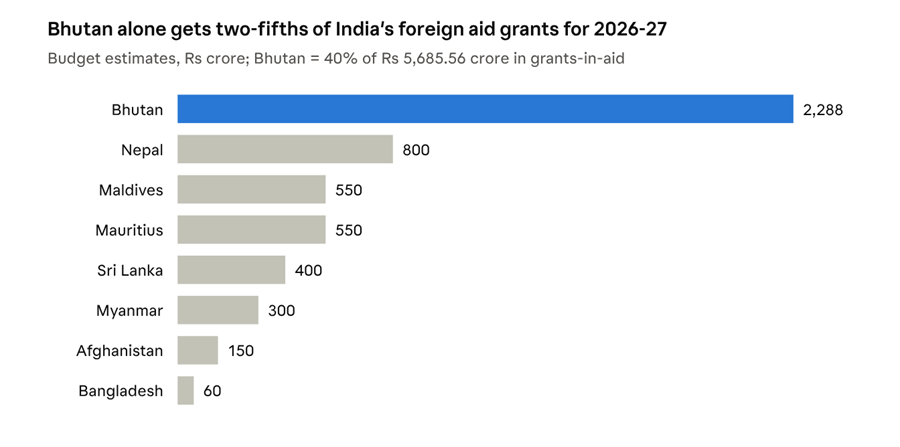
Union Budget 2026-27 via OrissaPOST/PTI, editorji, Daily Excelsior, NewsBytes (Feb 2026)
Bhutan’s allocation rose from Rs 1,950 crore in the 2025-26 revised estimates. The cuts tell a story too: aid to Bangladesh was halved to Rs 60 crore amid frosty ties, while Afghanistan rose to Rs 150 crore. About Rs 4,548 crore of the Rs 6,997 crore development-partnership portfolio is reserved for immediate neighbours.
Citizens abroad: passports, mobility and the diaspora
Two subjects deal with Indians rather than governments, and both involve record numbers.
Passports. Every passport issued in India since May 28, 2025 is a chip-based e-passport under Passport Seva 2.0. A government report recorded more than 1.27 crore passports issued in 2025, including 88.87 lakh e-passports, and 158 of 203 missions abroad have moved to the new system. Older passports stay valid until expiry, with full e-passport coverage targeted by 2035. Passport Seva Kendras grew from 77 to 453 in 11 years. The committee will also review the Passports Act and Rules.
Diaspora and remittances. The welfare and mobility subject covers the world’s largest remittance flow.
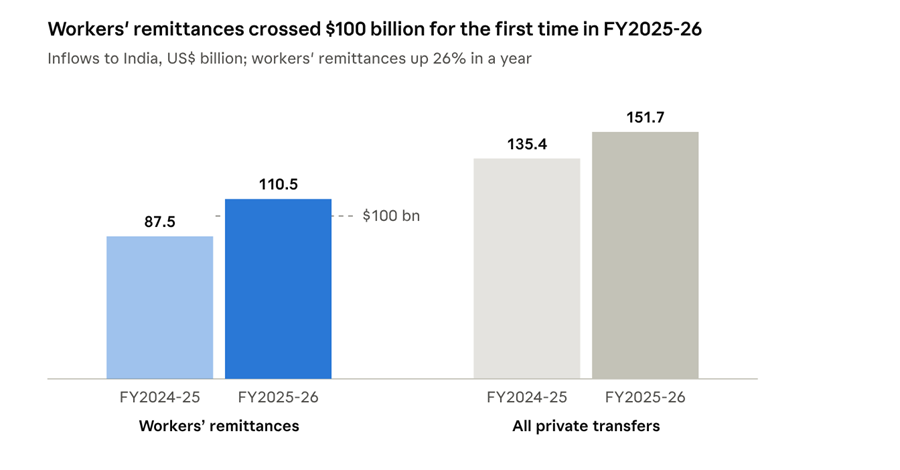
RBI balance of payments data via Policy Circle and Vajiram & Ravi (Jun 2026) A weaker rupee and precautionary transfers from the Gulf during West Asia tensions drove the jump. India has been the world’s top recipient for over two decades, and advanced economies such as the US now send more than the Gulf (RBI remittances survey via Finnovate


