



Online voter applicants in states still under the Special Intensive Revision (SIR) must now file two documents, not one: the statutory Form 6 and a separate SIR declaration, each with its own OTP and e-signature. The Election Commission of India (ECI) confirmed the change on November 4, 2026, carrying out an October 21 decision it had disclosed to the Supreme Court.
The split does not scrap the declaration. It only stops the ECINet portal from presenting it as if it were part of Form 6, the form prescribed under the Registration of Electors Rules, 1960. Two of the three Election Commissioners had objected on record to that merger, one calling it unauthorised and illegal.
A day earlier, on November 3, the ECI told state Chief Electoral Officers that voters dropped from draft SIR rolls may use Form 6 to get back on, and that filing it would not by itself expose them to prosecution under Section 31 of the Representation of the People Act, 1950.
How it unfolded
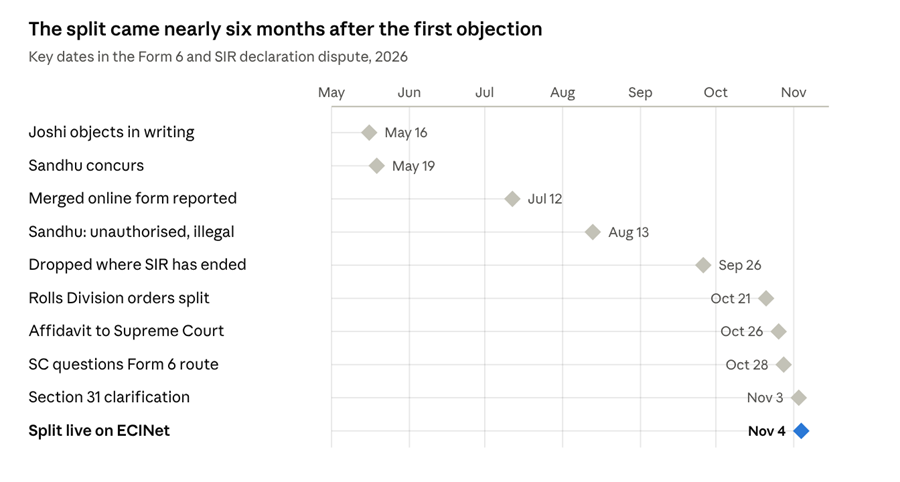
Compiled from Indian Express reporting via Deccan Chronicle, NewsBytes, SC Observer, Business Standard/PTI
The declaration stayed on the online form for about three months after the second written objection, and the ECI moved only after the dissent became public in September.
Dissent inside the Commission
The objection was legal, not procedural: a form prescribed by the Rules can only be changed by amending the Rules, which is the Union government’s job, not the ECI’s. Election Commissioner Vivek Joshi recorded this on May 16, 2026, and Election Commissioner Sukhbir Singh Sandhu agreed on May 19.
The declaration went onto the online Form 6 anyway in July. The Indian Express reported on July 12 that the ECINet version carried it while the downloadable Form 6 did not. Sandhu then wrote on August 13 that the change was unauthorised and illegal and asked for it to be removed.
The Law Ministry’s Legislative Department has said it had no information on any ECI proposal to amend Form 6 or the 1960 Rules to add an SIR declaration. The Indian Express has also reported that the two Commissioners objected on record at least 14 times in 10 months to SIR decisions they said were taken without their knowledge.
What the declaration asks. Applicants must say whether they, a parent or a grandparent appeared on the roll at the last intensive revision in the early 2000s, or confirm that none did. The online form would not submit until this was answered.
What the ECI told the Supreme Court
The ECI’s position is that Form 6 was never amended and could not have been, since only the Central Government can change forms under the 1960 Rules. It filed this in a counter-affidavit of about 250 pages on October 26, 2026, in Rakesh Kumar Singh v. Union of India, a petition challenging the Chief Election Commissioner’s functioning.
- Why the two were merged online: so applicants could finish both with one OTP and one e-sign. The ECI conceded the presentation could be read as an amendment.
- The fix: the Electoral Rolls Division decided on October 21 to split the online application into Form 6 and the SIR declaration, matching the paper process.
- Unanimity: the affidavit, filed by Deputy Election Commissioner Bhanu Prakash Yeturu, says the SIR orders of June 24, 2025, October 27, 2025 and May 14, 2026 were approved by all three Commissioners.
- Scope: the ECI says the Supreme Court upheld the declaration for the duration of SIR, and the standard Rules forms apply outside it.
That last claim is contested. The ECI said in a September 25 press release that the Court had approved the Form 6 changes in May; the Chief Justice later said the Court gave no such approval.
How many voters this touches
The Form 6 question matters because SIR drafts have left out tens of millions of previously listed electors, each of whom must file a claim to get back on.
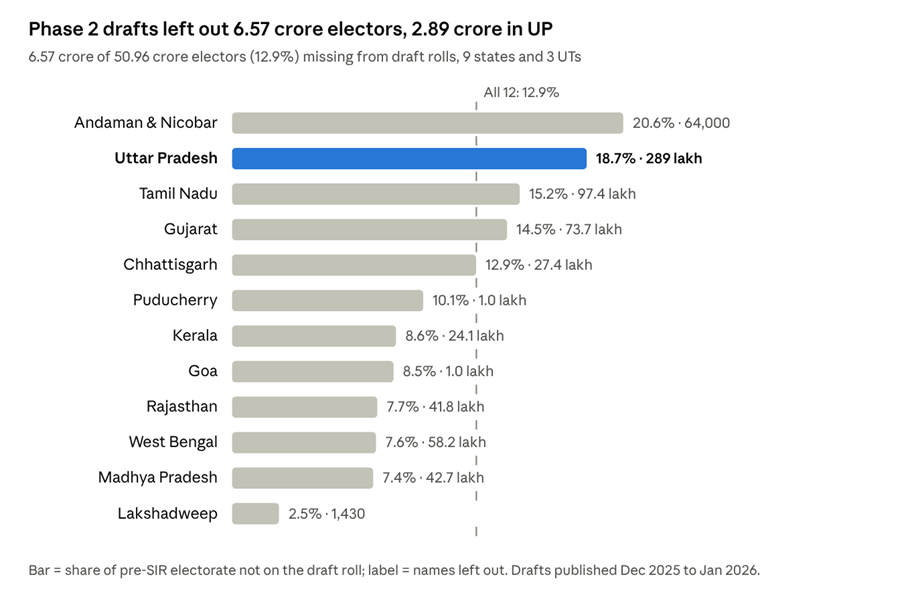
Deccan Herald compilation of state CEO draft-roll data, SIR Phase 2 (12 states/UTs)
The ECI classes these exclusions as absent, shifted, dead or duplicate: of the Phase 2 total, 4.64 crore were marked as shifted, 1.46 crore as dead and 44 lakh as multiple registrations. Draft exclusions are provisional; about 2 crore people were later added back or newly enrolled, leaving net Phase 2 deletions near 5.2 crore. Delhi, in the current phase, stands out at 32.8% left off its August 31 draft.
The Form 6 dilemma for dropped voters
Voters cut from draft SIR rolls are told to re-enter through Form 6, a form built for first-time voters that asks them to affirm they are applying for inclusion for the first time. A false declaration under Section 31 of the 1950 Act can bring up to a year in prison, a fine, or both.
That clash surfaced on the ground before it reached the ECI’s desk:
- Maharashtra: the state CEO wrote to the ECI that officials were struggling to persuade previously registered voters to sign Form 6, and asked for the form to be changed.
- Nationwide drive: on September 29 the ECI ordered a special drive in 20 states and UTs where SIR had finished, asking omitted voters to apply through Form 6.
- Lost visibility: about 1.4 crore voters were added in the first two SIR phases, but because returnees and genuinely new voters use the same form, there is no way to tell them apart.
The November 3 clarification. In a letter to all CEOs, the ECI said filing Form 6 after being left off a draft SIR roll does not, on its own, amount to a false declaration. An ERO may not start Section 31 action merely because a previously listed elector files Form 6 during or after SIR. The protection does not cover someone already enrolled in another constituency or who makes an otherwise false statement, CEOs were told to publicise it widely.
The Congress dismissed the clarification as word games that leave the underlying problem in place. Note that the clarification is an administrative instruction; the wording of Form 6 itself is unchanged.
Courts weigh in
The Delhi High Court has accepted the ECI’s Form 6 route for now; the Supreme Court is still asking why it is needed at all.
- Delhi High Court: two voters deleted in Delhi’s SIR argued they should correct their existing entries through Form 8 rather than declare themselves first-time applicants. The ECI’s counsel said they could use Form 6, and the Bench called the fear of a false-declaration charge misplaced on those facts before closing the plea.
- Supreme Court, October 28: hearing a challenge to Delhi’s SIR, Chief Justice Surya Kant asked why a voter who can cite an earlier booth, roll entry and voter number must file Form 6 at all. Advocate Prashant Bhushan argued it forces a false declaration; the ECI replied that “first-time inclusion” means inclusion in the fresh SIR roll and that no prosecution has followed.
The Delhi petition says 47,56,722 electors, 32.78% of the pre-SIR roll, were left off the draft published on August 31. Proposals to fix the problem at its root include a separate restoration form, floated in commentary as a “Form 6X”.
What it means for voters now
What you file depends on where you live and whether SIR is still running there.
| Your situation | What to file online | Notes |
| New voter, state where SIR has ended | Form 6 only | Declaration removed from ECINet and CEO portals after the September 26 Commission meeting |
| New voter, state where SIR is under way | Form 6, then the SIR declaration | Two separate submissions, each with its own OTP and e-sign; both are needed |
| Previously enrolled, missing from the draft SIR roll | Form 6, plus the SIR declaration while SIR runs | ECI says this alone is not a false declaration; Section 31 still applies if enrolled elsewhere or if any statement is false |
| Existing voter who moved | Form 8 | Form 8 corrects or shifts an existing entry |
The declaration was already gone from ECINet in states with published final SIR rolls by September 30, leaving it live only in the 13 states where revision was continuing.


