The Rashtriya Swayamsevak Sangh’s second-in-command has told India’s young protesters two things at once: that their anger is legitimate, and that “anarchic forces” at home and abroad may be steering it. Speaking in Indore on Wednesday, November 4, general secretary Dattatreya Hosabale also defended the Election Commission’s Special Intensive Revision (SIR) of voter rolls — the very exercise that turned this year’s Gen Z movement from an exam-leak protest into a fight over the vote.
Hosabale spoke at the close of the RSS’s three-day Akhil Bharatiya Karyakari Mandal meeting (November 2–4), its main organisational body, with about 407 functionaries expected. The Sangh had flagged in advance that youth unrest would figure prominently, alongside a review of its centenary year.
“Regimes change through elections,” he said, conceding that people may hold political goals of “regime change” but warning that unrest, division and violence do not serve society. Asked by reporters about the recent agitation at Delhi’s Jantar Mantar, he said forces within and outside the country were conspiring to incite the young.
This article sets his remarks against the record: what the protesters actually want, what the jobs data say, and what the Election Commission’s own numbers show about the voter-roll purge he defended.
From a satirical hashtag to a national movement
India’s Gen Z protests grew in under six months from an online joke into the country’s largest youth mobilisation in years, winning one ministerial resignation and then turning on the Election Commission. The spark was a remark in May 2026 by Chief Justice Surya Kant likening some unemployed youth to cockroaches; strategist Abhijeet Dipke answered with a parody outfit, the Cockroach Janta Party (CJP), launched on May 16.
The movement fused with fury over the leak of NEET medical entrance questions and the cancellation of results. Street protests began on June 6 demanding Education Minister Dharmendra Pradhan’s resignation, and experts linked the anger to youth unemployment and stalled mobility. A July 20 march from Jantar Mantar toward Parliament met batons and tear gas; Pradhan resigned within days, a victory CNN described as the government blinking.
The second act began in late September, when The Indian Express reported that two of the three election commissioners had objected in writing 14 times over 10 months to steps taken in the SIR. The CJP demanded Chief Election Commissioner Gyanesh Kumar’s resignation. On October 10, police sealed central Delhi, suspended mobile internet and detained the CJP’s leaders on arrival, with Al Jazeera reporting about 2,000 arrests; days later Jantar Mantar lost its status as a designated protest site.
| Date | Event |
| Oct 13, 2026 | CJP leaders detained after entering Jantar Mantar, newly de-designated as a protest site |
| Oct 10, 2026 | Delhi lockdown; CJP founder and roughly 2,000 others detained; leaders released next day on a one-year no-breach-of-peace condition |
| Oct 2, 2026 | EC calls the “13 crore deleted” claim misleading |
| Sep 23, 2026 | Indian Express reports 14 recorded objections by Election Commissioners Sandhu and Joshi; EC says decisions were unanimous |
| Jul 25, 2026 | Education Minister Dharmendra Pradhan resigns |
| Jul 20, 2026 | March from Jantar Mantar toward Parliament dispersed with tear gas |
| Jun 6, 2026 | Street protests over NEET leak begin |
| May 16, 2026 | Cockroach Janta Party launched online |
| Sep 8–13, 2025 | Nepal’s Gen Z uprising topples the Oli government |
| Jun 2025 | SIR begins in Bihar |
The regional backdrop explains why the word “conspiracy” carries weight. Youth-led uprisings brought down governments in Bangladesh in 2024 and Nepal in September 2025, and Hosabale explicitly cited “the experiences of other countries”. Even in Indore the label is contested: a 2025 campus probe at Devi Ahilya Vishwavidyalaya alleged a Nepal-style “Gen Z” protest was engineered by seniors through fake social-media accounts.
The grievance is measurable
Whatever moved the crowds, the economic grievance under them is in the government’s own data: in April–June 2026, the quarter the protests began, unemployment among 15- to 29-year-olds reached 15.9%, the highest in the revamped quarterly survey. The monthly figure for June alone was 16.2%, also a series high.
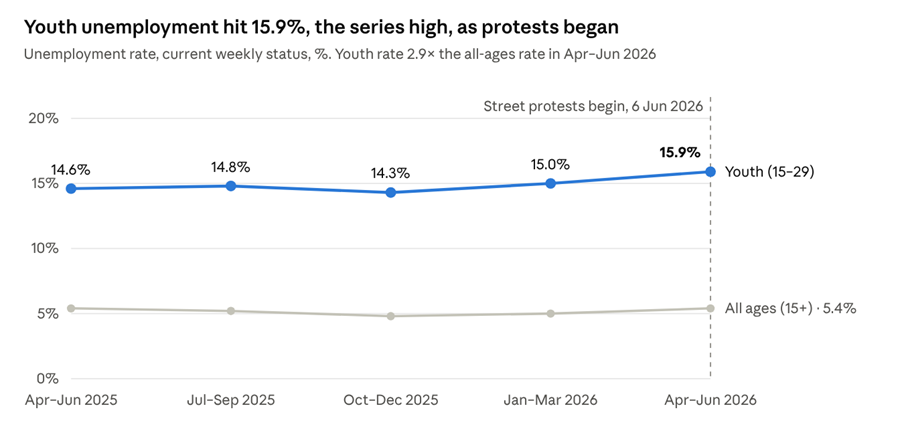
Source: MoSPI Periodic Labour Force Survey quarterly bulletins, via Business Standard, The Wire, The Economic Times and Policy Edge · Apr 2025–Jun 2026
The pain is sharpest among young women, whose rate jumped from 16% to 19.6% in a year, and urban young women sit near 25%. The government points to a different yardstick: the annual usual-status rate for youth fell to 9.9% in 2025 from 10.6% in 2022, a minister told the Lok Sabha. Both are official; the quarterly weekly-status series captures recent, short-term joblessness, which is what a 22-year-old feels.
Add roughly a quarter of young people neither working, studying nor training, and a cancelled medical entrance exam reads less like a one-off scandal and more like the last straw. This is the terrain on which Hosabale conceded that young people “have the right to demand” administrative fixes.
Dialogue and suspicion in the same breath
Hosabale’s message was built in two halves: sympathy for the protesters, suspicion of whoever might be guiding them. He offered no names, organisations or evidence for the conspiracy, saying only that it “appears” so from other countries’ experience.
The sympathetic half was unusually personal. “We were also young once,” he said, recalling his own part in the JP movement — Jayaprakash Narayan’s 1974–75 student uprising against the Indira Gandhi government, which preceded the Emergency. Hosabale himself was jailed during the Emergency. The parallel cuts both ways: JP’s movement was itself branded destabilising by the government of its day.
He drew the line at method rather than motive:
- Accepted: anger at the establishment, demands for administrative remedies, and young people’s ideas for reforming society, which he said deserve a hearing.
- Rejected: using youth anger for political self-interest, dividing society, or violence.
- Called for: “the organised voice of well-meaning people” to speak up, warning that silence by “good people” lets anarchic forces dominate.
That last line matters most for what comes next. The RSS, which reports more than one lakh daily shakhas, is effectively signalling a counter-mobilisation of its own networks rather than a crackdown. It also fits a broader government shift: since the July protests, the BJP has courted Gen Z while police have charged organisers under public-order laws.
The voter-roll numbers do not support the “13 crore dead” claim
Hosabale’s central factual claim on the SIR does not match the Election Commission’s own figures. According to the report of his remarks, he said around 13 crore names on the rolls belonged to people no longer alive; EC data show about 13.3 crore names removed from draft rolls in total, of which death accounts for roughly 2.8 crore. (A PTI account renders his point more loosely, as “many” of those removed being dead or duplicates.)
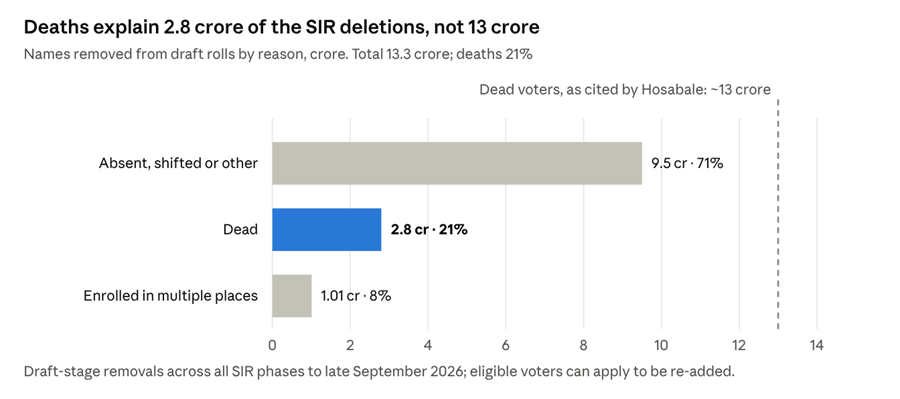
Source: Election Commission data as analysed by Deccan Herald (Sep 2026); Hosabale’s figure as reported from his Indore press conference, Nov 4, 2026
The largest category, about 9.5 crore, is voters marked absent, permanently shifted or removed for “other” reasons — the category critics say sweeps up migrant workers and the poor. The EC itself has called the bare “13 crore deleted” figure misleading, arguing these were names flagged as absent, shifted, dead or duplicate at the draft stage, and that eligible voters can re-apply through Form 6.
His second justification, foreign nationals on the rolls, is also thinly evidenced so far. Union Home Minister Amit Shah framed the SIR as a drive to “detect, delete and deport” infiltrators; the Congress says only about 1,600 foreigners were identified across six states, including 716 in Karnataka against 99.7 lakh names removed there. A Reporters’ Collective investigation found the EC’s software had no option to tag a voter as a foreigner, and Bihar registration officers recorded none in RTI replies.
Hosabale’s personal anecdote — his name lingering on his native village’s roll for 20 years — is the strongest part of his case. Duplicate and dead entries are a real, long-documented problem: SIR has removed about 1 crore multiple registrations. The dispute is less about whether rolls need cleaning than about scale, method and who bears the burden of proof:
- Process: two election commissioners objected on record 14 times in 10 months, including to changes in Form 6 they called unauthorised; the EC says all decisions were unanimous.
- Appeals: in West Bengal alone, 38.31 lakh appeals were filed, the EC told the Supreme Court.
- Precedent: Hosabale says such revisions are routine; most states last had one between 2002 and 2004, and the term “Special Intensive Revision” itself appears new.
Two reassurances: on reservation and on reach
On the two other questions put to him, Hosabale offered reassurance rather than controversy. On caste reservation, he said the RSS backs continuing it for communities left socially and educationally backward by discrimination “until the inequality is removed”, and that any change should be made only after consulting the communities that benefit. He likened it to affirmative action in the United States, also called positive discrimination elsewhere.
The phrasing is significant because it hands the beneficiaries, not the state, the judgement of when equality has arrived. It also repeats a position the Sangh has stressed since Bhagwat’s 2015 call for a review of reservation became an election liability in Bihar.
On the RSS’s global presence, Hosabale said volunteers work in 80 to 100 countries to organise Hindu communities under local laws, but that the Sangh itself “works only within the borders of India” and has no plan to become international. The answer sits alongside a separate, live domestic question: functionaries told reporters the RSS, which is not a registered body, has no proposal to register, and Hosabale said no law requires it.
How each side reads the moment
The disagreement is not over whether young Indians are angry, which no one disputes, but over who is speaking for them and whether the voter rolls are being cleaned or culled.
| Position | Held by | Core argument |
| Genuine anger, possibly exploited | RSS (Hosabale) | Grievances are real and need dialogue; outside “anarchic forces” may be inciting unrest; change power through elections |
| SIR is a necessary clean-up | EC, BJP, RSS | Rolls carry dead, duplicate and ineligible names; “13 crore deleted” conflates draft flags with final deletions; eligible voters can re-apply |
| SIR is mass disenfranchisement | Congress, INDIA bloc, CJP | Deletions fall heaviest on absent or migrant voters; commissioners objected internally; few foreigners found; CEC should resign |
| Protest is being policed, not heard | CJP, rights groups | Detentions, internet shutdowns and the de-designation of Jantar Mantar contradict calls for dialogue |
Critics will note that the “conspiracy” charge arrives without evidence and echoes how governments in Nepal and elsewhere first described their own youth movements. Supporters of the Sangh’s view will point to the Indore campus case, where a “Gen Z” protest was allegedly manufactured, as proof that the label can be gamed.