



The human eye is one of the most fragile structures in existence. It requires just a fraction of a gram force to Tear the retina, rupture the globe, and pushes a life into darkness, Yet the teaser for the upcoming bollywood action film Chauhan(2027), a voice over by actor Ajay Devgan coolly dismisses the horror of metal shotguns firing into crowds of Kashmiri youth as mere “limited damage.”
For those who understand the reality of Kashmir Valley, those two words are not just an intensive piece of cinematic dialogue. They are devastating, revisionist rewrites of a profound humanitarian tragedy. By reducing a weapon that has blinded, maimed and traumatized thousands into a punchline for an “alpha male” savior complex, Chauhan demonstrates a profound failure of empathy, turning real-world agony into cheap box-office bait.
The Reality of the “Right to Maim”
To understand why the film’s teaser has sparked such intense anguish, one must look at the actual structural violence inflicted upon Kashmiri bodies. In the arena of modern conflict, there exists an unsettling biopolitical framework that scholar Jasbir Puar terms the “right to maim”: a logic where a state shifts from the “right to kill” to a policy of “will not let die,” intentionally creating a perpetually debilitated, impaired population to maintain absolute control.
When the Indian state deployed 12-gauge pellet shotguns during the 2016 summer uprisings under “Operation Calm down,” the adoption of these weapons was heavily postured as a “gentler, more humane” form of crowd control. The truth, however, is that a single cartridge explodes into 450 to 600 jagged metal pellets that spray indiscriminately. When fired into public gatherings or funeral processions, these cartridges do not just manage crowds; they shatter internal organs and penetrate the fragile structures of human eyes, leading to what international observers have called the world’s first mass blinding.
Despite Standard Operating Procedures dictating that these weapons be fired strictly below the waist, the staggering volume of ocular injuries proves that indiscriminate firing was the norm. Security forces even admitted to the Jammu and Kashmir High Court that they had used hundreds of thousands of these pellets, yet the government actively withheld information regarding the chemical composition of the metal, citing “national security”. This isn’t “limited damage”, it is state-sanctioned debilitation wrapped in a narrative of benevolence.
“Infinite, Lifelong Agony”
The sheer clinical detachment of the film’s script completely collapses when confronted by those who survived the crackdowns. For the people who watched the valley transform into an open-air trauma ward during the heights of the unrest, Chauhaan feels like an intentional erasure of history.
An eyewitness who lived through the events of 2010 and 2016 in Kashmir, she shares with FOEJ team.
”Seeing the film Chauhaan reduce our lived trauma to a narrative of ‘limited damage’ is deeply painful and fundamentally false. There was nothing limited about the destruction. I have watched firsthand as pellet guns shattered the lives, futures, and eyesight of countless young men, young girls, and even infants. This weapon does not control damage; it inflicts infinite, lifelong agony. To call it ‘limited’ is to erase the permanent blindness and stolen youth of real people. The film presents a profoundly biased, sanitized fiction that completely detaches itself from the horrific realities we continue to carry with us.”
This first-hand story highlights a fact that Bollywood ignores: when the harm is permanently stored in the bodies of survivors, it cannot be measured or diminished. Doctors are often compelled to leave the sharp metal fragments permanently embedded in the skull out of concern that extraction could be lethal because the complex components of the eye do not mend like skin.
The trauma, moreover, does not stop at physical blindness. The psychological toll on survivors is catastrophic. According to a formal clinical study conducted by the Department of Psychiatry at the Government Medical College in Srinagar, 85% of pellet gun victims developed severe psychiatric disorders, predominantly Post-Traumatic Stress Disorder (PTSD).
Illusion of “Non-Lethality”
By hiding behind the bureaucratic label of “non-lethal” or “less-lethal” weaponry, both the state and films like Chauhaan create a dangerous moral shield. They imply that as long as a body is left breathing, no true violence has occurred.
Another local of Kashmiri quotes, his review of trailer as:
”One of the problems with describing pellet shotguns as ‘less-lethal’ in Chauhaan is that it frames violence almost exclusively in terms of death. In Kashmir, the more enduring legacy has often been one of disability, blindness, and trauma, raising important questions about how we define and measure violence.”
This perspective aligns with the notion that the term ‘non-lethal’ results in a ‘violence of de-realization’ treating kashmiri lives as an abstract, infinite threat that can be subjected to endless bodily harm without it counting as a statistic of war.
Maiming serves a dual insidious function: it keeps the official death toll low enough to evade international press scrutiny, while effectively destroying a population’s capacity for a normal life. It produces the ‘living dead’ individuals incapacitated not just by physical blindness, but the structure and infrastructure inequalities in the conflict zone stripped of adequate medical rehabilitation.
The Weight of Documentation: What the Reports and Photo Essays Reveal
The fictional bravado of commercial cinema cannot obscure the vast repository of human rights documentation and visceral journalism that records this systemic trauma.
In their exhaustive joint report, “My World is Dark”: State Violence and Pellet-firing Shotgun Victims from the 2016 Uprising in Kashmir, the Association of Parents of Disappeared Persons (APDP) and the Rafto Foundation meticulously trace the structural aftermath of these weapons. By following 23 distinct survivors, the report unmasks how the weapon enforces lifelong economic dependency and strips youth of their agency in an infrastructure intentionally deprived of medical rehabilitation tools.
This local documentation is mirrored globally by Amnesty International India’s report, “Losing Sight in Kashmir,” which underscores how the indiscriminate “spray” pattern of the shotgun explicitly violates international crowd-control declarations, a reality further condemned in the landmark UN Human Rights (OHCHR) Reports calling for an outright ban on the weapon.
Where reports provide statistical gravity, photojournalism provides undeniable visual evidence. In his powerful photo essay “Faces in the Darkness” for TIME magazine, Italian photographer Camillo Pasquarelli forces the world to confront the medical reality of the “limited damage” dialogue.
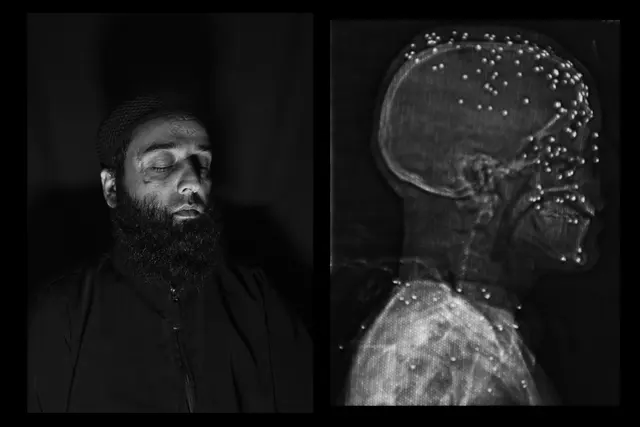
By overlaying portraits of young survivors alongside their actual clinical X-rays, Pasquarelli reveals the internal horror: the images show skulls, facial bones, and eye sockets literally peppered with dozens of tiny, opaque white circles the metal lead balls permanently lodged in their tissue because surgical extraction was deemed too fatal by doctors.
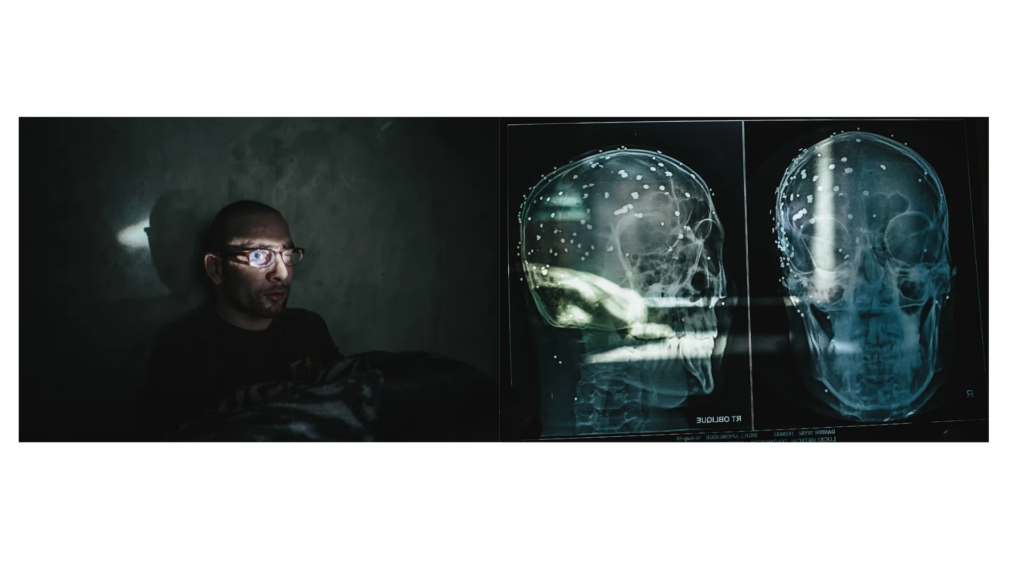
Similarly, photojournalist Zacharie Rabehi’s gallery for Al Jazeera, focusing on a totally blinded survivor named Danish, illustrates the quiet, heavy domestic toll of this violence showing a younger sister painstakingly applying daily medical drops to wounded eyes, and a father physically guiding his grown son through basic movements.
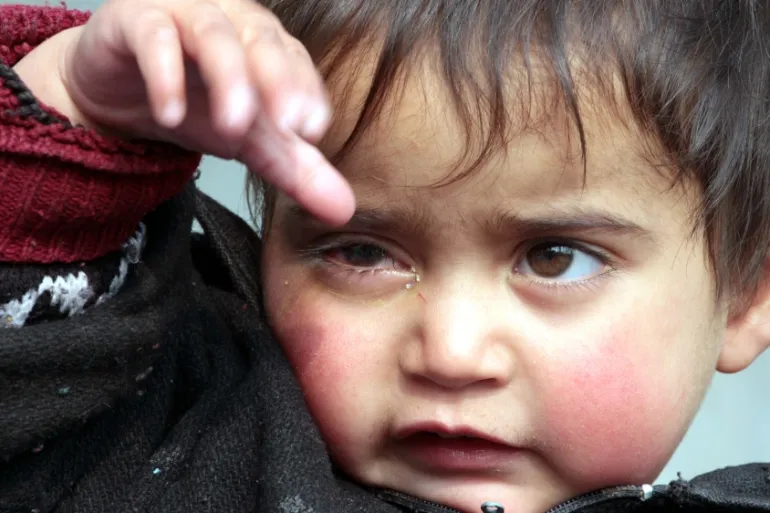
Meanwhile, Baba Tamim’s raw hospital-ward photography inside the Shri Maharaja Hari Singh (SMHS) hospital captures overcrowded ophthalmology wards where children lay asleep beneath blood-soaked face bandages a stark reminder of the valley’s youngest casualties, like 18-month-old toddler Hiba Nisar, whose eye was ruptured while in her mother’s arms.
Chauhaan is part of a grim, lucrative trend in mainstream cinema where real-world human suffering is smoothed into a hyper-patriotic commercial spectacle. When filmmakers recycle this particular kind of violence for entertainment, they dehumanize the victims, turning their stolen futures into cheap cinematic thrills.
Kashmir is a society in the process of healing, rebuilding and coping with enormous structural trauma. What its people require from the artistic and cinematic community is nuanced storytelling, accountability, and a recognition of their shared humanity.
By choosing instead to mock pellet victims and market a tragedy as an explosive action entertainer, Chauhaan proves that for a segment of the film industry, Kashmiri pain is only valuable if it can be sold for the price of a movie ticket. The true damage isn’t “limited” it is ongoing, and cinema like this only ensures that the wounds continue to bleed.