



India’s 80th Independence Day marks a striking shift to get Vande Mataram be placed at the center of the country’s national ceremony. For the first time since Independence, the song was sung at the Red Fort before the National Anthem with its full version being used. The development can be seen as the Narendra Modi government marks the 150 years of Vande Mataram through a year-long national campaign.
There is nothing unusual about honoring a song that played a significant role in India’s freedom struggle. What deserves scrutiny is the government’s growing attempt to transform that cultural legacy into an instrument of official nationalism.
The question, therefore, is not whether Vande Mataram deserves respect. It unquestionably does. The more important question is why a song that once united people against colonial rule is increasingly being turned into a test of how Indians should demonstrate their patriotism.
The History Behind the Song
Vande Mataram was written by Bankim Chandra Chattopadhyay in 1870s which was later incorporated into his novel Anandamath published in 1882. The novel is set against the backdrop of the late-18th-century Sannyasi rebellion during the Bengal famine and the consolidation of East India Company power. Anandamath contributed by transforming the historical setting into a nationalist literary narrative.
But the historical rebellion was more complicated than the version presented in the novel. Historical scholarship records the participation of both Hindu sannyasis and Muslim fakirs in resistance and conflict across Bengal and Bihar. But the novel centers the Hindu sannyasi as protagonists and portrays Muslim rulers as antagonists. Scholars have consequently pointed to the gap between the historical rebellion and Bankim’s literary reconstruction of it. That distinction matters today because Vande Mataram is discussed today like its history were politically uncomplicated. It is not. It is simultaneously a literary creation, a nationalist symbol and a product of a particular 19th-century social and political imagination.
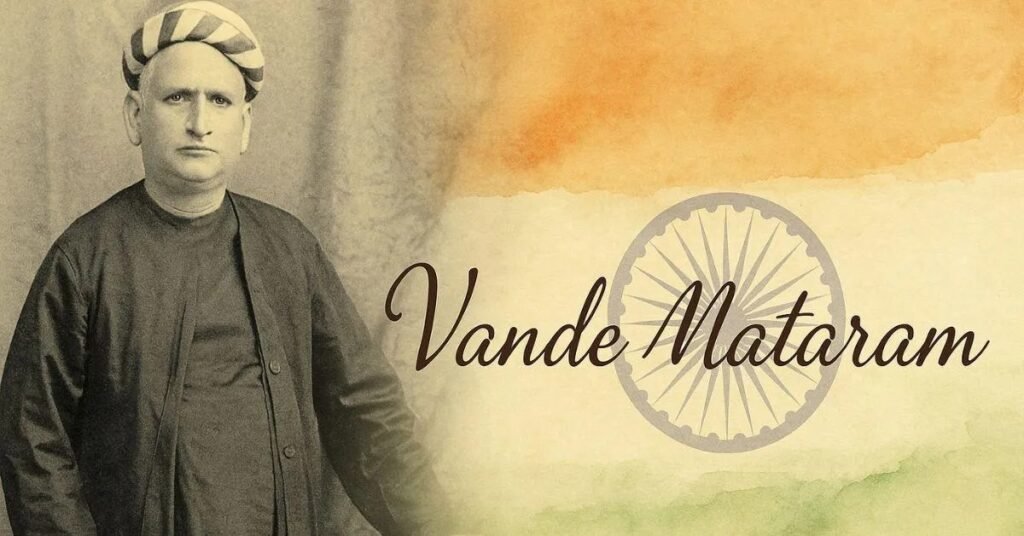
Yet during the freedom movement, the song acquired a meaning larger than its original literary setting. It became an anti-colonial cry, especially during the Swadeshi movement and was embraced by people fighting British rule.
Mahatma Gandhi himself recalled the song with deep affection. In 1939, he described it as an anti-imperialist cry and said that he had associated it with the “purest national spirit”. But Gandhi’s admiration came with an important warning that he did not want the song to become a source of conflict in mixed gatherings.
That distinction is crucial.
Why the First Two Stanzas Became the National Version
The decision in 1937 to use only the first two stanzas at national gatherings is often presented today as an example of political appeasement. The historical record suggests something more nuanced.
The Congress Working Committee recognized the extraordinary place Vande Mataram had acquired in the freedom movement but also acknowledged concerns about the religious imagery in the later stanzas. Therefore, it recommended that only the first two stanzas be used at national gatherings, allowing other songs to be performed at the same time.
The later stanzas contain references to Hindu religious imagery, including Goddess Durga. The compromise was therefore an attempt to preserve the song’s nationalist meaning without making a religiously diverse population feel excluded.
Gandhi’s position went even further. In 1939, he wrote that if someone objected to Vande Mataram at a mixed gathering, he would not risk a quarrel over singing it.
This is the historical lesson that gets lost when the 1937 decision is reduced to a story of “appeasement”.
The leaders of the freedom movement were not necessarily rejecting the song. They were asking whether national unity required everyone to perform patriotism in precisely the same way or not.
When Patriotism Becomes Compulsion
The present government’s campaign represents a significant shift from that older understanding.
The full version of Vande Mataram is being foregrounded in official ceremonies, while Parliament has extended statutory protection to the National Song under the law dealing with insults to national honor. That changes the nature of the debate. The song is no longer merely a cultural symbol but has become part of a regulated performance of nationalism.
And that should concern a democracy.
Patriotism is meaningful precisely because it is an expression of belonging. Once the state begins prescribing how that belonging must be performed, respect can easily turn into compliance.
India has encountered this problem before. In 2016, the Supreme Court ordered cinema halls to play the National Anthem before films and required audiences to stand. The decision produced confrontations over people’s conduct before being modified in 2018. The episode demonstrated how quickly a symbolic expression of national respect can become a dispute over who is patriotic enough.
The same danger exists with Vande Mataram.
A song born in the anti-colonial struggle should not become an instrument for policing citizens’ loyalty in independent India. The irony is difficult to miss – the freedom struggle was fundamentally about resisting imposed authority. Turning patriotism itself into an obligation risks forgetting that history.