



I – Six Years of Waiting
Six years ago, two years felt like a very long time.
When Umar was arrested, his family thought that he might be in jail for two years. At that time, even two years felt terribly long. Unfortunately, the arrest has been stretched for six years with no clear sign of justice.
Speaking at the press club of India during the launch of Umar Khalid’s book, his mother recalls the year 2016 which was very difficult for the whole family. The way police and media presented him, paved the way for the creation of his public image and narrative, she said. According to her, Umar Khalid was covered very prominently surrounding his arrest and disappearance, which in turn made it difficult to separate him as a person known to his family and his dear ones.
The effect was not solely limited to Umar. The impact of this scrutiny was also extended to the family who were forced to live under sustained public and social pressure. She recalled how the family of her daughter’s friends asked their children to stay away and keep no contact with them.
Yet, six years after his arrest, she returned to the same point: time itself had become part of the ordeal. What once seemed like an impossibly long period of two years had become six, with little visible indication of when the waiting might end.
She said the family still has faith in the courts, while also acknowledging the difficulties and delays that they have experienced.
II – From a Thesis Written Under Pressure to a Book
This part shifts focus to the journey of Umar’s thesis that has now been published as a book.
His mother recalls of Umar Khalid being under constant psychological pressure from court cases and legal proceedings. Despite those circumstances, he managed to complete his thesis.
She thanks all the people who helped Umar complete his thesis during the time of adversity and tribulation.
However, thesis submission became another obstacle. According to her, the thesis was not allowed to get submitted initially but it was done after the court intervention.
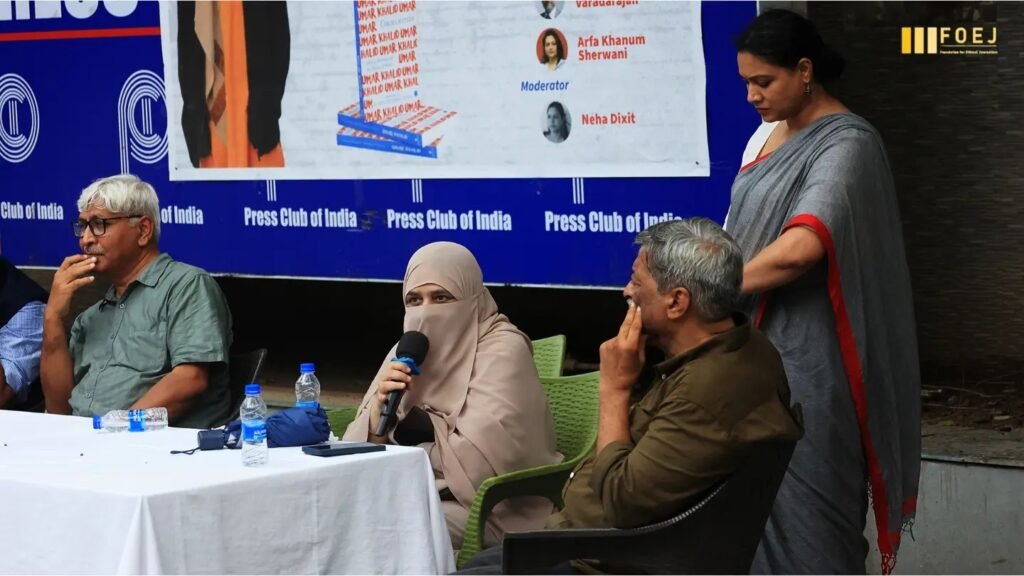
Here, his mother provides an interesting contradiction. What began as an academic thesis took a very different turn. When Umar Khalid was writing his thesis, he hardly anticipated thousands of people would read it and thought it was only limited to his supervisor and mediator. But now thousands of people have purchased the book and read it.
For her, the book is a source of happiness and sadness together. There is an immense satisfaction that his work is reaching to thousands of people but that happiness can’t be separated from the pain of not seeing him witnessing the moment.
She urged the readers not to approach the book as the work of someone who is in jail, i.e., not to be read in sympathy. It should be seen as a serious intellectual work by understanding, discussing and critically engaging with the ideas.
III – Knowing Umar Through His Ideas
At the heart of her appeal is a question of representation: how can people understand Umar Khalid beyond the image that has been constructed around him?
She argues that the narrative set by media around him has played a crucial role in building his public perception. People who have not known him personally have a very different impression of him from those who have only seen him on-screen.
But she believes the book provides an opportunity for people to understand him through his ideas.
She specifically mentions about the issues that concerned her son Umar – Adivasis, minorities, marginalised communities and suppressed sections of the society. This allows a reader to understand what he stood for, which issues of certain communities he used to raise, what were his social and political concerns and how he looked at the structural problems of the society.
In this sense, the book becomes more than a publication. It becomes an alternative route in understanding a person whose public image has been shaped overwhelmingly through political and media narratives.
She eventually returned to the passage of time. When Umar Khalid was arrested, two years seemed to be a prolonged period but six years have passed and the uncertainty remains.
In the end, her message about the book is one hope. She appealed that it would reach as many people as possible, both in India and abroad in order to understand his ideas and draw conclusions from it.
Six years after Umar’s arrest, his physical absence continues to define his family’s reality. But his ideas are travelling in a different direction through the pages of a thesis that was once expected to be read by only a handful of academics and is now being read by thousands.
For his mother, that readership offers something the years of media coverage could not: a chance to encounter Umar through his own words.