



As tens of thousands of founders, investors, and tech executives converge on Paris for the annual VivaTech conference, and world leaders gather down in Évian-les-Bains for the G7 summit. The atmosphere isn’t just filled with the usual corporate optimism; instead, a deep sense of unease is taking center stage: Europe’s stark realization that it has become almost entirely dependent on American artificial intelligence.
For years, European policymakers have spoken broadly about digital independence, but a sudden policy move out of Washington has turned those theoretical worries into a full-blown strategic crisis.
Impetus of Fear
The immediate cause for the current diplomatic friction came when the United States government issued a sweeping directive tightening access to advanced AI models for foreign entities. Citing national security concerns, Washington effectively blocked non-U.S. users from accessing Anthropic’s newest and most powerful foundational models, Fable 5 and Mythos 5.
In response, Anthropic pulled access entirely from foreign markets. For European companies, startups and government bodies that had started integrating these advanced tools into their daily work, the abrupt cut-off was a brutal wake-up call. It showed the power of political shifts or regulatory mandates from across the Atlantic to upend European digital infrastructure overnight.
Pushing Back
The repercussions have sparked a swift and assertive response from European leadership. French Prime Minister Sébastien Lecornu was forthright, asserting that dependence on tools created by foreign powers is no longer sustainable for national resilience.
To back up the rhetoric with action, Lecornu announced that France’s domestic intelligence agency would terminate its long-standing contract with the U.S. data analytics company Palantir, opting instead for a French domestic competitor, ChapsVision.
Meanwhile, European Commission President Ursula von der Leyen has used the dual backdrop of the G7 and VivaTech to advance plans for a state-backed alternative. The EU is now aggressively proposing the creation of public “AI gigafactories” alongside regional cloud and semiconductor networks.
The goal is to build a sovereign European environment where local companies can test, train, and deploy large language models without needing to rely on American computing platforms or risk moving their intellectual property overseas.
Industry Reality Check
On the ground at VivaTech, where over 180,000 attendees are checking out the latest tech, the tension between commercial reality and political ideals is obvious.
While industry giants like Amazon founder Jeff Bezos are drawing huge crowds, European operators are left questioning how to protect their operations. Ana Paula Assis, Senior Vice President at IBM, pointed out that the definition of sovereignty needs a practical overhaul.
To truly succeed, they must recognize that true sovereignty is about retaining total control over data and governance where it matters most, rather than focusing purely on where the underlying technology was built.
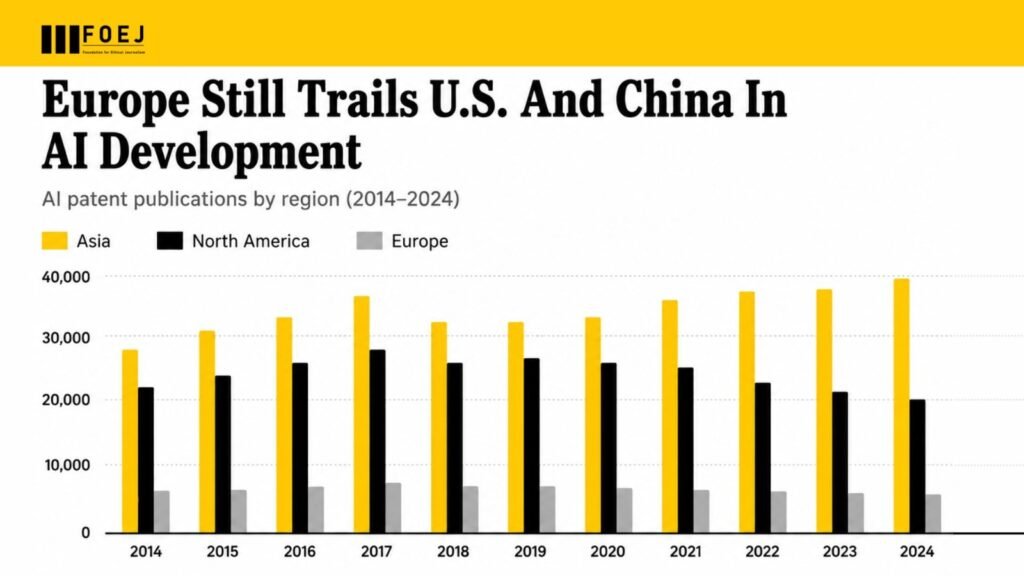
Despite billions of euros funneled into domestic success stories like Mistral AI, Europe still finds itself years behind its American competitors. As the week’s high-level meetings draw to a close, European leaders face a difficult paradox: finding a way to assert their strategic independence while their tech ecosystems remain completely intertwined with the Silicon Valley giants driving the AI era.