



After months of devastating direct military hostilities that have systematically shaken West Asia, a historic, preliminary peace agreement framework has been finalized between the United States and Iran. The highly anticipated memorandum of understanding, quitely brokered by Pakistan behind closed doors, is officially set to be signed this Friday, June 19, 2026, in Switzerland.
While international oil and commodities markets reacted with a collective sign of relief, the diplomatic breakthrough remains far from a guaranteed success. Instead, it has set off a high stakes domestic political thriller inside Tehran, forcing Iran’s moderate interim leadership onto a dangerous tightrope against powerful hardline military elements.
The accord’s blueprint
According to finalized details of the accord, the initial agreement focuses primarily on cooling down the immediate hot war and easing the economic strangulation of the region. The three immediate core pillars of the blueprint include:
A Universal Ceasefire: An immediate and permanent termination of military operations across all operational fronts. This explicitly encompasses a binding freeze on border regional proxy conflicts, building upon localized stepping stones like the recent Washington brokered Israel-Hezbollah truce in Lebanon.
Lifting the Naval Holds: U.S. President Donald Trump has authorized the immediate removal of the heavy U.S. naval blockade on Iranian ports. This blockade has been aggressively choking off nearly 90% of Iran’s pre-war crude shipments, effectively forcing Tehran to the bargaining table under immense economic distress.
Reopening the Strait of Hormuz: The vital international maritime corridor will be reopened toll free to commercial shipping. The reopening will be phased over a 60-day period as Iranian forces actively sweep and clear underwater mines. Global Brent Crude oil prices immediately tumbled by over 4% on the news.
The 60-Day Nuclear Question
Despite the extensive nature of the ceasefire, the framework leaves the thorniest geopolitical issues entirely unresolved i.e., Iran’s nuclear capabilities.
While the immediate threat of a nuclear breakout is temporarily frozen, Iran’s nuclear material is still very much on the ground, though currently unreachable. Before the U.S. and Israeli airstrikes of late 2025 and early 2026, Tehran had amassed a massive stockpile of more than 9,000 kg of enriched uranium. Crucially this includes 440 kg of uranium enriched to 60% just a tiny hair width technical step away from weapons grade purity.
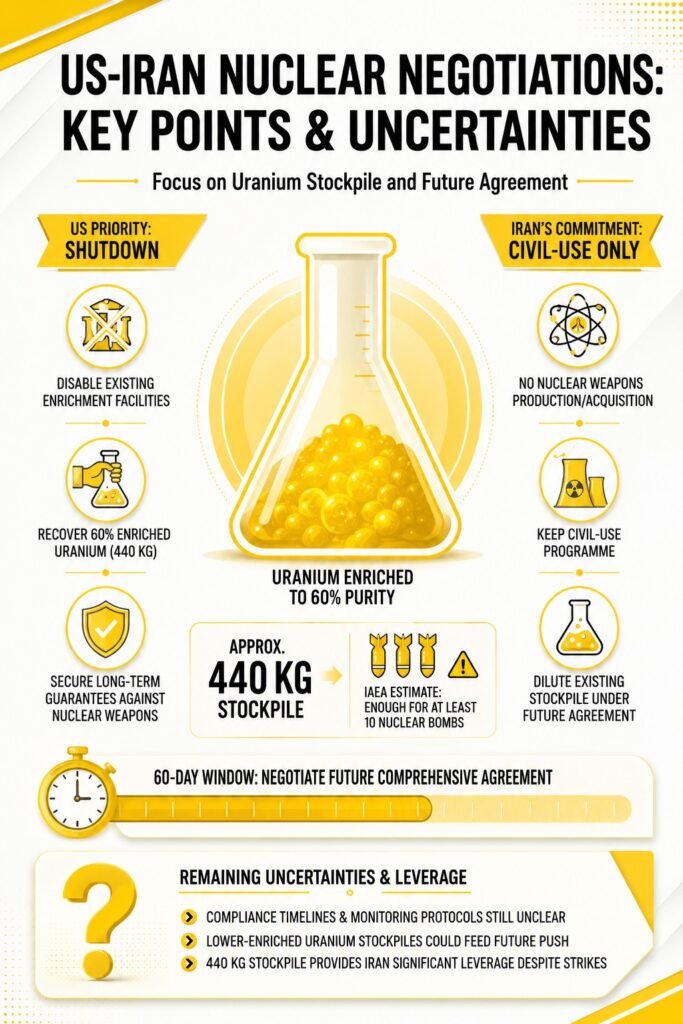
The ultimate complication for Friday’s peace deal is how to safely dig up and verify this buried “nuclear dust.” Intelligence reports from mid June 2026 revealed that the Iranian military has deliberately collapsed tunnels and heavily mined the entry points of the bombed Isfahan nuclear complex. Theran did this to prevent the U.S. from launching a surprise ground raid to seize the Uranium Stockpile.
To secure an immediate halt to the airstrikes, international mediators deferred the complex technical details regarding non-profeleration. Instead, the text locks Washington and Tehran into a strict, post signing 60-day window. During this tight timeline, both sides must launch intense technical negotiations to design a verifiably safe mechanism to completely downblend and dispose of Iran’s enriched uranium stockpile.
Foreign policy analysts warn that this 60-day clock is a diplomatic time bomb. If technical negotiations stall by late August, the naval blockade will return, the cease fire will instantly collapse, and the entire security architecture will disintegrate back into active conflict.
Pezeshkian’s Battle for Iran’s Political Stability
The ultimate vulnerability of the deal, however, lies in the volatile domestic political vacuum currently gripping Iran. Following the death of Supreme Leader Ayatollah Ali Khamenei during the height of the conflict, the country is being governed by a temporary Interim Leadership council, fronted by President Masoud Pezeshkian, Chief Justice Mohesni Ejei and Ayotallah Alireza Arafi.
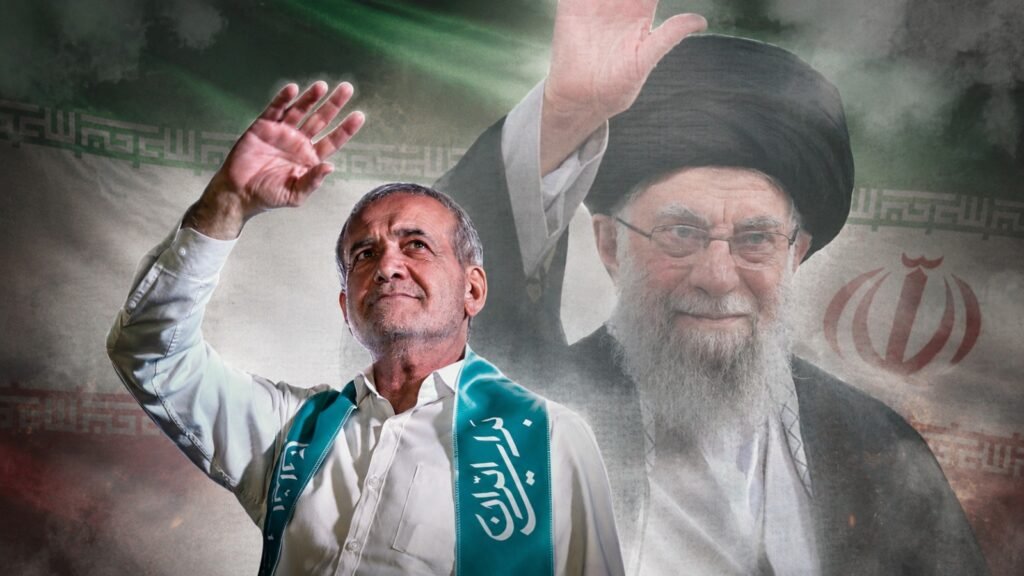
Pezekhian and his moderate allies view the Swiss Framework as an absolute necessity to prevent a total state collapse, lift the economic siege, and stave off renewed civilian unrest. But powerful hardliners within Islamic Revolutionary Guard Corps (IRGC) are treating the deal as an insult to Khamenei’s legacy. To the IRGC, agreeing to dismantle and handover enriched uranium stockpiles within 60 days amounts to a total capitulation to Western Imperialism.
This internal fracture is being heavily squeezed by Washington. President Trump has deployed aggressive public messaging, warning on social media that if Iran walks away from Friday ceremony, the U.S. is fully prepared to directly seize Kharg Island and place Iran’s entire domestic oil infrastructure under the direct control of the Treasury Department.
With Vice President J.D. Vance, already prepared to fly out to witness the formal signing, the world is watching to see if Pazeshkian can hold his internal government together. The next two days determine if West Asia is on the cusp of a permanent peace or a far larger domestic explosion.