



“There is no tyranny more cruel than that which is perpetrated under the shield of the law and in the name of justice”
— Montesquieu
More Than an FCRA Dispute
The Madras High Court’s recent judgment in Kanzeon Public Charitable Trust v. Union of India may appear, at first glance, to be another dispute over the Foreign Contribution (Regulation) Act, 2010. A charitable trust running a Montessori school and a Zen Meditation Centre in Kodaikanal had its application for FCRA registration rejected because it had not correctly disclosed itself as a religious organisation. The High Court upheld that decision.
There is, however, something considerably more consequential in the judgment than the fate of one charitable trust. The case raises uncomfortable questions about how constitutional institutions are beginning to speak about religion, conversion and Indian identity. More importantly, it raises a larger question: what happens to a secular republic when its institutions begin using language that appears to place one religious tradition within a position of cultural superiority over others?
The Judgment and the Language of Religion
The Court held that Zen Buddhism is a variant of Mahayana Buddhism and therefore the trust should have identified itself as a religious organisation. On this narrow question, the judgment is relatively straightforward. The Court also clarified an important point: being a religious organisation does not, by itself, prevent an institution from applying for FCRA registration. The problem, according to the Court, was inadequate disclosure.
But the judgment did not stop there. While discussing the nature of religious organisations and the possible misuse of foreign contributions, the Court observed that “unlike Hinduism which is inclusive, the Abrahamic religions are inherently exclusive.” It went on to describe Jews, Christians and Muslims as believing that theirs is the “one true and complete revelation”. This is where the judgment enters much more troubling constitutional territory.
When Judicial Observations Become Constitutional Questions
A court may certainly discuss differences between religious traditions when those differences are relevant to a case. But describing one major religious tradition as inherently inclusive while grouping three others together as inherently exclusive is not merely a neutral description of theology. It is a sweeping civilisational characterisation. And when such a characterisation comes from a constitutional court, its significance cannot be dismissed as casual commentary.
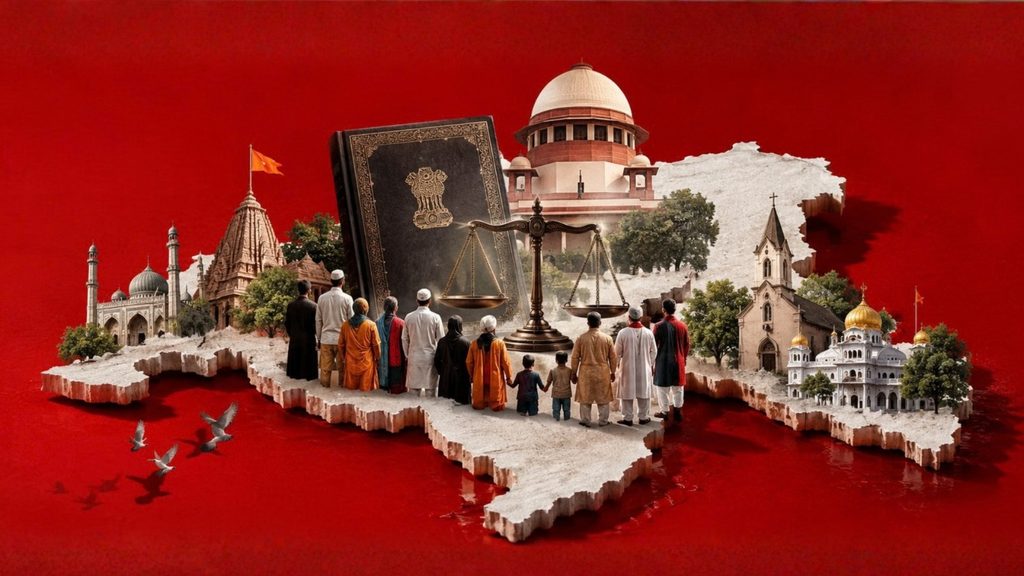
A court’s words carry institutional authority. They can influence how society understands communities, identities and constitutional belonging. India’s Constitution does not establish a hierarchy of religions. The State does not exist to determine which faith is more inclusive, more indigenous, more tolerant or more authentic. Its obligation is considerably simpler and more difficult: treat citizens equally, regardless of their religion.
Conversion, Foreign Funding and the Politics of Suspicion
The Court’s language becomes even more significant when read alongside its discussion of conversion. The judgment warns that foreign funds could facilitate conversion activities and states that “radical Christian Institutions” are “notorious” for engaging in such activities.
It also makes the important observation that a fundamentalist Hindu organisation engaged in “Ghar Wapsi” should equally be denied FCRA registration. That latter observation is undoubtedly significant. It indicates that the Court did not explicitly exempt Hindu organisations from the legal restrictions applicable to other religious organisations. Yet constitutional equality is not only about whether the same legal sentence can theoretically be applied to everyone. It is also about the assumptions and narratives through which institutions understand different communities.
This is precisely why judicial language matters.
The Constitutional Meaning of Secularism
“No real nationalism could be built except on the basis of secularity”
— Jawaharlal Nehru
For decades, the Indian constitutional imagination has rested on the idea that India is neither a Hindu state nor a Christian, Muslim, Sikh or Buddhist state. It is a republic in which the State is expected to maintain principled distance from competing religious claims.
The Indian model of secularism has never meant that religion must disappear from public life. Quite the opposite. Religion has always been deeply woven into Indian society. The constitutional challenge has been to ensure that the presence of religion does not translate into political or legal privilege for one community. That distinction becomes increasingly important in today’s India.
How Does a Hindu Rashtra Take Shape?
“If Hindu Raj does become a fact, it will no doubt, be the greatest calamity for this country… It is incompatible with democracy. Hindu Raj must be prevented at any cost”
— Dr. B.R. Ambedkar
The political project of transforming India into a Hindu Rashtra has often been discussed primarily in terms of elections, legislation, political speeches, campaigns and street mobilisation.
But majoritarianism does not necessarily arrive in a single dramatic constitutional moment.
It can also become normalised gradually—through institutions, vocabulary and everyday assumptions about who belongs to the nation and whose religious identity represents the country’s civilisational core. This is where the judiciary becomes particularly important.
Courts possess enormous symbolic authority. When a politician makes a majoritarian statement, citizens can identify it as political rhetoric. When a constitutional court uses similar civilisational categories, the words acquire a different weight. They can begin to appear not merely as political claims, but as part of an authoritative interpretation of Indian society.
That does not mean that every controversial judicial observation proves that the judiciary has abandoned constitutional secularism. Nor does it establish that judges are consciously working towards the creation of a Hindu Rashtra. Such a conclusion would require evidence far beyond one judgment.
But it does justify asking whether majoritarian ideas are increasingly finding legitimacy within institutions that are constitutionally expected to protect minorities from majoritarian excesses.
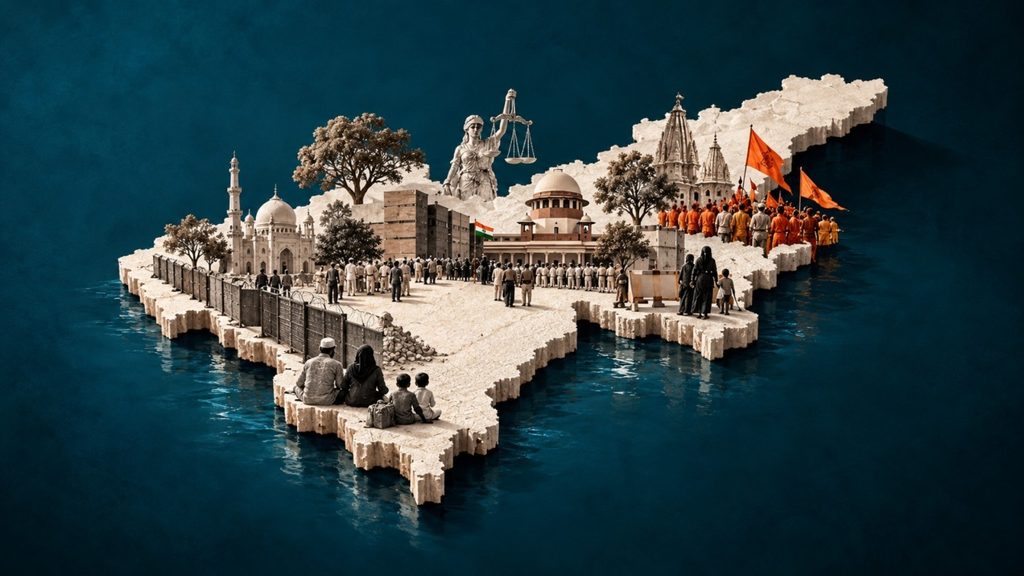
The Paradox of Protecting Pluralism
The irony in the present judgment is particularly striking. The Court warns that India is a pluralist nation and says that the existing balance could be disturbed if one religious group gains ascendancy. It describes India as a “salad bowl”, rather than the “melting pot” associated with the United States.
But pluralism cannot survive merely as a demographic arrangement. It requires institutional neutrality. If Hinduism is described as inherently inclusive while Abrahamic faiths are described as inherently exclusive, the danger is that pluralism itself begins to acquire a hierarchy: one tradition becomes the presumed cultural norm, while others are treated as potentially problematic, particularly when their institutions receive foreign support or engage in conversion.
Who Gets to Define “Indian Culture”?
The Court’s observation that organisations teaching Vedanta, the Bhagavad Gita, the Upanishads, Yoga and Indian Knowledge Systems should not automatically be treated as religious institutions is also noteworthy. It rightly recognises that education and culture cannot automatically be equated with religious activity. But that principle must operate consistently.
The same intellectual generosity must extend to Islamic, Christian, Buddhist, Sikh and other traditions when their institutions engage in education, scholarship, culture, social welfare or preservation of knowledge. Otherwise, the distinction between “Indian culture” and “religion” can itself become politically loaded—where Hindu traditions are quietly absorbed into the category of national culture while minority traditions remain marked as religious.
That is precisely the kind of hierarchy a secular constitutional order must resist.
FCRA and the Expanding Power of the State
There is another troubling aspect of the judgment: the considerable deference it extends to the FCRA authorities. The Court states that considerable leeway and “unfettered discretion” should be given to the authorities in deciding applications under Sections 11 and 12 of the FCRA, subject to judicial review where discretion is exercised perversely or relevant material is ignored. FCRA already gives the executive substantial control over the ability of civil society organisations to receive foreign contributions. When that administrative power is combined with broad judicial deference, the burden on independent civil society becomes heavier.
This matters because civil society is often the first space where marginalised communities organise, document injustice, provide relief and challenge the power of the State. A democracy should therefore be particularly careful when restricting the financial and organisational capacity of civil society.
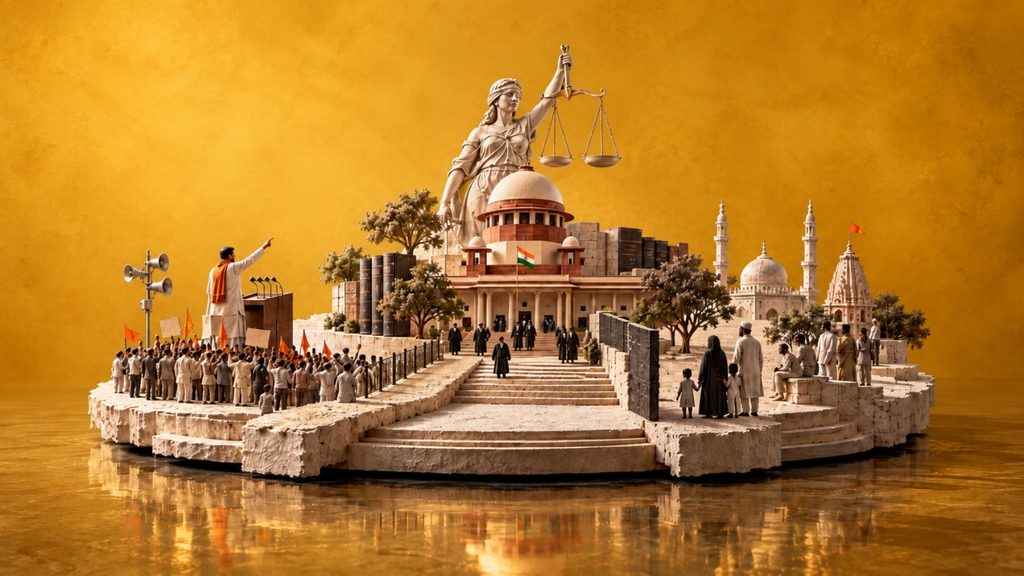
The Question Is Bigger Than One Trust
The larger question is not whether a Zen Buddhist trust should have ticked the correct box on an FCRA form. It should have.
The larger question is what kind of constitutional culture we are building around such regulations. A Hindu Rashtra need not necessarily begin with the Constitution being formally rewritten. It can begin when the distinction between Hinduism and “Indian culture” becomes blurred; when minority religions are increasingly viewed through the prism of conversion and foreign influence; when majoritarian assumptions enter institutional language; and when constitutional equality becomes subordinate to a civilisational understanding of the nation.
That is why this judgment deserves scrutiny beyond the immediate FCRA dispute.
When Institutions Begin Reflecting the Majority
The judiciary has historically been one of the most important safeguards against majoritarianism. Minorities do not approach courts because they expect the majority to protect them; they approach courts because the Constitution promises protection even when the majority does not.
That promise becomes fragile when judicial language itself begins to reproduce the cultural assumptions of the majority. The concern, therefore, is not simply about one sentence in one judgment. It is about a broader institutional culture in which religious identity increasingly becomes part of how organisations, communities and citizens are understood.
If a Hindu organisation, a Muslim organisation, a Christian organisation and a Buddhist organisation approach the State, the constitutional question should not be which religion is culturally more authentic. The question should be whether the State applies the same constitutional standard to all of them.
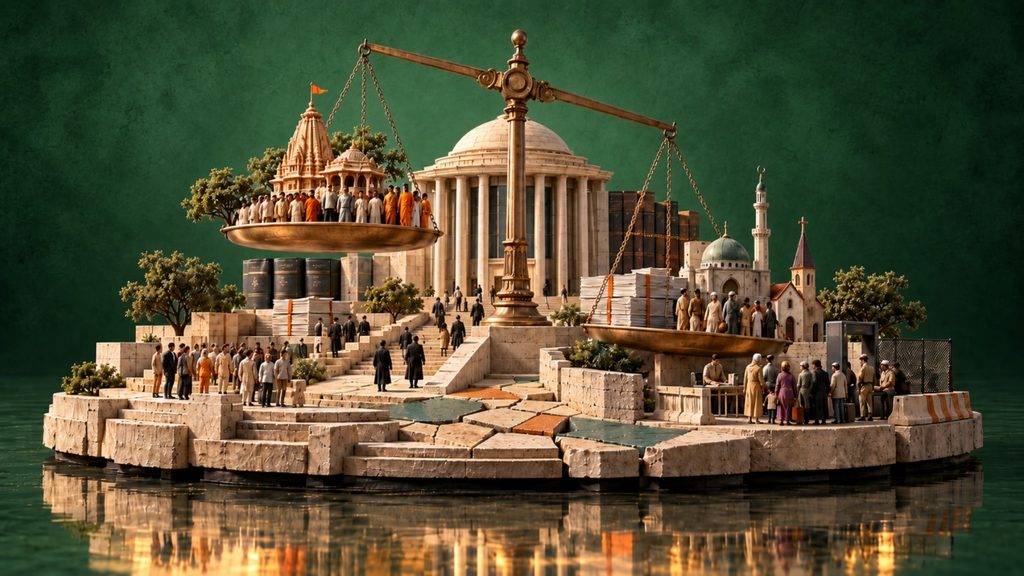
The Republic at the Crossroads
India’s constitutional identity was not created to establish which religion is more inclusive. It was created to ensure that the State would not decide which religion deserves greater constitutional belonging. The question, therefore, is not whether Hinduism is inclusive or whether Christianity, Islam or Judaism is exclusive. Those are theological and historical questions that contain enormous internal diversity.
The constitutional question is simpler: Can the Indian State remain genuinely neutral when its institutions begin speaking about religions through a hierarchy of cultural legitimacy? If the answer becomes uncertain, the danger is not simply to India’s minorities. It is to the republic itself. Because the transformation of a secular democracy into a majoritarian state rarely happens overnight. Sometimes, it happens one assumption at a time.
“A hundred years scarce serve to form a state; an hour may lay it in the dust”
– Byron