



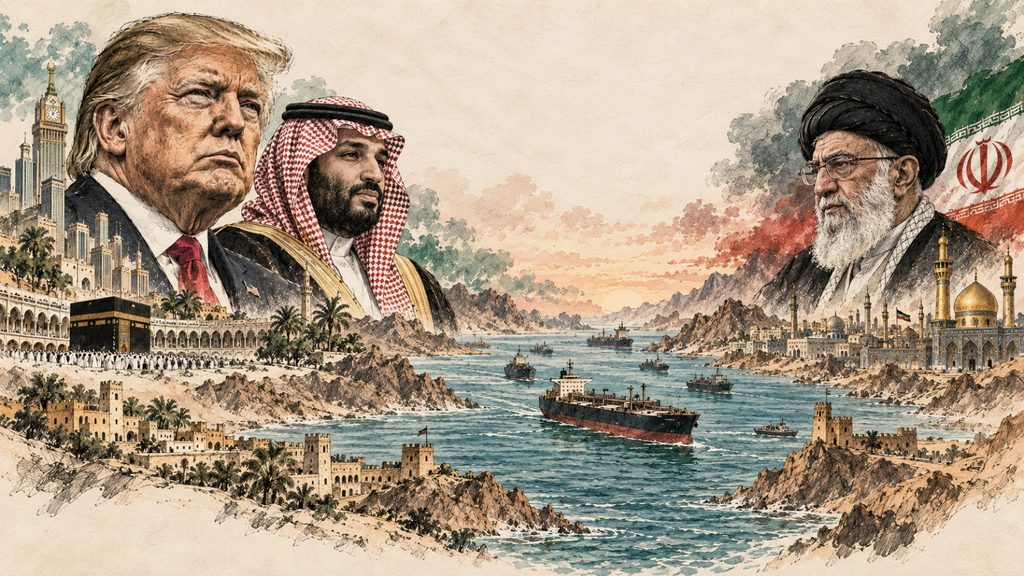
The war between Yemen’s Houthis and Saudi Arabia has entered a dangerous zone. This year, the war has expanded in scope. Advancing along the Red Sea coast, capturing the port of Mokha and Perim Island, and threatening the strategic Bab el-Mandeb Strait, the war has created the security threat of the Red Sea for Saudi shipments and, in turn, resurfaced the Shia-Sunni conflicts between Riyadh and Tehran. Saudi Arabia pounded Houthi territory with missiles and drones while seeking additional assistance from the United States which was denied. In response, the Houthis attacked Saudi energy infrastructures, including Aramco facilities, the economy hub of the country.
The roots of the Houthi movement emerged from grievances over religious discrimination, state power, and marginalisation of communities in northern Yemen. The armed conflict between the Houthis and then-President Ali Abdullah Saleh began in 2004. However, Saudi Arabia entered the fighting in 2009, but the decisive transformation came in 2014, when the Houthis seized Sanaa, the Yemeni capital. In March 2015, Saudi Arabia led a military coalition into Yemen in an attempt to reverse the Houthi advance and restore the previous government. Eight years of violence—air warfare, missile attacks, blockades, and displacement—followed.
On 2 April 2022, the United Nations-brokered truce produced a period of relative calm and prosperity. It reduced the violence, facilitated the fuel imports through Hudaydah, and resumed the commercial flights from Sanaa. The truce, nevertheless, did not last longer and expired on 2 October 2022, but the broader reduction in hostilities endured for several years.
To understand the contemporary Houthi military movement, Iran should be placed at the centre, but the relationship should not be simplified into the formula of “Iran orders, Houthis obey.” Tehran has supplied the movement with military assistance, technology, and expertise; subsequently, it supported the Houthis’ growing missile and drone capabilities substantially. Iran’s relationship with the Houthis, however, serves an obvious strategic purpose, which gives Tehran significant leverage over Bab el-Mandeb.
Iran is a predominantly Shia country while Saudi Arabia a Sunni-dominant monarchy. The two are considered the religious centres in West Asia. Saudi Arabia controls the two holiest sites of Islam, the House of Allah: the Kaaba in Mecca and the holy shrine of the Prophet Muhammad in Medina, which attract millions of Muslims every year on Hajj and other occasions. On the other hand, Islamic Republic of Iran is a Shia seminary, known as Hawzah. In contrast to Iraqi Shia scholars, Iranian Shia scholars are active participants in the politics of the country. The holy shrine of Imam Reza is also a centre of devotion for the Shia community.
For decades, Saudi Arabia has been viewing revolutionary Iran as a strategic competitor, while Iran is constantly seeking influence across the regions in which Gulf monarchies traditionally held considerable power.
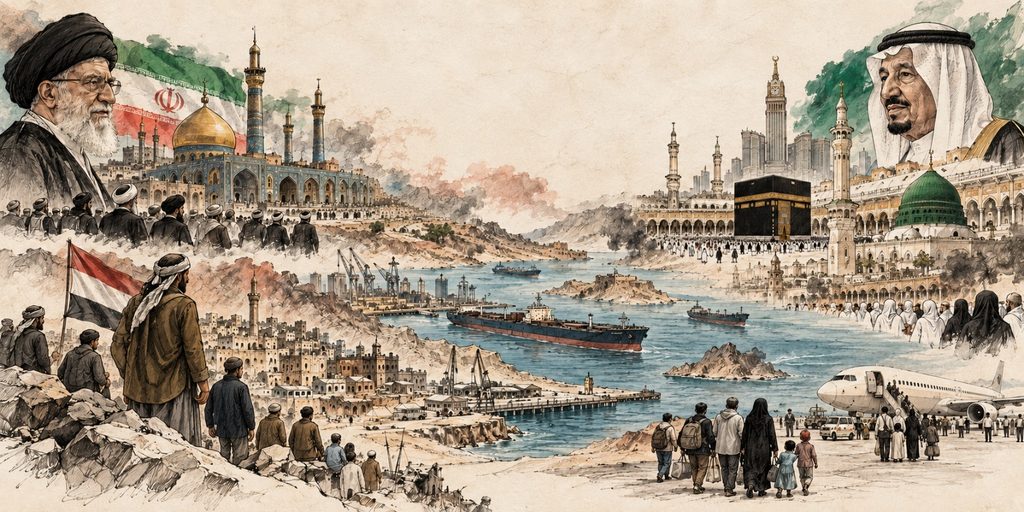
In Yemen, the regional rivalry became materialised. Both Riyadh and Tehran, as many analysts note, have contributed to a sectarian political discourse which led Yemen towards a larger Saudi-Iranian contest despite the announcement of March 2023 rapprochement between Riyadh and Tehran in Beijing which restored diplomatic relations and reaffirmed the principles of sovereignty and non-interference.
In August 2026, Saudi Arabia, Türkiye, and Pakistan signed the Mecca Joint Defence Agreement, establishing a trilateral defence principle: an attack on one is an attack on all. The pact brought Turkey’s advanced defence capabilities and Pakistan’s nuclear-armed forces into a collective-defence and deterrence agreement. It became the subject of sharper debate when Saudi Arabia said it intercepted a Houthi drone in the south of Mecca before it entered the city’s restricted airspace. The Houthis denied targeting the holy city of Mecca, and Iran condemned “any aggression against Islamic holy sites.”
Meanwhile, many social media users have resurfaced the Abraham Accords. Saudi Arabia is not a signatory to the accords and has not established diplomatic relations with Israel, while several Arab states—the United Arab Emirates, Bahrain, Morocco, and Sudan—have established and pursued diplomatic normalisation with Israel. Riyadh has repeatedly stated that, until there is a pathway towards Palestinian statehood, including East Jerusalem as its capital, it will not establish diplomatic ties with Israel. Riyadh has expanded its strategic cooperation with Washington, while continuing to endorse a Palestinian state based on the 1967 borders and a two-state settlement.
On the other hand, Saudi has softened its stance towards Israel through significant changes to its textbooks. The expression “Muslims will never give up Jerusalem” has been removed. As many observers suggest that these incidents may constitute a pathway towards establishing a relationship with Israel.
The recent development unfolds more profound aspects of the debate. Mecca embodies religious unity; Bab el-Mandeb, economic vulnerability; Palestine, unresolved conflicts of sovereignty and self-determination. Beneath all these calculations lies a simpler truth: when geopolitics reaches the sacred city of Mecca, and when the language of Palestine travels through the waters of the Red Sea, war ceases to be merely territorial. It becomes a contest over legitimacy, identity, and the meaning of dignity.
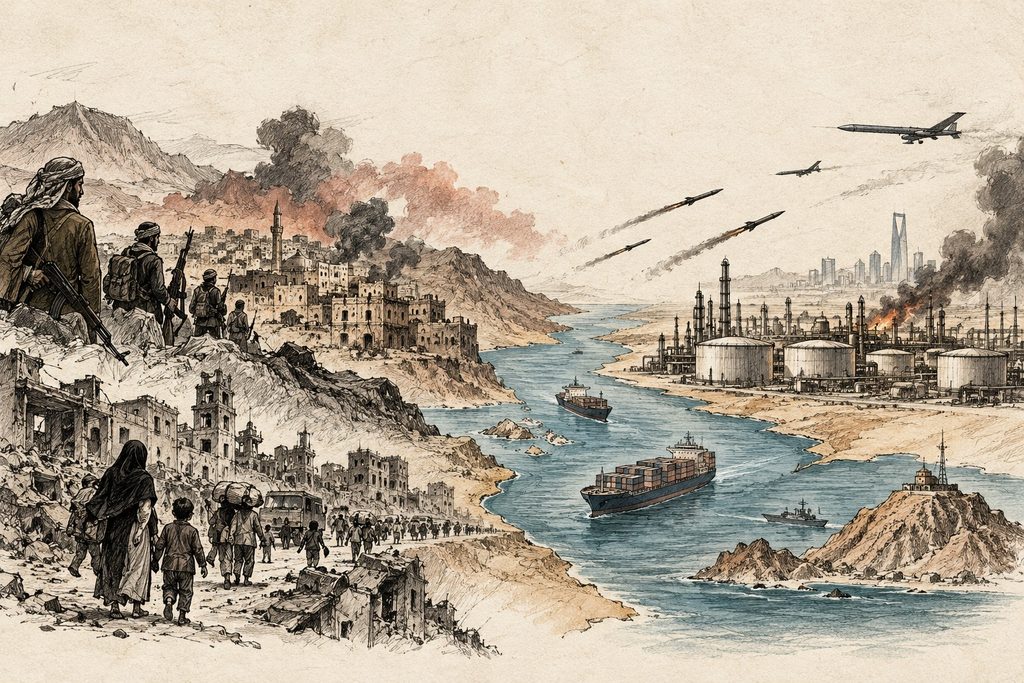
For Saudi Arabia, the Houthis are a territorial and security threat, threatening oil infrastructure and maritime commerce. For Iran, they constitute a source of regional leverage over a vital waterway, challenging Israel and its partners. For the Houthis, the war is a resistance against Saudi intervention in Yemen and a struggle for the Palestinian cause.