A user whose Instagram account is disabled cannot ask the Delhi High Court to restore it through a writ petition. In Sarthak Bhagat v. Union of India & Ors, decided on 27 October 2026, Justice Amit Mahajan held that Meta Platforms India does not perform a public function or discharge a public duty, so it is outside the court’s writ jurisdiction under Article 226 of the Constitution.
The user’s remedy against Meta, the court said, is a civil suit for damages. It refused a mandamus against the Union government, but directed the government’s Grievance Appellate Committee (GAC) to decide his pending appeal expeditiously.
| At a glance | |
| Case | Sarthak Bhagat v. Union of India & Ors |
| Court | Delhi High Court, single judge (Justice Amit Mahajan) |
| Order dated | 27 October 2026 |
| Issue | Is a writ under Article 226 maintainable against Meta for disabling an Instagram account? |
| Holding | No. Providing a social media platform is not a public function or public duty |
| Remedy pointed to | Civil suit against Meta; statutory appeal to the GAC under Rule 3A, IT Rules 2021 |
| Relief granted | GAC told to decide the pending appeal expeditiously |
The ruling matters because writ petitions had become a common shortcut for users locked out of their accounts. It also lands while the GAC, the one public-law forum the court pointed to, is carrying a backlog of roughly 50,000 appeals.
The facts
Sarthak Bhagat’s Instagram accounts were disabled by Meta without prior notice or a chance to respond. The only reason given was an alleged breach of Instagram’s Community Standards. He was told the decision could not be reviewed again and that his data would be permanently deleted.
He used Instagram’s in-app review, which produced neither restoration nor specific reasons. On 11 September 2026 he appealed to the GAC under Rule 3A of the IT (Intermediary Guidelines and Digital Media Ethics Code) Rules, 2021. That appeal was still pending after the 30 days Rule 3A(4) contemplates.
He then filed a writ petition asking the High Court to:
- direct Meta to restore his accounts, and
- direct the Union government to make Meta comply with the IT Act, 2000 and the 2021 Rules.
What the court held
The court dismissed the claim against Meta at the threshold: Bhagat had not shown why a writ should lie against a private company at all.
- Meta is a private actor. Its operations are private in nature, and no government mandate delegates any traditional State function to it.
- Influence is not duty. The court accepted that platforms shape public opinion and spread information. But it treated public discourse as a by-product of running a platform, not a duty the platform owes. In its words, merely providing a platform for communication is not, “by itself, … a governmental function”.
- Remedy lies in civil law. Bhagat’s recourse against Meta appeared to be a civil suit, where he could claim damages if any.
- No mandamus against the Union. A mandamus issues only where a public authority has neglected a statutory duty. Bhagat placed no concrete material showing such a failure by the government.
- But the GAC must act. Noting the appeal had sat past its 30-day window, the court directed the GAC to decide it expeditiously.
The court did not rule on whether disabling the accounts was right or wrong. That merits question now sits with the GAC or a civil court.
The legal test: when can a private company face a writ?
Article 226 lets a High Court issue writs to “any person or authority”, so a writ can reach a private body. It does so only when that body performs a public function.
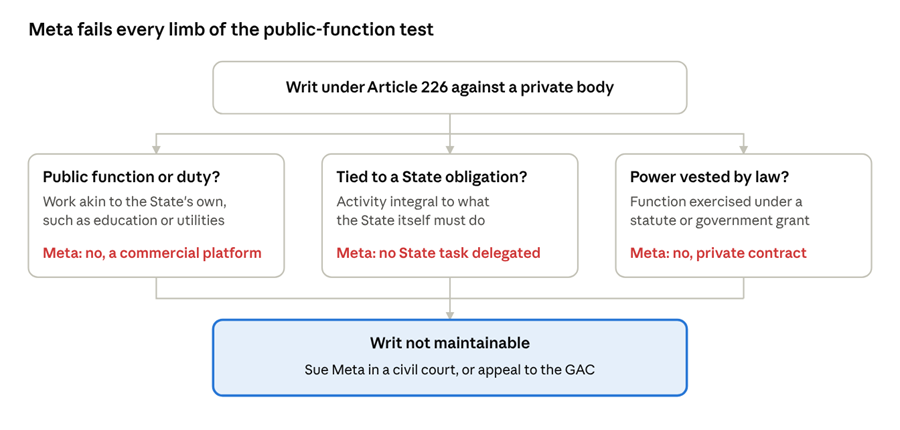
The test comes from a long line of Supreme Court cases. Andi Mukta Sadguru Trust v. V.R. Rudani (1989) let a writ reach a privately run college because education is a public duty. Later cases such as Federal Bank v. Sagar Thomas (2003) and Binny Ltd v. V. Sadasivan (2005) narrowed it: a private body’s commercial or contractual acts stay outside writ jurisdiction. Twitter relied on Rudani in 2020-21, when Senior Advocate Sanjay Hegde sought restoration of his suspended account, arguing a positive public obligation is needed before an activity counts as a public duty.
Meta made the same case in 2022, telling the court that Instagram is a voluntary service governed by a private contract (LiveLaw, 2022). The Bhagat order adopts that framing.
A consistent line from the Delhi High Court
Bhagat is the third Delhi High Court ruling in just over two years to hold that running a widely used digital service is not a public function. Two of the three came from Justice Mahajan within three weeks of each other.
| Order | Case | Service | Judge | Outcome |
| 27 Oct 2026 | Sarthak Bhagat v. Union of India | Instagram (Meta) | Amit Mahajan J. | Writ not maintainable; civil suit; GAC told to decide appeal expeditiously |
| Oct 2026 (reported 10 Oct) | Janta Live Press Network v. Google LLC | Gmail (Google) | Amit Mahajan J. | Writ dismissed; email is a commercial service and Google has no monopoly over it |
| Sep 2026 | SFI’s disabled Instagram account | Instagram (Meta) | Amit Mahajan J. | GAC directed to decide appeal in 3 to 4 weeks; no ruling on merits |
| 23 Jul 2024 | Sanchit Gupta v. Union of India | X, formerly Twitter | Sanjeev Narula J. | Writ not maintainable; remedy is a contract claim |
The common thread is that reach does not decide the question. In the Gmail case the court said the nature of the function, not the entity’s popularity, determines whether a writ lies. In the X case it accepted the platform’s large role in public debate yet still found no public function in the strict legal sense.
The other thread is the GAC. Where the court refuses to act against the platform, it increasingly pushes the government’s own appeal body to do its job on time.
The forum the court pointed to is swamped
The court’s answer for users is the Grievance Appellate Committee, but its backlog has exploded. As of 22 September 2026 the GAC had received 63,353 appeals and disposed of 13,375, leaving 49,978 pending; in November 2025 only 174 were pending.
SFLC.in via sflc.in (Jan, Sep, Nov 2025); GAC dashboard via ThePrint (22 Sep 2026); gac.gov.in dashboard as indexed late Oct 2026
The rules ask the GAC to try to decide appeals within 30 calendar days. SFLC.in says appeals now take 90 to 100 days on average, with some pending beyond 120 days. A former MeitY official blamed middlemen filing complaints in bulk from around May 2026.
Between January and November 2025 the GAC disposed of slightly more appeals than it received. Between November 2025 and September 2026 it received 57,364 and disposed of 7,560, about 13 for every 100. Bhagat’s own appeal, filed 11 September, is one of those caught in the queue.
Bhagat’s problem is the most common one
Disabled accounts, not removed posts, are what drive users to seek help. Of the 590-plus complaints SFLC.in’s free helpline had received by 22 September 2026, account disablement made up 513.
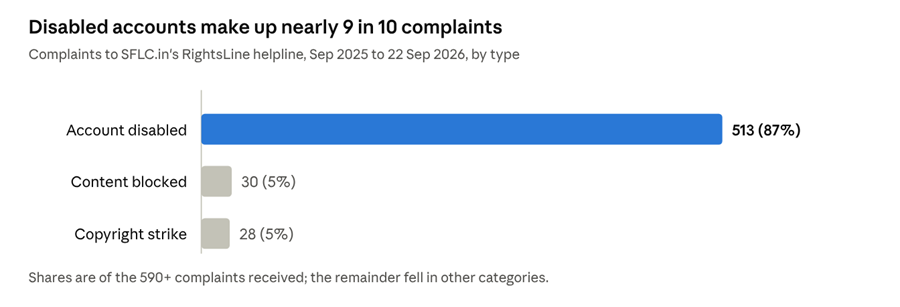
SFLC.in RightsLine data as reported by ThePrint, 30 Sep 2026
SFLC.in said most of these disablements came from automated moderation, with false flags and no explanation. Complainants who first went to the platform, the police or MeitY mostly got automated replies. That is the same pattern Bhagat described: a one-line Community Standards notice and a review that changed nothing.
Analysis: what the ruling settles, and what it leaves open
The ruling keeps writ courts out of everyday moderation disputes, but it leaves users with slow or costly remedies.
The case for the ruling
- It follows settled Supreme Court doctrine: commercial and contractual acts of private bodies sit outside Article 226.
- Meta argued, and the court accepted, that Instagram is a voluntary service under a private contract. Treating every account ban as a constitutional case could flood High Courts.
- Parliament has already built a remedy: a platform grievance officer, then the GAC under Rule 3A, with platforms required to report compliance with GAC orders.
The case against
- Scale and dependence. For creators, small businesses and journalists, a disabled account can mean lost income and audience overnight, with no notice or reasons.
- The Supreme Court’s Constitution Bench in Kaushal Kishor v. State of Uttar Pradesh (2023) held that some fundamental rights, including free speech under Article 19, can be enforced against private actors. Critics argue the public-function test has not caught up with that reasoning.
- The statutory route is clogged. With about 50,000 appeals pending and average decisions taking 90 to 100 days, “go to the GAC” can mean months offline.
- A civil suit is slow and expensive, and damages do not restore an account quickly.
One door stays open. The ruling covers a platform enforcing its own Community Standards. When an account is withheld because of a government order, the State is involved and a writ against the Union is a different question. In October 2026, Meta restricted several Delhi protest reporters’ accounts in India citing unnamed “legal requirements” under the IT Rules; four were restored after legal notices.
What a user with a disabled account can do now
- Use the in-app review, and keep screenshots of every notice.
- Complain to Meta’s India Grievance Officer under the IT Rules.
- Appeal to the GAC at gac.gov.in within 30 days of the grievance officer’s decision, or of getting no reply.
- If the GAC sits past 30 days, a narrow writ asking it to decide, as in Bhagat and the SFI case, has worked.
- For loss suffered, sue Meta in a civil court under its terms of service.