A university born in protest, 106 years ago today
Jamia Millia Islamia turns 106 today. Its foundation stone was laid at Aligarh on Friday, 29 October 1920, by the freedom fighter and theologian Maulana Mahmud Hasan. In Urdu, Jamia means university and Millia means national. Few Indian universities were founded as an act of defiance. Jamia was. It began as a walkout from a colonial-aided campus during Gandhi’s Non-Cooperation Movement. It survived near-bankruptcy, a move across two cities and the violence of Partition. It grew from a few hundred students in rented rooms into a central university of about 24,000 students on a 239-acre campus in south Delhi.
Its recent history is just as eventful. Jamia has been at the centre of national debates on minority rights, policing and protest, most visibly during the 2019 citizenship law agitation. This article traces that whole arc, from 1920 to October 2026.
Origins: the 1920 walkout from Aligarh
Jamia was founded because a group of Aligarh Muslim University (AMU) teachers and students wanted a national Muslim university free of government control. They saw AMU’s administration as pro-British.
The political moment. In 1920 the Khilafat and Non-Cooperation movements called on Indians to boycott institutions run or aided by the colonial state. In September 1920, many AMU teachers, alumni and students left the campus. Within two months they had founded Jamia in Aligarh itself. Around 300 of them gathered at the AMU mosque on 29 October 1920 to lay its foundation.
The founders. The founding members included:
- Maulana Mohammad Ali Jauhar, Khilafat leader and Jamia’s first vice-chancellor (1920 to 1923)
- Hakim Ajmal Khan, physician and Congress leader, first chancellor (1920 to 1927)
- Dr Mukhtar Ahmad Ansari, Congress president in 1927, later chancellor
- Abdul Majeed Khwaja, lawyer and nationalist
- Maulana Mahmud Hasan Deobandi, leader of the Silk Letter Movement, who laid the foundation stone
Mahmud Hasan had just returned from internment in Malta. His speech was read aloud by his student Shabbir Ahmad Usmani. The wider foundation committee included Syed Sulaiman Nadwi, Hussain Ahmad Madani, Abdul Bari Firangi Mahali, Saifuddin Kitchlew and Kifayatullah Dehlawi.
Gandhi’s role: Gandhi backed the project from the start. He saw Jamia as a place to educate students in a shared Indian culture, and he sent his youngest son, Devdas Gandhi, to teach Hindi there.
The idea: Jamia was meant to offer progressive education to students of all communities, especially Muslims, with Indian nationalism at its core. Zakir Husain later described it as a struggle for education and cultural renaissance, rooted in Islam but building a common national culture.
Surviving the early years: Karol Bagh, Okhla and the Zakir Husain era
Jamia nearly collapsed within five years. It took no government money, and it lost its main patrons as the Khilafat movement faded after 1924.
The move to Delhi (1925): Hakim Ajmal Khan, Dr M.A. Ansari and Abdul Majeed Khwaja, known as the “first trio”, moved Jamia from Aligarh to rented premises in Karol Bagh, Delhi, in 1925 with Gandhi’s backing. When money ran short, Gandhi reportedly told them that Jamia had to run, and that he would go about with a begging bowl if needed.
The “second trio” arrives (1926): Three young Indians studying in Germany, Zakir Husain, Abid Husain and Mohammad Mujeeb, decided to give their careers to Jamia. They sailed back early in 1926. Zakir Husain, with a Berlin doctorate in economics, took a salary of Rs 100. His two friends were offered Rs 300 each and cut theirs to Rs 100 to match. When Hakim Ajmal Khan died in 1927, Jamia lost its chief financier, and leadership passed to Zakir Husain, vice-chancellor from 1926 to 1948.
The Life Members’ pledge: A group of young teachers led by Zakir Husain pledged to serve Jamia for 20 years on a salary of no more than Rs 150 a month. A second group took the same pledge in 1942. The society’s constitution barred Jamia from seeking or accepting any help from the colonial administration.
The Okhla campus (1935 to 1936). On 1 March 1935, the foundation stone of a school building was laid at Okhla, then a village on Delhi’s southern edge. By 1936, every Jamia institution except the press, the Maktaba (publishing house) and the library had moved there That site is today’s Jamia Nagar.
A laboratory for national education. Jamia followed Gandhi’s programme of self-reliance, with spinning on the charkha and takli as everyday crafts. In 1937 Zakir Husain chaired the committee that drafted Gandhi’s Nai Talim (Basic Education) scheme. Jamia’s Teachers’ Training Institute opened in 1938 to train teachers for it.
Partition, then recognition: 1946 to 1988
Jamia came through Partition damaged but intact, and spent the next four decades turning from a national-movement school into a recognised university.
Silver Jubilee on the eve of Partition (1946). Jamia completed 25 years on 29 October 1945, and the celebration was held on 17 November 1946 amid rising communal tension. The stage held leaders who would soon be on opposite sides of the border: Mohammad Ali Jinnah and Liaquat Ali Khan sat on one side of Zakir Husain, and Nehru, Asaf Ali and C. Rajagopalachari on the other.
The riots of 1947: The violence reached Jamia’s properties. The old Karol Bagh premises were ransacked, and Maktaba Jamia’s press and books worth over Rs 7 lakh were reportedly lost. In Parliament, Maulana Azad later put the damage to books and furniture at nearly Rs 5 lakh. Zakir Husain himself narrowly escaped being killed at Jalandhar in August 1947; a Sikh army captain and a Hindu railway official saved him.
Gandhi’s last visit: On returning to Delhi from Noakhali on 9 September 1947, Gandhi reportedly asked first whether Zakir Husain and Jamia were safe. He visited the Okhla campus, then sheltering Partition refugees, the next morning. It was his last visit before his assassination in January 1948. Jamia students and teachers worked in relief camps at Humayun’s Tomb and Purana Qila and urged Delhi’s Muslims to stay in India.
After independence: Zakir Husain left in 1948 to lead AMU, and Mohammad Mujeeb became vice-chancellor. Zakir Husain went on to become Governor of Bihar, Vice-President and, in 1967, President of India; he is buried on the Jamia campus.
From deemed to central university. Under Mujeeb, the University Grants Commission granted Jamia deemed-university status on 9 June 1962. A commemorative stamp marked its golden jubilee in 1970. On 26 December 1988, Parliament passed the Jamia Millia Islamia Act, making it a central university.
Growth: from a national school to a research university
Today Jamia has 11 faculties, about 24,000 students and a 239-acre campus, with a budget of Rs 538 crore in 2022-23
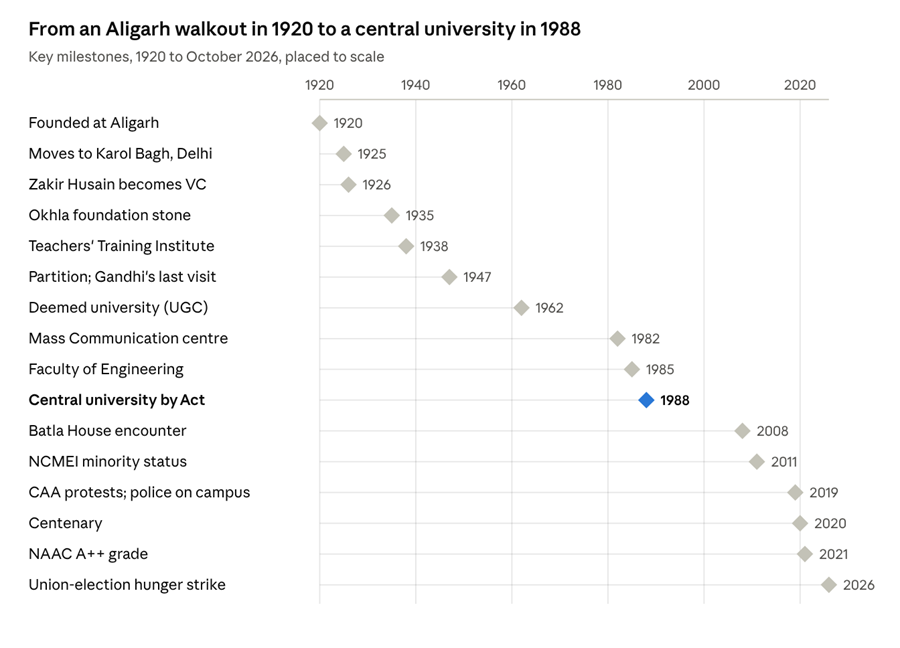
Milestones compiled from the sources cited in each section
Most of that growth came after central-university status. Key additions:
- Media and technology: the A.J. Kidwai Mass Communication Research Centre opened in 1982 and the Faculty of Engineering and Technology in 1985.
- Professional schools: the Faculty of Law opened in 1989, and architecture teaching began in 2001-02. Jamia is the only central university with a Faculty of Architecture and Ekistics.
- Research centres: the Academy of International Studies (1988), the Centre for Theoretical Physics, the Centre for Nanoscience and Nanotechnology, and more than 20 others, including centres for Dalit and minority studies and North East studies.
- Health: in July 2023, Jamia announced Central government approval to set up a medical college.
- Schools: Jamia still runs schools from nursery to senior secondary, a link to its origins as a school-led movement.
Leadership firsts. Najma Heptulla became Jamia’s first woman chancellor in 2017, and Najma Akhtar its first woman vice-chancellor in 2019. Syedna Mufaddal Saifuddin, head of the Dawoodi Bohra community, became chancellor in 2023, and JNU professor Mazhar Asif was appointed vice-chancellor in 2024.
Notable alumni include actor Shah Rukh Khan, filmmaker Kabir Khan, cricketer Virender Sehwag, journalists Barkha Dutt and Anjana Om Kashyap, and Pulitzer-winning photojournalist Danish Siddiqui.
The minority-status dispute: 2011 to today
Whether Jamia is a minority institution has been in court since 2011 and is still undecided.
2011: declared a minority institution. In February 2011, the National Commission for Minority Educational Institutions (NCMEI) declared Jamia a religious minority institution, on the ground that it was founded by Muslims for the benefit of Muslims. This allowed Jamia to reserve up to 50% of seats for Muslim students. It also means the standard central-university quotas for SC, ST and OBC students do not apply in the same way.
The challenge. Five writ petitions challenging the order were filed in the Delhi High Court in 2011. In August 2011, the UPA government’s HRD Ministry told the court it respected the NCMEI declaration.
2018: the Centre reverses its stand. On 5 March 2018, the NDA government filed a fresh affidavit opposing minority status. It relied on the Supreme Court’s 1967 Azeez Basha ruling that a university created by an Act of Parliament cannot claim to be a minority institution. Jamia said it would defend its minority character.
Waiting on Aligarh. The Delhi High Court deferred the case until the Supreme Court decided the parallel question for AMU. On 8 November 2024, a seven-judge bench overruled Azeez Basha by 4:3, holding that an institution does not lose minority status merely because a statute created it . The court sent AMU’s actual status to a regular bench, and the ruling is widely seen as a precedent for Jamia’s case.
Supporters argue the history of Jamia’s founding settles the question. Opponents argue that a central university funded by the state should follow national reservation rules. The final word rests with the courts.
Batla House, 2008: the encounter that politicised a campus
The Batla House encounter turned Jamia’s teachers and students into an organised civil-liberties voice, and it is still marked on campus every September.
What happened. On 19 September 2008, six days after serial bomb blasts in Delhi, the Delhi Police Special Cell raided flat L-18 in Batla House, a locality in Jamia Nagar. Two young men from Azamgarh whom police called terror suspects, Atif Ameen and Mohammad Sajid, were killed . Police Inspector Mohan Chand Sharma was shot and died later that day . The 13 September blasts had killed 39 people.
Jamia’s response. Students, teachers and residents doubted the police account. Jamia teachers formed the Jamia Teachers’ Solidarity Group, later the Jamia Teachers’ Solidarity Association (JTSA). It questioned why no independent witnesses were present during the raid. It held a public hearing in Jamia Nagar on 12 October 2008 and led a citizens’ march on 24 October 2008 with students from Jamia, Delhi University, JNU and IGNOU
The official findings. The National Human Rights Commission cleared the police in July 2009, and courts later convicted accused in the case. Critics, including the JTSA, continued to dispute the verdicts and demand a judicial inquiry.
Still contested in 2025. On the 17th anniversary, 19 September 2025, Delhi Police detained several Jamia students during a march demanding a judicial probe. Student groups alleged manhandling; police denied that anyone was dragged.
December 2019: Jamia and the citizenship law protests
Jamia became the starting point of India’s nationwide student protests against the Citizenship (Amendment) Act (CAA) in December 2019. The night of 15 December, when police entered the campus and its library, remains the most contested event in the university’s recent history.
13 December. Protests against the CAA and the proposed National Register of Citizens began at Jamia on 13 December, days after Parliament passed the Act. Police used tear gas to break up a student march that day.
15 December. A march near the campus turned violent; demonstrators allegedly threw stones at police and set vehicles on fire. Police then entered the university, saying they were pursuing “outsiders” involved in the arson. Hundreds of officers went in and more than a hundred students were detained. Students in the library said they were beaten. A law student, Minhajuddin, who said he was reading there, lost the sight of his left eye. The university asked the HRD Ministry for a judicial inquiry.
National reaction. The crackdown sparked protests at campuses across India and abroad, including at IIM Ahmedabad, Oxford and Harvard.
The NHRC report (June 2020). The NHRC called the 15 December protest an “unlawful assembly” and recommended an SIT to find the “real perpetrators” behind the violence. It also recommended action against officers who beat students and damaged the library, and noted that the library attack had no bearing on controlling law and order Injured students said the report ignored their testimonies; police denied using brutality.
30 January 2020: the shooting. On Gandhi’s death anniversary, a teenage gunman shouting pro-CAA slogans fired at Jamia students marching to Raj Ghat, injuring one student. Home Minister Amit Shah promised strict action.
Arrests and court cases. After the February 2020 Delhi riots, Jamia students Safoora Zargar, Meeran Haider and Asif Iqbal Tanha, and alumni association president Shifa-ur-Rehman, were booked under the anti-terror law UAPA. Zargar was about three months pregnant when jailed. In the separate Jamia violence case, a trial court discharged 11 accused, including Sharjeel Imam, Tanha and Zargar, on 4 February 2023. On 28 March 2023, the Delhi High Court partly reversed that order and framed charges including rioting against nine of them.
Two readings of these events persist. Students and rights groups describe an unprovoked assault on a campus and its library. Police and the courts point to violence on the streets that day and to protesters who, they say, went beyond peaceful assembly.
Protest after 2020: anniversaries, suspensions and the fight for a union
Since 2020 the main conflict at Jamia has shifted from students against the state to students against their own administration, over the right to protest and to elect a union. Jamia dissolved its students’ union in 2006, citing campus violence, and has held no election since.
The 2026 hunger strike, as of today. The current agitation began on 12 October 2026, three days after Aligarh Muslim University agreed to hold union polls following a 19-day hunger strike there. The main events so far:
- 21 October: the vice-chancellor approved a committee to draft a union constitution by 20 December; students rejected the two-month timeline.
- 24 October: classes moved online, gates were barricaded and hostel residents were asked to leave.
- 25 October: students trying to enter campus were detained by Delhi Police and CRPF personnel.
- 26 October: a 4:15 am order promised elections within 15 days of the constitution being approved, revoked suspensions and show-cause notices, and set up an inquiry into security staff. Students said they were pressured into signing it and rejected it because it set no date for approving the constitution.
- 27 to 28 October: the university said protesters and locals vandalised gates and CCTV equipment overnight and brought down Gate 4C. Prohibitory orders under Section 163 of the BNSS were in force around the campus, and four students remained on indefinite hunger strike.
Students also accuse Vice-Chancellor Mazhar Asif of steering Jamia toward the RSS, citing an RSS centenary event held on campus. A group of faculty condemned the administration for bringing staff to the protest site as a show of force. The administration says students pushed staff and refused repeated offers of dialogue. As of 29 October, the standoff is unresolved.
Earlier flashpoints since 2020:
| Date | Event | Outcome |
| Sep 2025 | 17th Batla House anniversary march | Several students detained; police denied manhandling |
| Feb 2025 | Sit-in against show-cause notices to two PhD scholars over the 2024 “Jamia Resistance Day” march | About 14 to 15 students detained; 17 suspended ; Delhi HC stayed some suspensions, and 10 were revoked in March |
| Dec 2024 | Fifth anniversary of 15 December 2019 | Permission refused; two PhD scholars issued show-cause notices |
| Mar 2024 | Protest after CAA rules were notified | Students demanded repeal and release of jailed activists; police and drones deployed outside |
| Dec 2022 | Third anniversary vigil | Hundreds attended amid heavy police deployment |
Rankings and recognition
Jamia climbed from 83rd among Indian universities in the first NIRF edition in 2016 to third place from 2022 to 2024, and was fourth in 2025, the latest edition published.
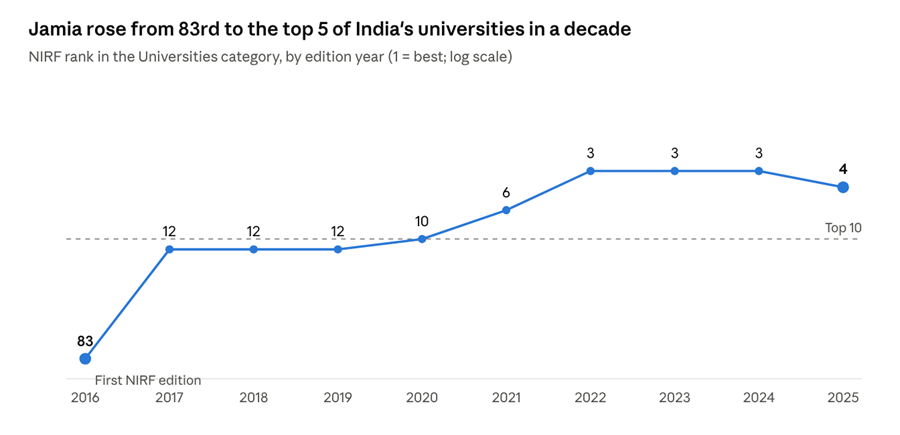
NIRF India Rankings, Universities category, 2016 to 2025 · JMI press releases, NIRF 2023 report, Careers360, ThePrint
The rise continued straight through the 2019 to 2020 turmoil: Jamia entered the top 10 for the first time in June 2020. Earlier ranks are from the NIRF 2023 report and JMI’s 2022 release. NIRF had not published its 2026 results as of early October 2026.
Other milestones:
| Recognition | Result |
| NIRF 2025, other categories | 13th overall, 5th in Architecture, 8th in Law, 3rd in the new SDG category |
| NAAC accreditation | A++ grade, December 2021 |
| Ministry of Education, 2020 | First among central universities |
| QS World University Rankings 2026 | 761 to 770 band, up from 851 to 900 in 2025 |
| THE World University Rankings 2026 | 401 to 500 band |
Jamia at 106: what has changed and what has not
Jamia turns 106 as both a top-five Indian university and a campus in open conflict with its own administration. Classes have been online since 24 October, prohibitory orders surround its gates, and four students are on hunger strike for a union the university has not had in 20 years.
The traditional Talimi Mela, held every year on Foundation Day, 29 and 30 October, marks the anniversary.
Three threads run through the whole story:
- Born in dissent. Jamia began as a walkout from a government-aided campus. Its students have kept invoking that origin, from the Batla House marches to the 2019 protests and today’s hunger strike.
- A test of Indian secularism. Gandhi, Zakir Husain and the founders saw Jamia as a Muslim institution that was also wholly national. The minority-status case, the 2019 crackdown and the current debate over the administration’s direction all turn on what that balance should mean today.
- Academic rise despite turmoil. Its rankings climbed sharply in exactly the years of its sharpest political conflict.
Still open: the Delhi High Court’s ruling on minority status, the trials from the 2019 violence, and whether students get a union election date.
Sources
- JMI: History and JMI citizen charter
- Wikipedia: Jamia Millia Islamia
- The Wire: Gandhi, a lifelong friend of Jamia
- Countercurrents: Jamia’s role in the freedom struggle
- Live History India: Jamia, an ode to unity
- The Jamia Review: Jamia, Partition and Independence
- The Quint: minority status and the Supreme Court
- LiveLaw: Supreme Court overrules Azeez Basha
- ThePrint: a year after the Jamia violence
- The Wire: NHRC report on the Jamia violence
- LiveLaw: Delhi HC sets aside discharge, 2023
- The Caravan: 2025 detentions and suspensions
- The Wire: students fight for a union, October 2026
- ETV Bharat: protest enters 17th day
- JMI press release: NIRF 2025