A Muslim woman filed a police complaint alleging cruelty by her husband. An FIR was registered. But there’s an existing document, issued by a private religious body, stating that her marriage has already ended. That is what the Chhattisgarh High Court found itself untangling earlier this month, when it declared a Sharia court’s divorce order null and without any legal effect. It was held that the Idara-e-Sharia’s communication purporting to confirm that woman’s marriage has ended through her husband’s pronouncement of talaq, could not alter her civil status. Religious bodies could offer opinions grounded in faith, the Court said, but they could not assume the powers of a family court or any other authority created by law.
The ruling breaks no new doctrinal ground. It follows the line laid down in Vishwa Lochan Madan v. Union of India, 2014, which stripped fatwas of legal validity without banning the dar-ul-qaza system, and is reaffirmed more recently in Shahjahan v. State of Uttar Pradesh, 2025, where the Supreme Court held that a “Court of Qazi” or “Sharia Court” has no recognition in law, and that any declaration it issues bind only the parties who choose to accept it, and only where that acceptance does not conflict with any other law. The recent decision of Chhattisgarh High Court earlier this month in Nirosh Abbasi v UOI, however is a reminder that religious adjudication is not only an academic question. It arrives in courtrooms attached to maintenance and custody claims of women who often have nowhere else to go.
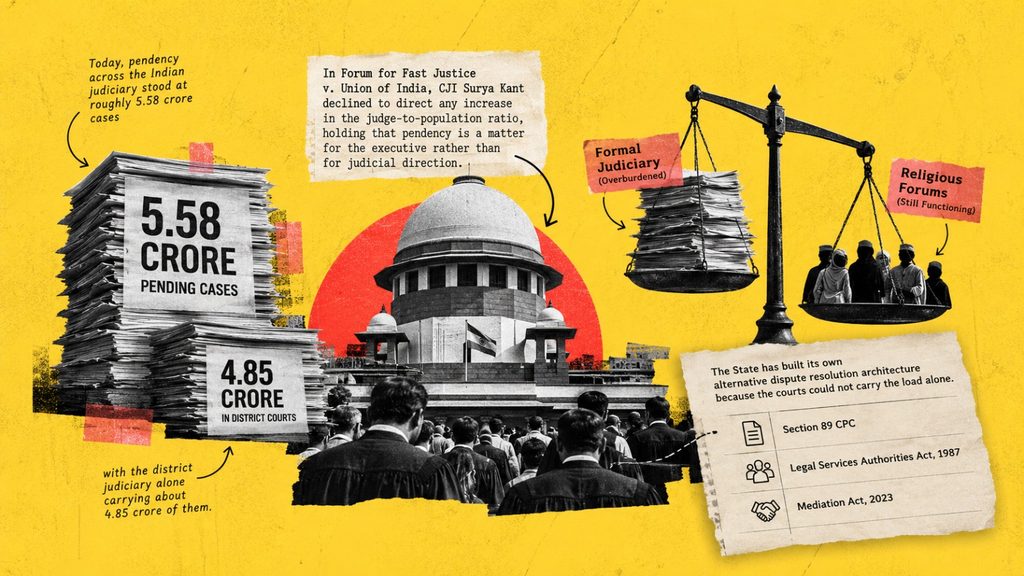
That is the paradox Indian law has sat with for over a decade now. The Supreme Court keeps telling these forums that they have no legal authority but the forums keep functioning anyway, because the alternative the State offers is the judiciary that cannot absorb the demand. Today, pendency across the Indian judiciary stood at roughly 5.58 crore cases, with the district judiciary alone carrying about 4.85 crore of them. Earlier this year, in Forum for Fast Justice v. Union of India, a bench led by CJI Surya Kant declined to direct any increase in the judge-to-population ratio, holding that pendency is a matter for the executive rather than for judicial direction. If the formal system cannot resolve the disputes already before it, it is not realistic to expect millions of Muslim, Christian, Parsi, Hindu sectarian and caste-based family disputes to funnel into it once religious forums are declared illegitimate. The State has, after all, built its own alternative dispute resolution architecture, through Section 89 CPC, the Legal Services Authorities Act, 1987, and the Mediation Act, 2023, precisely because the courts could not carry the load alone. A major legal conundrum here is the State endorsing consensual settlement through Lok Adalats while treating consensual settlement through dar-ul-qaza as devoid of any legal force.
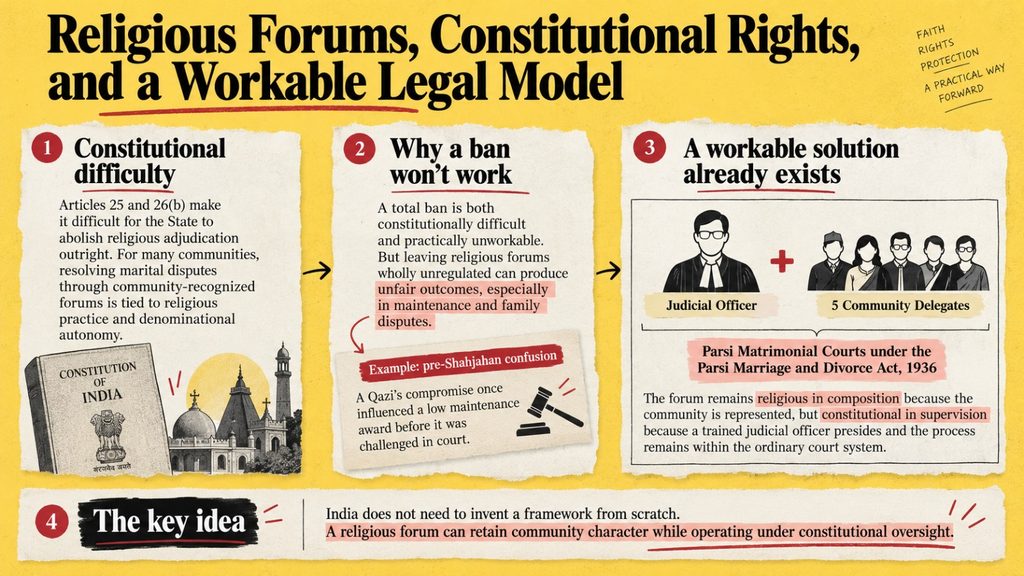
Article 25 sharpens the difficulty further. For many communities, resolving marital disputes through community-recognized forums is inseparable from the practice of religion, and Article 26(b) protects a denomination’s right to manage its own religious affairs. If the State tried to abolish religious adjudication outright, that abolition would lead to infringement of these fundamental rights, and would invite exactly the kind of challenge the Supreme Court has dealt with in Sabarimala reference.
Banning religious forums is constitutionally difficult and practically unworkable. Leaving them wholly unregulated produces exactly what happened before Shahjahan reached the Supreme Court, a family court in Jhansi relying on a Court of Qazi compromise to award a woman just Rs 2,500 maintenance for two children, and a woman having to litigate for years to be told that the compromise was never binding on her in the first place. Chhattisgarh shows the same structure repeating.
The solution here is simple. India does not need to invent the workable framework from nothing. It already has an ideal model. The Parsi Matrimonial Courts, set up under the Parsi Marriage and Divorce Act, 1936, are presided over by a judicial officer, but the officer sits with five delegates drawn from the Parsi community, who function much like a jury deciding the facts. The forum stays religious in composition, because the community itself is represented on the bench, while remaining constitutional in supervision, because a trained judicial officer presides and the proceeding is subjected to the ordinary court system above it. This shows that bringing a religious forum inside constitutional oversight does not require stripping it of its religious character.
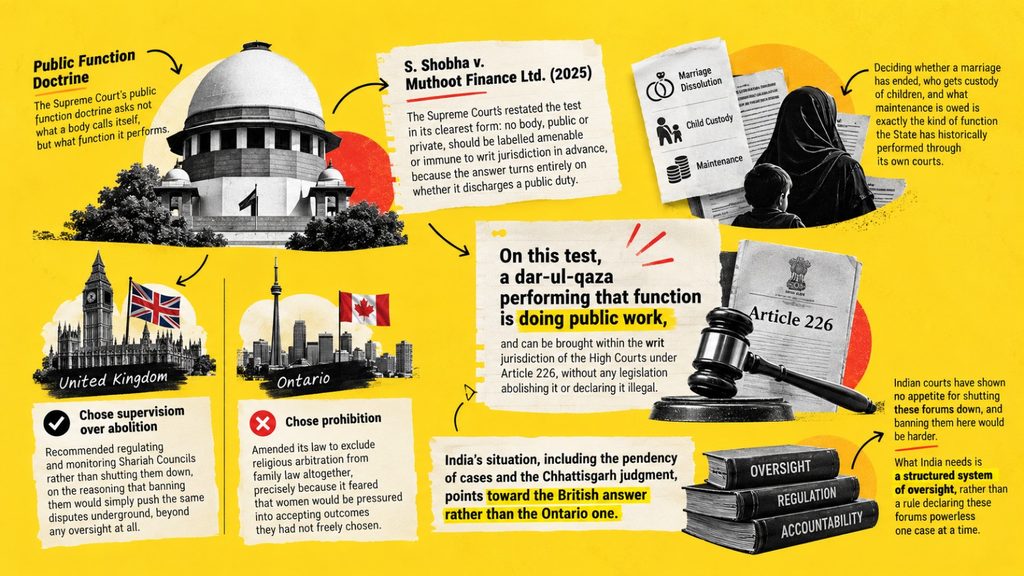
Another route to extend this kind of supervision to bodies like dar-ul-qazas exists too. The Supreme Court’s public function doctrine asks not what a body calls itself, but what function it performs. In S. Shobha v. Muthoot Finance Ltd., 2025, the Supreme Court restated the test in its clearest form: no body, public or private, should be labelled amenable or immune to writ jurisdiction in advance, because the answer turns entirely on whether it discharges a public duty. Deciding whether a marriage has ended, who gets custody of children, and what maintenance is owed is exactly the kind of function the State has historically performed through its own courts. On this test, a dar-ul-qaza performing that function is doing public work, and can be brought within the writ jurisdiction of the High Courts under Article 226, without any legislation abolishing it or declaring it illegal.
Other countries have faced a version of this same choice and split in opposite directions. The United Kingdom chose supervision over abolition, it recommended regulating and monitoring Shariah Councils rather than shutting them down, on the reasoning that banning them would simply push the same disputes underground, beyond any oversight at all. Ontario, on the other hand, chose the opposite path, responded by amending its law to exclude religious arbitration from family law altogether, precisely because it feared that women would be pressured into accepting outcomes they had not freely chosen. India’s own current situation i.e. pendency of cases, and Chhattisgarh’s judgment now, points toward the British answer rather than the Ontario one. Indian courts have shown no appetite for shutting these forums down, and for the reasons above, banning them here would be harder. What India needs is what the UK has attempted and India has not: a structured system of oversight, rather than a rule declaring these forums powerless one case at a time.
Chhattisgarh’s judgment, following Vishwa Lochan Madan and Shahjahan, confirms that Indian courts will keep declaring these forums powerless, case by case, for as long as Parliament and the higher judiciary decline to say what standards they must meet to operate at all. A woman should not have to wait for years for a Court to tell her that the religious forum her husband invoked against her never had the power it claimed. The doctrine to prevent this is already available. What is missing is the judiciary or the legislature’s will to pick it up and put it in place.
The author, Sadaf Parvez, is a Lecturer at Faculty of Law, Jamia Millia Islamia, specializing in Personal Laws and Comparative Constitutional Law.