On 28 October 1627, a royal camp descending from Kashmir halted in the Pir Panjal foothills. Inside it, Emperor Jahangir, whose throne name means “World-Conqueror”, was dying. He had ruled for 22 years, raised Mughal painting to new heights and filled his memoirs with notes on birds and flowers. He never saw the plains of Punjab again.
A sick man on the Pir Panjal road
By 1627, decades of opium and wine had worn Jahangir down. He went to Kashmir hoping the cool air would revive him, then turned back for Lahore as the cold set in. The route ran from Srinagar over the Pir Panjal, through Rajouri and Bhimber, and down to the plains, a chain of caravanserais spaced roughly a day’s march apart.
Where exactly he died is still disputed. Museum and encyclopaedic records place his death near Bhimber, now in Pakistan-administered Kashmir. Historians and local writers in Jammu place it in the hills near Rajouri, on the Indian side. Pakistani accounts narrow it to the stretch between Chingus Sarai and Sarai Saadabad. The camp was moving, and both claims describe the same final stretch of road.
The imperial route ran south from Srinagar to Lahore; the two candidate death sites now lie on opposite sides of the Line of Control.
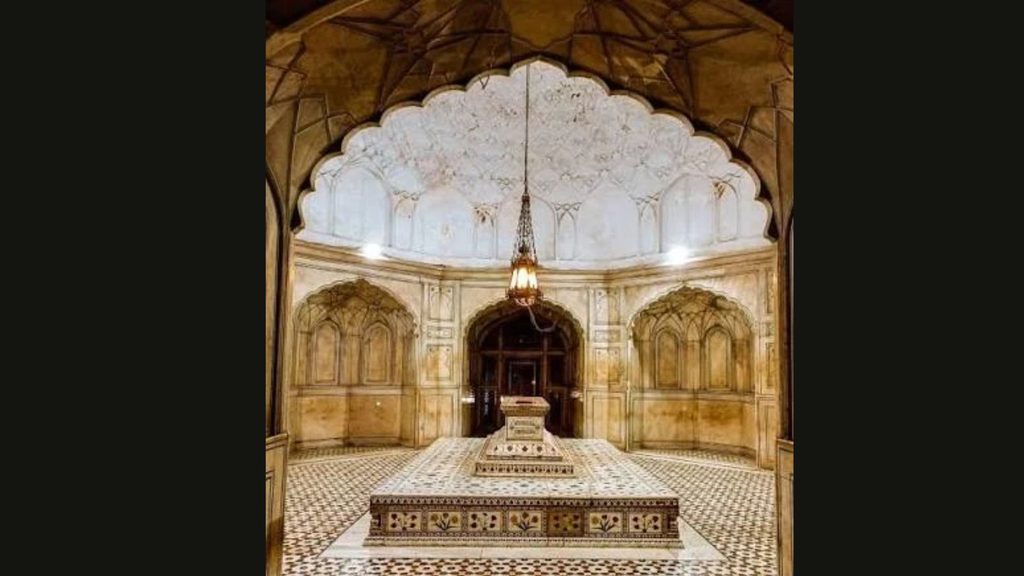
One emperor, two graves
To carry the body hundreds of kilometres to Lahore, attendants removed and buried the internal organs. Tradition in Jammu holds that they lie at a sarai about 35 km from Rajouri, once called Khanpur. It came to be known as Chingus, from a Persian word for entrails. A small marble cenotaph still marks the spot in its central courtyard. Pakistani sources, however, place the entrails at Baghsar Fort near Bhimber.
The embalmed body reached Lahore on 12 November 1627. It was buried in Dilkusha, a garden at Shahdara on the Ravi that Jahangir and Nur Jahan had loved. The mausoleum over it was completed in 1637 at a reported cost of 10 lakh rupees. Popular memory credits Nur Jahan with the tomb, but Shah Jahan paid for it; she had been left only a modest allowance.
The legend of the propped-up emperor
A signboard at Chingus says Nur Jahan seated her dead husband on an elephant “as if he was alive” to avert a war of succession. It is a vivid story. The scholarship tells a different one.
Jahangir had named no heir. Nur Jahan backed Shahryar, his youngest son and her own son-in-law. Her brother, Asaf Khan, backed his son-in-law Khurram, the future Shah Jahan, who was far away in the Deccan. To buy time, Asaf Khan freed Dawar Bakhsh, grandson of Jahangir, and declared him emperor as a stopgap. Coin records note the khutba was read in Dawar’s name at Bhimbar itself.
In her 1993 biography of Nur Jahan, Ellison Banks Findly describes Asaf Khan sending the corpse to Lahore under Maqsud Khan. Nur Jahan was ordered to stay with the body at every stage. That reads less like an empress staging a deception than a widow under watch.
The endgame was swift. Asaf Khan’s army defeated Shahryar near Lahore, and the prince was blinded. Shah Jahan was proclaimed at Lahore on 30 December 1627. On 23 January 1628, on his orders, Dawar Bakhsh, Shahryar and three other princes were put to death. Some accounts claim Dawar escaped to Persia; the evidence remains thin. Shah Jahan was crowned at Agra in February 1628. Nur Jahan lived out her life in Lahore on a pension and died in 1645.
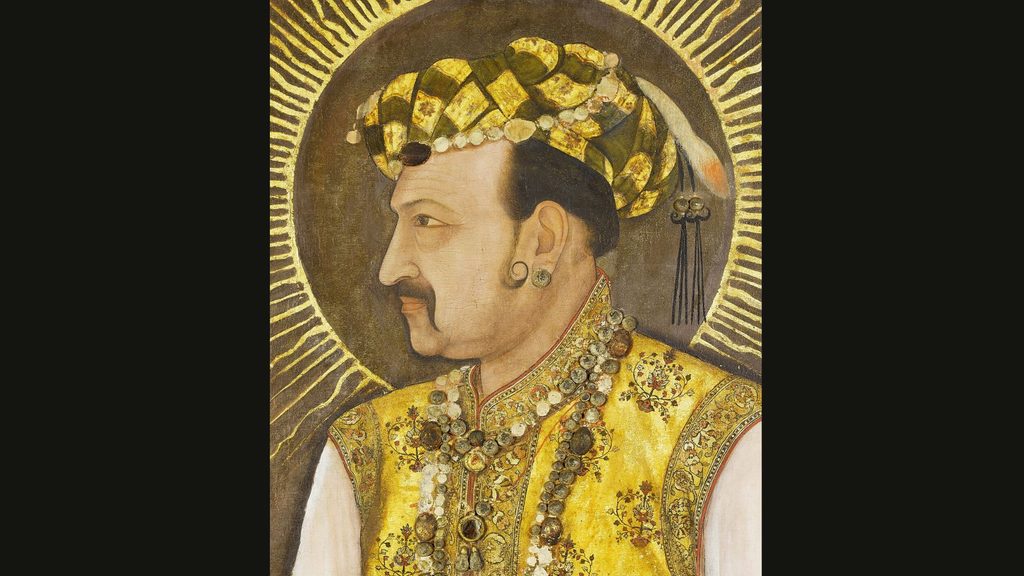
A road now cut by a border
Jahangir’s last journey ran through what is now one of the world’s most militarised frontiers. Rajouri and Chingus lie in Jammu and Kashmir; Bhimber and Lahore lie in Pakistan.
Chingus Sarai has been a protected monument of Jammu and Kashmir since 1984, yet it draws few visitors. The Wire found a cracked cenotaph, walls taken over by plants and graffiti, and one caretaker shared with a monument in Poonch. Even its signboard misdates the death to “Oct-1927”. A July 2026 essay in the Daily Excelsior noted there is still no proper interpretation on site and called for scientific restoration.
Across the border, the Lahore tomb has sat on UNESCO’s tentative World Heritage list since 1993.
The road home
The “World-Conqueror” died with no heir named and no control over what came next. Within four months his favourite queen was sidelined and five princes were dead. His remains were divided between two places that now sit in two countries.
Next October marks 400 years since that death. The anniversary could prompt the restoration and shared scholarship the episode deserves. Until then, a weathered sarai in Rajouri remains the most intimate witness to how one reign ended and the age of the Taj Mahal began.
Sources
- Dr Harmeet Singh Soodan, “The Emperor’s Last Road”, Daily Excelsior, 5 July 2026
- Jehangir Ali, report on the condition of Chingus Fort, Rajouri, The Wire
- Akshay Chavan, “Jahangir’s Tomb: Mughal Gem in Lahore”, Live History India, 12 October 2022 (quotes Ellison Banks Findly, Nur Jahan: Empress of Mughal India, Oxford University Press, 1993)
- Jammu and Kashmir Tourism, Chingus Fort/Sarai, Rajouri
- K.D. Maini, “Mughal Sarai Chingus”, Daily Excelsior
- Saint Louis Art Museum, constituent record: Jahangir
- Baghsar Fort and Tomb of Jahangir, Wikipedia
- Dawar Bakhsh and Shahryar Mirza, Wikipedia (citing G.P. Taylor’s 1907 numismatic study)
- Noble Numismatics, Dawar Bakhsh coin lot note
- Encyclopaedia Britannica, Shah Jahan
- Walled City of Lahore Authority, Shahdara Complex