



Public toilets at several locations across Delhi continue to struggle with basic facilities, including water, cleanliness, lighting and maintenance despite the city receiving its Open Defecation Free (ODF ++) certificate in 2024 under Swachh Bharat Mission. A spot check of multiple public facilities maintained by the Municipal Corporation of Delhi (MCD) and the Delhi Development Authority (DDA) found toilets without water access, broken infrastructure, and poor upkeep, causing severe inconvenience to its users.
In Sangam Vihar’s DDA park, facilities maintained by the MCD have been without a proper water supply for over four years.
“I have been coming to this park for years, and whenever I need to use the toilet, I end up spending ₹10 to ₹20 to buy a bottle or pouch of water. There has been no proper water supply in the facility for years, and most of the time it remains without water,” said Mahesh Singh, a 53-year-old regular visitor.
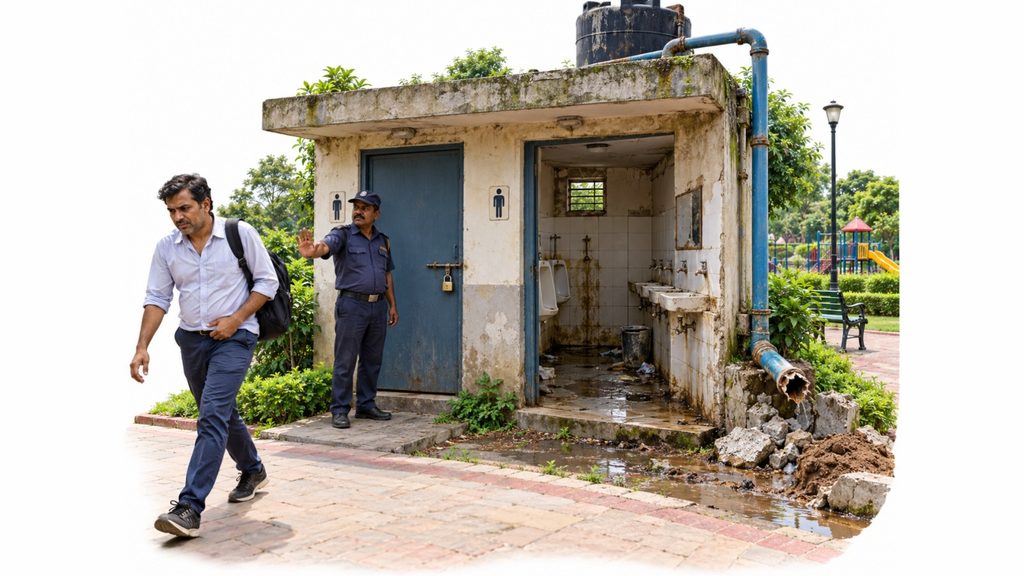
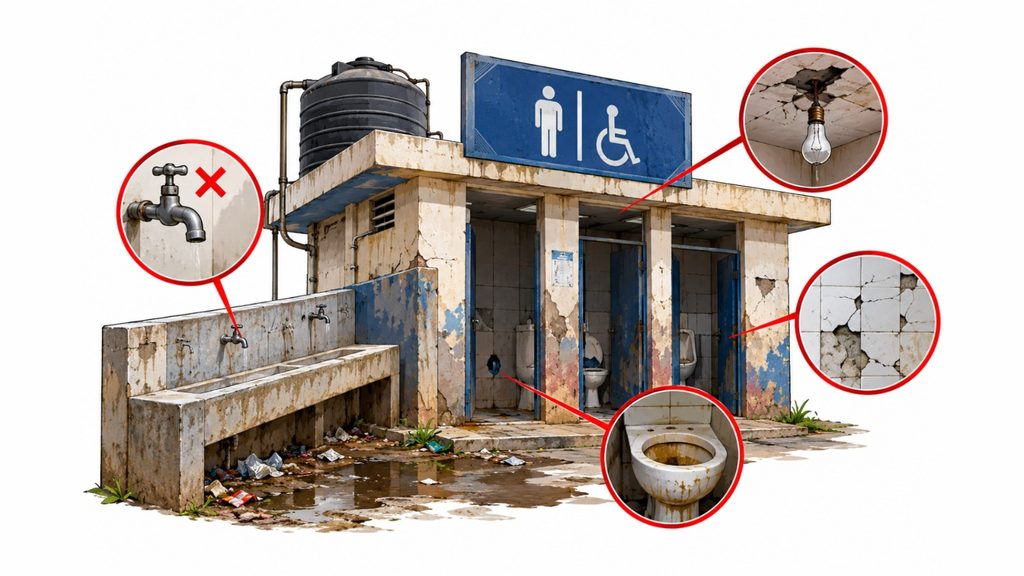
During the visit, the facility was found in a state of disrepair, with paint peeling, broken toilet seats, fittings and washbasins missing. A strong stench lingered in the area. Visitors and local residents continue to face inconvenience due to poor maintenance and lack of functional public toilets in the vicinity
Residents of Gandhi Camp, located within the park premises, said they have been dealing with these problems for the past couple of years. Despite filing complaints to MCD officials, they allege their complaints have gone unaddressed.
“This camp houses around 150 people, and most of them depend on this toilet for their daily needs, and there has been no proper water supply in the facility for over four years, so we have to carry water from our homes to use the toilet,” said 45-years-old Ramrati Devi, a resident of Gandhi Camp. “We have filed several complaints with the MCD, but our concerns have not been addressed,” Devi added.
The DDA park has two public toilet facilities within its premises, one near the entrance and another close to the camp. The facility near the entrance remained abandoned, with garbage piled up along the passage leading to it.
A few metres away, along the Mehrauli-Badarpur Road, two more public toilet facilities maintained by the MCD were found locked. With no functional public toilets available in the area, people are often compelled to urinate in the open.
Satish Kumar, 32, an e-rickshaw driver, who has been working in the area for more than two years said he has never seen these two facilities in use. “The facilities have been closed and non-functional since I started driving an e-rickshaw here,” said Kumar.
Vinay Pratap Singh, 37, a security guard at Sangam Vihar’s DDA park, said the lack of functional public toilets in the vicinity leaves people with little choice but to urinate in the open. “There is no proper functional public toilet nearby, so we are left with no option, but to use the open field.”
DDA’s Children’s Park and Indian Park: Toilets Shut Over Water Supply Issues
During a visit to DDA’s Children Park in Lado Sarai Phase-I, the public toilet facilities remained uncleaned and unusable for two consecutive days after its water supply line broke, causing inconvenience to park visitors.
“The toilet has not been cleaned for the last two days and is not in usable condition. The water supply line broke a couple of days ago. The supervisor has been informed and repair could take another two days. We are informing visitors not to use the toilet.”
Ramesh Kumar, a Delhi Transport Corporation (DTC) bus driver, was among those unable to use the facility. “I came here to use the toilet, but there is no water inside. Now, I will have to go to another public toilet at Saket Metro station, which is around 1 km away from here,” said Kumar. Another public toilet inside DDA’s Indian Park was found closed. “The toilet is locked because there is no water,” said a security guard posted at the site.
Lajpat Nagar Market: Public Toilet Lacks Basic Facilities
These problems extend beyond residential areas and public parks. A public toilet facility, maintained by the MCD near the Ram Laddu Corner in Lajpat Nagar’s Central Market, was found to use a curtain at the entrance. Inside, the urinals were found broken, the floor was wet, and an unbearable stench lingered throughout the facility. The facility also had no electricity.
“The toilet has no proper door and is often left unclean, but I still use it because it’s close to my workplace. You can see the level of maintenance – they have not even fixed the door.” said a garment shop worker in the market.
Another public toilet inside the market was found inaccessible to persons with disabilities. The entrance door was locked and garbage bags were dumped on the ramp leading to the facility.
“This door is usually locked; we rarely see it open,” said a local shop owner.
The absence of basic facilities such as clean water and soap can also have implications beyond inconvenience. Dr Raj Shankar Ghosh, a physician trained in public health with experience in infectious diseases and primary healthcare, said,
“The absence of basic facilities such as clean water and soap makes it difficult for the people to maintain basic hygiene. Contaminated hands and high-touch surfaces such as door latches, taps, and flush handles can increase the chance of spreading infections, particularly where effective handwashing facilities are lacking. Some of the common infections that can spread this way are Norovirus, Rotavirus and Typhoid infections.’
‘Locked’ and ‘Paid’ Pink Toilets
Pink Toilets, specialised public sanitation facilities designed to provide safety, privacy, and hygiene for women and children in public spaces. Launched in 2017, former South Delhi Municipal Corporation (SDMC) along with National Commission for Protection of Child Rights (NCPCR), inaugurated the first Pink Toilet in the city’s Vikaspuri area.
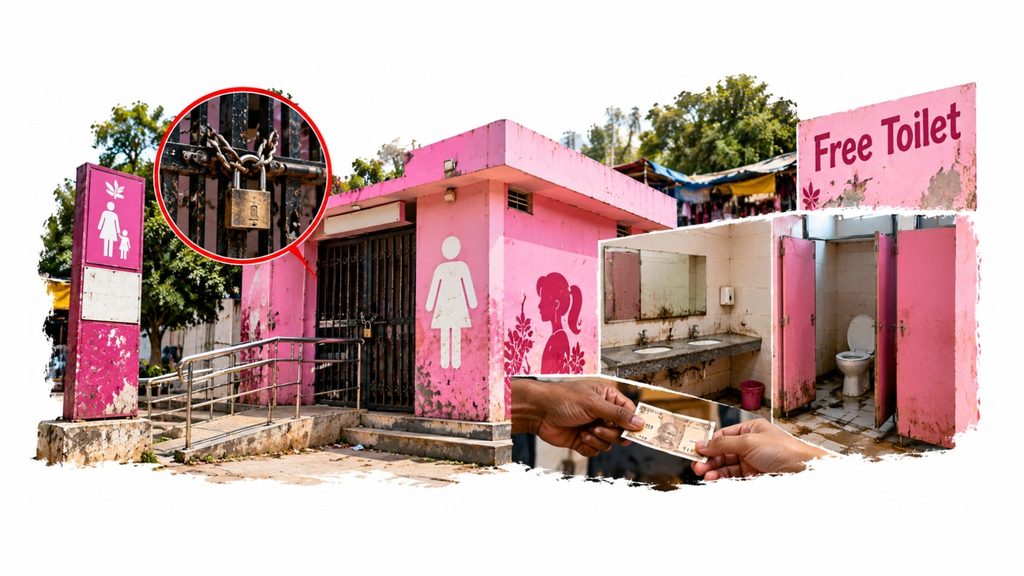
Currently, the pink toilets are being operated as a public-private initiative between Plan India, PVR Nest, and the Municipal Corporation of Delhi (MCD). During the visit, the facility was found locked, while users were being charged despite signage clearly stating, “Free Toilet.”
At Lajpat Nagar Market, the Pink toilet was found locked. The local shopkeeper said the caretaker opens and closes it at her discretion.
Kajal, who goes by her first name, a toy vendor in the market, said the toilet had been opened briefly before being locked again. The caretaker usually shuts the toilet long before the official operating hours.
“It used to be clean and properly functional during the initial days, but now it’s being poorly maintained,” she added.
The lack of functional and accessible toilets can have particular implications for women. According to Ghosh, women are particularly vulnerable to outcomes of lack of access to safe toilets in public places. With less water consumption and holding of urine, the chances of urinary tract infection (UTI) is high among women.
At the Sarojini Nagar Market, the women’s toilet was operational, but users were being charged despite a “Free toilet” sign painted on the wall.
“The facility has become paid; we are now charging users,” said the caretaker on duty, who refused to share her name.
Sangeeta Sharma, a shopper, expressed frustration over the charge. “The public toilet should be free, especially since this one is designated as a ‘Pink Toilet’. Not everyone can afford to pay ₹10 each time. There’s no point in calling it a public toilet if people are being charged to use it,” she said.
She further added, “the facility is also poorly maintained, the floor is wet, there is no provision for sanitary pads and other basic facilities.”
Praja’s report flags shortage of public toilets
In January 2024, the Municipal Corporation of Delhi (MCD) was certified with ODF ++ status (Open Defecation Free) by the Ministry of Housing and Urban Affairs, for ensuring zero open defecation and urination, maintaining fully functional public toilets in the Capital, and safely managing and treating all faecal sludge and sewage. The certification was part of national Swachh Survekshan assessments conducted under Swachh Bharat Mission (Urban).
However, according to the Praja Foundation’s, an NGO that works on urban governance, July 2024 report on status of the civic issues in Delhi, public dissatisfaction with basic municipal services saw a significant increase between 2019 and 2023. Complaints related to solid waste management had seen a 141% increase followed closely by those related to sewerage 120% and water supply 66%.
The report further highlighted the severe shortage of public toilet seats in the Capital, with one toilet seat approximately serving 9,767 male and 10,343 female users (population based on 2011 Census). In contrast, the SBM guidelines issued by the Ministry of Housing and Urban Affairs (MoHUA) prescribe one toilet seat for every 100–400 males and every 100–200 females. Praja analysed the distribution of public toilet seats by comparing MCD’s zone-wise seat data with the SBM norm.
In November 2019, the Union Ministry of Housing and Urban Affairs (MoHUA), conducted a survey of a total of 1,175 public toilets in Delhi. The survey found that nearly 55% of the facilities inspected were either completely unusable or extremely dirty.
The report showed toilets under the East Delhi Municipal Corporation (EDMC) were the worst. The facilities under the New Delhi Municipal Council (NDMC) were in the best condition in terms of cleanliness and usability.
In the former South Delhi Municipal Corporation (SDMC), 358 public toilets were inspected, of which 24% were found either unusable or extremely dirty, while 16% were rated very clean and 41% as excellent. In March, SDMC was recertified as open defecation-free. However, the recent ground visits in South Delhi’s area highlight that several public toilet facilities are continuously facing problems related to cleanliness, maintenance and other basic amenities. The report was then sent to the local bodies to take corrective measures.
Funds Allocated, But Spending Falls Short
MCD’s own budget raises questions about expenditure on the public toilet infrastructure. According to its 2024-25 Budget, the corporation had a budget estimate of ₹1 crore for the construction of public toilets in the market places and ₹50 lakh for the provision of mobile toilets. However, no expenditure was recorded under any provisions.
It also budgeted ₹1.25 crores for Mahila toilets in public places, but could only spend ₹62,000 against the estimated amount.
The under-utilization of funds for public toilet infrastructure is not a new concern. In 2018, despite having Rs 40.31 crore and 30 months at their disposal, the Delhi government failed to construct even a single toilet under Swachh Bharat Mission, according to the audit report by the Comptroller and Auditor General of India (CAG).
The report, tabled in the state assembly on April 3, 2018, noted that Rs 40.31 crore (Central share of Rs 30.23 crore and State share of Rs 10.08 crore) was released to the implementing agencies in January 2016 for construction of household toilets, community toilets and public toilets. All the funds allocated for this purpose remained unutilised in bank accounts.
Court Intervention
In July 2025, Jan Sewa Welfare Society, a registered NGO, filed a petition in the Delhi High Court seeking directions to the municipal authorities to ensure availability of hygienic public toilets with clean water and electricity in the Capital. The High Court criticised the civic authorities for “complete apathy and insensitivity” in maintaining public toilets in the city.
The bench of Chief Justice D.K. Upadhyaya and Justice Tushar Rao Gedela said, ”The municipal authorities and development bodies like MCD, DDA and NDMC have exhibited a complete apathy, insensitivity and even dereliction of duty so far as the maintenance of public conveniences is concerned”.
While hearing the petition, the court directed the authorities to take appropriate steps to ensure the proper functioning of public conveniences in the Capital.
At the time of publication, emails seeking comments from DDA and MCD officials had not received a response. This story will be updated if and when a response is received.