



“Article 370 of the Constitution, which grants special status to Jammu and Kashmir, has been removed by a presidential order, Home Minister Amit Shah said in parliament today…”
– NDTV, 5 August, 2019.
I was barely thirteen years old when the news came out on 5 August, 2019 and I heard my father and his family celebrate something I was not familiar with. “Kashmiriyat” only existed till the colonization was normalized. I was unaware of a home that existed outside of Delhi where the former prime minister of India, Jawaharlal Nehru, had promised a plebiscite to the people of Kashmir.
I remember asking my mother, “Why are we here, maa? Aren’t we supposed to be in Kashmir?” Her reply was, what I would call the casual savarna hate speech of caste-privileged Brahmin, “The Muslims drove us out.” She was not even a Kashmiri herself, though she shared the different Himalayan roots in the Garhwal region of Uttarakhand. I am not able to blame my mother, though. Not because she’s right, but because she allowed me to ponder within a modus vivendi that contradicted her own beliefs. I don’t think I would be able to think the way I think if I were born out of a womb other than my mother’s. She claims to be a progressive liberal who draws the line when the topic is about the systematic killings of Muslims and Dalits by the Hindutva forces or the occupation of Kashmir by the Indian state.
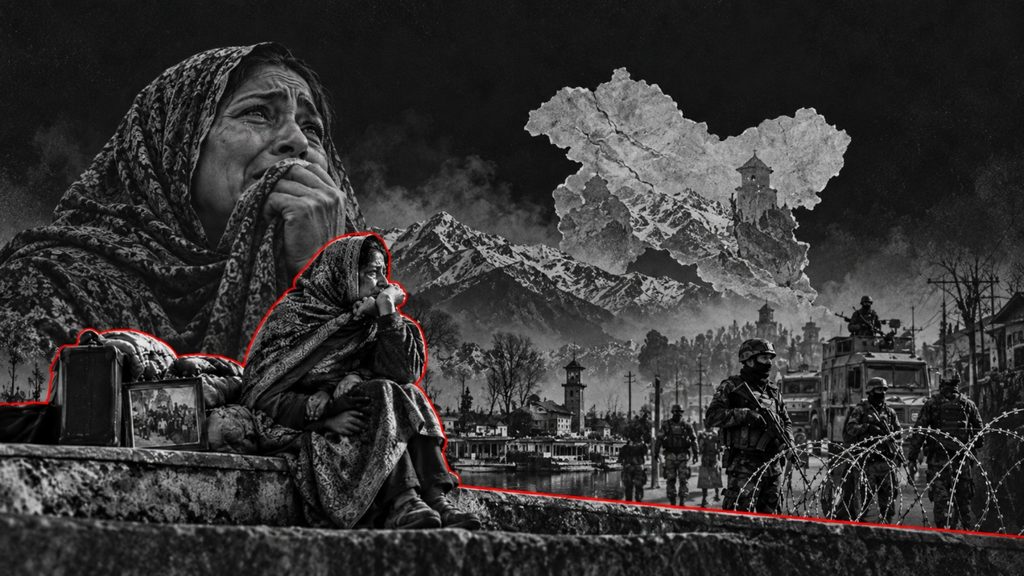
According to the Article 42 of 1907 Hague Regulations, territory is considered occupied when it is actually placed under the authority of the hostile army. The occupation extends only to the territory where such authority has been established and can be exercised. The definition lingers at the back of my cranium when I think of the Indian security forces conducting door-to-door search operations before the Indian Republic Day and I see a photo of a petrified old woman looking upon the masked faces of Indian troops with an Ak-47 on Al-Jazeera’s website.
The abrogation of the Article 370 of the Indian Constitution, which promised special autonomous state and internal freedom to the former state of Jammu and Kashmir, by the ruling Hindu nationalist Bharatiya Janata Party crushed the remaining hopes of witnessing the freedom’s dawn in the hearts of the Kashmiris who had been allegedly tortured, killed extra-judicially, raped, dehumanized, and occupied by the Indian forces. They had no idea that their future could be decided by a country they had never related to.
“Modi ki jai ho!” Hail Modi! – I heard a familiar voice.
Soon after the abrogation, over 175,000 additional Indian troops were deployed in the Indian-administered Kashmir which already had a majority of forces stationed in the valley.
Despite an internet shut-down and a curfew in the region, Mehbooba Mufti, the former Chief Minister of the former state, was able to tweet and express her condemnation of the move calling it “the darkest day in Indian democracy.” I began reading about the exodus of my community, the Pandits of Kashmir. I was torn between the state-affiliated and my family’s narrative and the factual literature of the exodus. The exodus was real, the displacement of a painful wound my community still carries. However, the communal construct of the exodus was built on a deception that can be debated through a series of readings. The first non-combatant to be killed by the armed rebels was not a Pandit, but a Muslim who worked for a pro-India political party that supported Kashmir’s contested accession to India. Furthermore, a dozen of Kashmiri Hindus denounced the government for encouraging them to leave Kashmir. According to a Hindu refugee in a letter to Alsafa’s editor, Jagmohan encouraged the Pandits to migrate from the valley so that the uprising armed resistance could be painted as a communal flare-up, including some self-styled Pandit leaders begging Pandits to leave Kashmir.
H.N Wanchoo, a prominent Kashmiri Pandit and human-rights activist, who refused to migrate and indulged himself with helping the Muslim-majority population of Kashmir against the state-repression by vehemently opposing the brutal violations committed by the Indian security forces, held that Jagmohan wanted to slaughter all Muslims in the valley. He was killed by unidentified gunmen. A Human Rights Watch report documents that a senior Indian official told Asia Watch that Wanchoo was allegedly killed on the orders of Girish Saxena and that this order was carried out by Ashok Patel, the BSF inspector general. The government claimed that Wanchoo’s assassination was carried out by militants, though the two major operating militant-bodies of that time— Hizbul Mujahideen and Jammu and Kashmir Liberation Front (JKLF)— called a strike to mourn his death, contradicting the state’s claim.
However, not all Pandits who were killed belonged to a pro-India political party. In March 1997, seven Pandits were killed in Sangrampora, in Budgam district. In January 1998, twenty-three Pandits were murdered in Wandhama by non-state armed groups. No group claimed responsibility, and the Hurriyat Conference condemned the killings.These events complicated the gordian knots of the debates claiming the “communal construct” of the exodus. My views of democracy, militancy, occupation, and freedom began to shatter.
Reading these, I have to be honest, I felt like a traitor to my own community. On one hand, my Pandit family was celebrating the abrogation, which brought massive arrests, detention, lockdown, and killings that already used to take place in Kashmir even before the abrogation, followed by Prime Minister Narendra Modi promising a wave of “normalcy” in the valley.13 On the other, I was weeping for Heeba Nisar, who was blinded by a pellet bullet shot by the Indian troops when she was just nineteen months old14 and the victims of Kunan-Poshpora mass rape.
A year later after the abrogation, the momentum of my heterodoxy was started by a YouTube video titled “Inside a Kashmir that India does not want you to see.” by The New York Times where people openly expressed their contempt of the Indian state by seeing the Indian troops through the lens of occupying forces who were guilty of grave human rights abuses.16 Later, I consumed independent documentaries made solely from a human rights perspective, one of them being Inshallah, Kashmir directed by Ashvin Kumar. Lawyer and Human-rights activist Parvez Imroz described a caricature of “enforced disappearances” as filling the serene Dal Lake, where Indian tourists row “peacefully”.
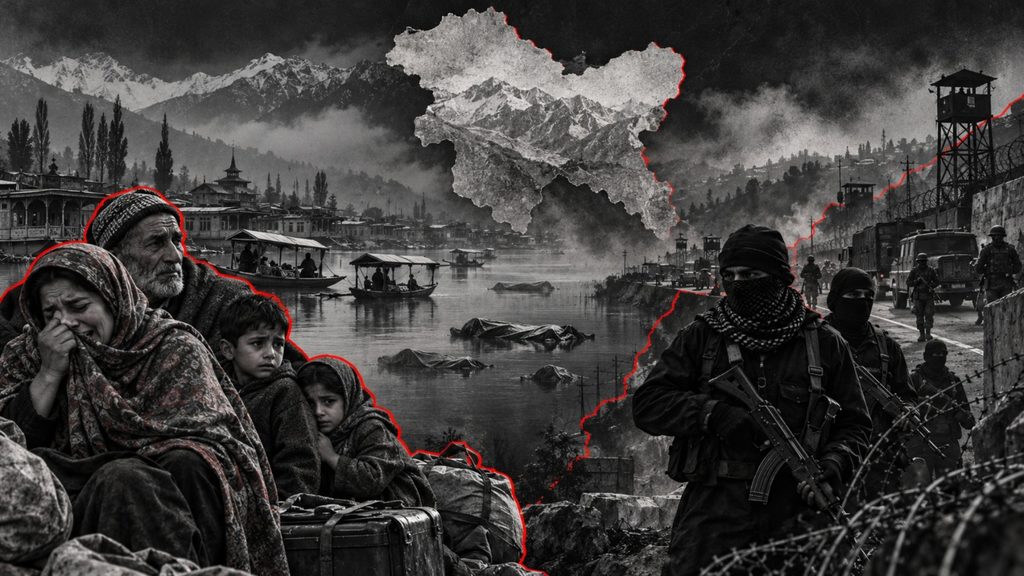
Kashmiri civilians who were labelled as militants by the Indian state.
My father would describe the people in the video as “Pakistanis” who do not belong to Kashmir with an occasional Islamophobic slur used as a punctuation. I knew there was something fundamentally fractured with how my father spoke about someone who’s under a military occupation and how my grandmother, while teaching me the poetry of Lal Ded, would describe her prior Muslim neighbors as “ruffians”.
Even children were not spared of the state-sponsored violence. Tufail Mattoo, a 17-year-old boy full of ambitions, and without ammunition, was killed by a teargas shell fired at his head from a close range by the Indian security forces. He was on his way to his tuition centre, completely unarmed. His murder became the synonym of the blood-covered Kashmir in 2010. The Indian forces’ claim of Tufail’s “mysterious death” was debunked by his autopsy that confirmed he died from a teargas shelling. A huge web of anti-India protests was triggered by the killing of the young martyr, during which 120 people, mostly youth, were killed by Indian forces. Protesting in Kashmir was followed by a chain of the same, systematic ramifications. Thousands, if not a million, lay scattered in the window-less Abu Ghraib of Kashmir.
Papa 2 was the infamous torture centre in Kashmir run by the Indian security forces. Hundreds who were sent to Papa 2 never returned, and those who did had completely lost ahold of their mental state. The detainees were made to look at very bright flash bulbs that would burn the human eye. Sometimes, the Indian forces would push their heads in a ditch filled with a farrago of kerosene oil and red chili powder while they were hanged upside down. Copper wires were tied around their arms and high voltage electric shocks were given making every hair on the body stand up. The worst was yet to come—the sexual torture of the Kashmiri “suspects”. A lot of lives were destroyed by this tactic used by the Indian forces, they would insert a copper wire inside their penises and give electric shocks.20 The Armed Forces Special Powers Act (AFSPA) gave them an odious impunity and the Public Safety Act (PSA) gave them the authority to detain anyone on mere suspicion. Most of the individuals who had been “disappeared” were taken to the torture centre, and if killed, they were labelled as “militants” who were killed in an encounter.21
I look at my mother, and then glance at Parveena Ahangar—often known as the Iron Lady of Kashmir, who established The Association of Parents of Disappeared Persons (APDA) in 1994. Ahangar’s son, Javid Ahmad Ahangar, was “picked up” by the security forces when he was 16 or 17 years old.22 Ever since then, she has been seeking whereabouts of her “disappeared” son and giving hope to other parents that their beloved would return one day. In a documentary, she explicitly states that no “disappeared” person has ever returned and she knows that they have been killed by the Indian state.23 Yet, the hope for seeking justice for those who have been subjected to enforced disappearances was not extinguished. I’ve never been more grateful to be able to hold my mother’s hand.
My personal struggles with recognizing the structural pattern of patriarchy in my family helped me understand the conflict through the lens of a gendered, male-chauvinistic dominance. I would observe the subtle notes of misogyny—my mother rushing to fill the glass with water as my father returned from work. Furthermore, I would observe the fear in her movements masqueraded as the “feminine duty”. I took note of the caste-inbred Hindu arranged marriage culture and how it promises to liberate the women from “physical labour” by offering them unpaid domestic work. This domestic “upliftment” replicates the geopolitical one. In patriarchal rape culture, a woman’s body is denied true autonomy; she must either accept a man’s control under the guise of ‘protection’ or be blamed for the gendered violence she encounters when asserting independence. Kashmiri demands for self-determination are vanquished with the same hypothesis of ‘emancipation’. The fundamental apparatus of imperial control in the region relies on forcing advancement and development onto a population regardless of their approval or autonomy.24 I first came across the alleged Kunan-Poshpora mass-rape through a documentary called the Ocean of Tears (2012) directed by Bilal A Jan.
On February 23, 1991, the Indian army launched a crackdown against the ‘hiding insurgents’. After 9 p.m, the Rajputana Rifles (RR) removed all the males from their houses at gunpoint, after which they were subjected to physical and sexual torture, including electric shocks to the genitalia. While this torture was taking place, other troops broke into homes and allegedly gang-raped 23 women, and are accused of molesting 100 others.
For a moment, I felt as if it was my fault— perhaps if we hadn’t left, the feminized body of the Kashmiri woman would not have been made rapeable. My exile got in the way of ‘their’ exile. Our survival banked on their demonization, and theirs on the resistance. The only ‘Indian’ they’ve seen is the one in uniform, holding guns, and establishing Indian rule in a territory that does not relate to him.
After the 2025 Pahalgam attack, where 25 tourists, mostly Hindus, and a local Kashmiri, were killed by unidentified militants, India witnessed a series of Muslim scapegoating, with documented 180 anti-Muslim hate attacks and at least 64 prominent in-person hate-speech across multiple states in the weeks following the attack.
According to Kashmir Times, “In the aftermath of the Pahalgam terror attack, security forces have launched extensive operations across Kashmir, demolishing about a dozen houses using explosives and conducting widespread searches and detentions. At least 1500 people are said to have been detained. The demolitions have occurred in multiple districts including Pulwama, Shopian, Anantnag, Kupwara, and Bandipora”.The phenomenon of collective punishment has been rooted in the enabling of rendering the Kashmiri body killable, where everyone is a possible suspect, and everyone is a martyr.
Across the table, I see my grandmother sipping Noon Chai, or as the Indian would call it, “Kashmiri pink tea.” Her eyes lacked the vitality they once carried. She had the habit of singing classical Kashmiri poetry out of the blue. I was introduced to Lal Ded, Habba Khatoon, and Rasul Mir by those same vitality-lacking eyes. As her wan, wrinkled fingers placed her cup on the table, she began to weave a Rasul Mir poem in her static voice:
aaz kukilah maedaan durai sui chhe paraan allah hu sui chha lalijmech wala washi durey, myeh chhu moorey lalvun naar
Today, a cuckoo was singing the praise of the Almighty in a field faraway,
Entangled in her distress; I have to nurture the fire of longing.
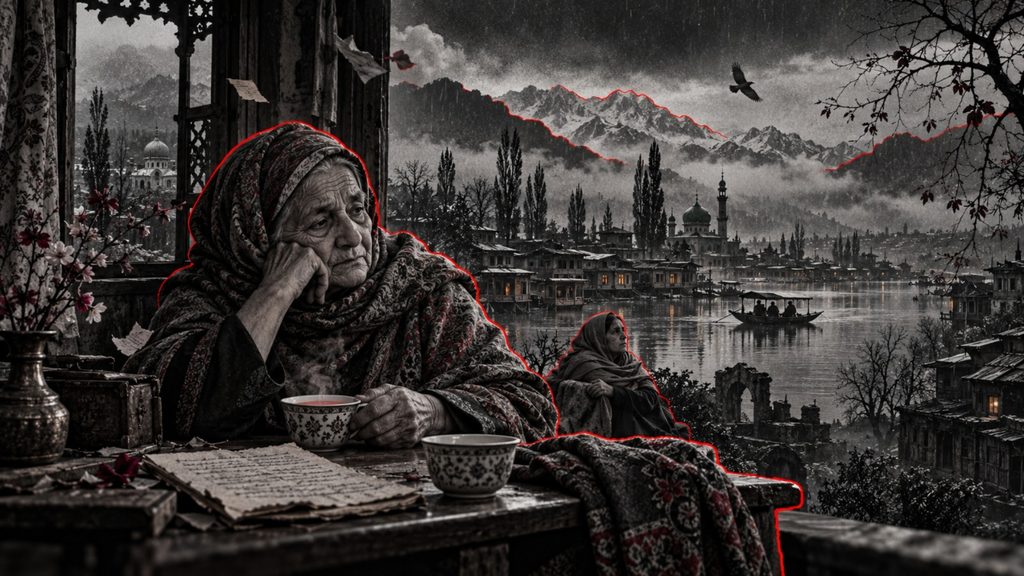
Before I could comprehend the meaning of these verses, I was taken back on her saying the word “Allah”—the Islamic term for God. I was put in a tumultuous state. I knew my grandmother as someone having a conservative, Islamophobic contemplation. Why would she choose to sing a poem with Islamic and sufi imagery? I think it is the culture that ties two communities together, even when one carries prejudices against the other. Perhaps literature and poetry do have the power of uniting people as one, two different tongues carrying the same language.
Kashmir’s air is filled with subjugation, mothers still waiting for their martyred children to return, where laughing is considered a militant thing. There’s nothing left in it, neither for the Pandit, nor for the Muslim. It is a mere dream that it was once. Amidst this predicament of freedom, militancy, martyrdom, exodus, rape, torture, and occupation, I found solace in literature and our heritage as a final hope of uniting the two estranged communities.
“It rains as I write this. Mad heart, be brave”
– Agha Shahid Ali, Kashmiri poet.