



Residents of 3,762 hutments on Central Railway land between Kurla and Trombay will protest at 11 am on 4 November 2026 outside the Bandra Collector Office, weeks after the Bombay High Court cleared the way for their eviction.
The Railway Ghar Sangharsh Samiti, which called the protest, says the homes shelter about 5,000 families, or nearly 25,000 people. Its demand is simple: no demolition until every family is rehoused. The slogan for the day is “Ghooskhor nahi nagrik hain, bheekh nahi ghar ka adhikar chahiye!” (We are citizens, not bribe-givers; we demand our right to housing, not charity).
By the numbers
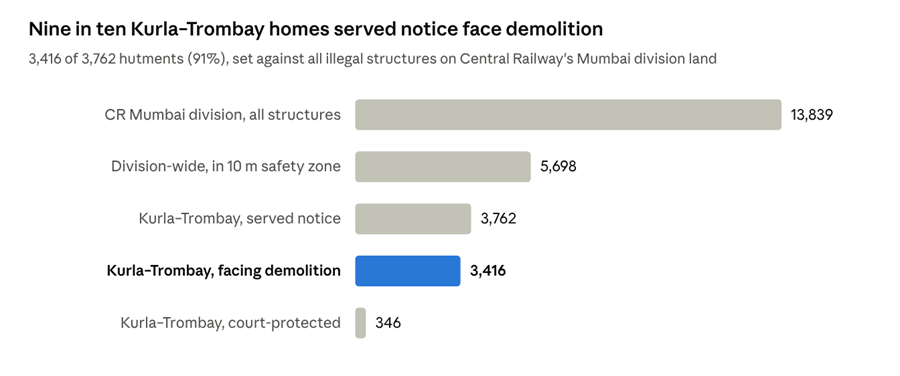
Central Railway figures via Free Press Journal (division-wide counts from an earlier FPJ report; Kurla–Trombay counts, Aug–Oct 2026)
The Kurla–Trombay hutments are about a quarter of the 13,839 illegal structures on Central Railway’s Mumbai division land. Only 346 households have court stays. By the Samiti’s count the rest house about 5,000 families and 25,000 people, roughly seven per home.
Why the Railways wants the land
Central Railway says the strip is needed for safety and for the long-delayed 5th and 6th suburban lines between CSMT and Kurla, part of MUTP-II (FPJ, Feb 2026). The project also aims to run more trains, raise tracks above flood levels and cut overcrowding.
- Land at stake: the 3,762 tenements cover roughly 9,000 sq m along the Kurla–Trombay line (Mumbai Live).
- Safety zone: the High Court found the huts sit inside the 10-metre buffer beside the tracks, which it said both blocks railway work and endangers residents (FPJ, Oct 2026).
- Cost of delay: the wider 5th/6th line upgrade, worth about Rs 2,500 crore, has been held up by settlements along the tracks; the Railways has no rehabilitation policy of its own and relies on the state to resettle people (Swarajya, citing Hindustan Times).
How it got here
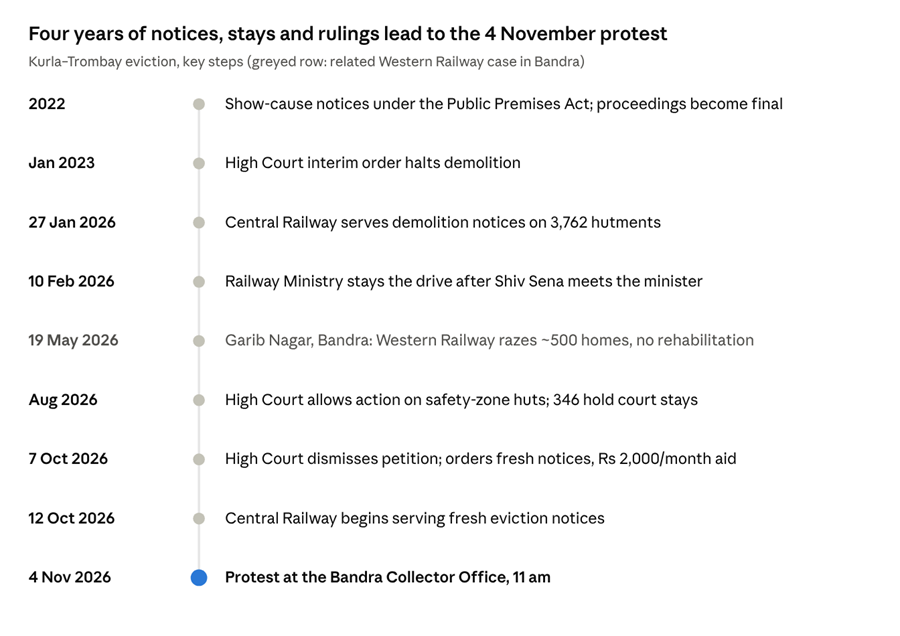
Kurla–Trombay eviction timeline · 2022 to Nov 2026, compiled from news reports (not to scale)
The legal case was settled in the Railways’ favour in 2022; since then, stays have come from interim orders and political pressure. The October ruling removed the last legal hurdle, which is why residents are now turning to the Collector.
The residents’ case
The Samiti rejects the word “encroacher”. It argues the Railways acquired this land from Indians under British rule to serve colonial interests, and that the Indian state, which inherited it, now calls citizens living on it illegal. “No city, no state should drive its workers to homelessness,” its press note says.
Those living on the land, it says, are the people who run Mumbai: domestic workers, sanitation workers, construction labourers, clerks, auto and cab drivers, and gig workers. Their wages cannot buy formal housing in one of the world’s costliest cities, so they built homes informally. Some houses are over 50 years old and hold three generations. The Samiti also points to the Centre’s unmet promise of Housing for All by 2022.
Its demands:
- Stop all eviction and demolition drives on railway land between Kurla and Trombay now.
- No demolition until residents get adequate housing and full rehabilitation.
- A comprehensive Central housing policy covering all central land, including railway property.
- Rehabilitation within 3–5 km of the present settlements, so families keep their jobs and schools.
- The Collector, whom court orders make responsible, must ensure every affected resident is rehabilitated before any demolition.
On that last point the High Court agrees only in part. It ordered the Suburban Collector to record every family’s identity before demolition, and the Collector and SRA to explore housing under schemes such as PMAY within six months. But it also ruled that evicted residents cannot insist on rehousing at the same spot (FPJ, Oct 2026).
The bigger picture
Kurla–Trombay is one front in a citywide push to clear railway land for new lines, and the first test of how the courts’ rehabilitation conditions work in practice.
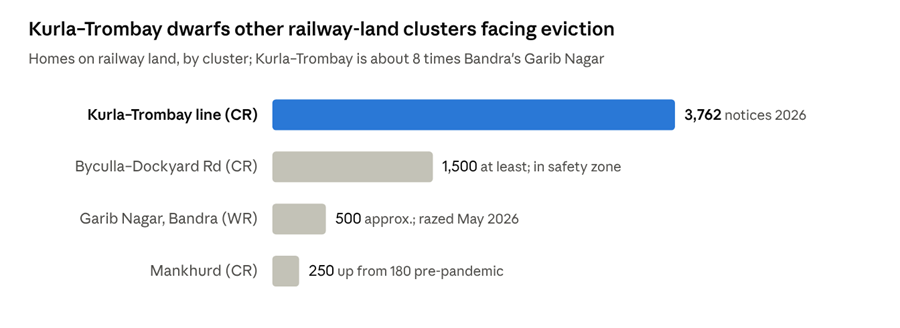
Free Press Journal, Land Conflict Watch, Swarajya/Hindustan Times; counts as reported, different dates
- Half the city lives informally. About 6.5 million people, roughly 55% of Mumbai, live in slums (FPJ).
- Railway land is shrinking as a refuge. Satellite data show slum area within 100 m of rail lines fell 11.5% between 2005 and 2022 (ghar.tv). Yet in Mankhurd, huts on railway land grew from 180 to 250 despite notices in 2022 and 2024.
- The Garib Nagar precedent. In May 2026 Western Railway cleared about 500 structures on land worth nearly Rs 600 crore near Bandra East, amid clashes (The Pioneer). The site was walled off and the Railways said encroachers could not be rehabilitated (Land Conflict Watch).
- A long-running housing fight. Groups such as Ghar Bachao Ghar Banao Andolan have contested slum demolitions in eastern suburbs like Mankhurd and Mandala for two decades.
What happens next
Central Railway said it would start serving fresh notices in the week of 12 October. Under the court’s order, families who have not left once the notice period ends can be evicted with police protection.
- Notice period is unclear. FPJ reports the court set 30 days; Mumbai Live reports seven days. Residents should check the notice they receive.
- Money on offer: Rs 2,000 a month for six months per demolished structure, shared between the Railways and the state. That totals Rs 12,000 per structure over six months.
- Housing is not guaranteed. The court asked only that options be explored within six months, and only for eligible families. At Bandra’s Garib Nagar, the Railways said it could not rehabilitate encroachers at all.
- Politics can still intervene. A February stay came after a ministerial meeting, not a court order.
Open questions: how many of the 346 court-protected households keep their protection after the October ruling, and who counts as “eligible” for PMAY or SRA housing.


