



At around 11:00 am, hours before the lunch rush hits the market on Sangam Vihar’s Mangal Bazar road, a quiet line begins to form near the Delhi Development Authority (DDA) park. Construction workers, e-rickshaw drivers, and auto mechanics with grease still stuck under their nails – all patiently wait for the Atal Canteen to open for lunch.
Inside the canteen, large steel vessels filled with rajma are kept behind the token counter. And the smell of Aloo ki Sabzi (potato curry/veggies) fills in the air, and the rice plates move swiftly across the counter. For the price of a small Parle-G biscuit packet – ₹5, a full meal is served at the Atal Canteen
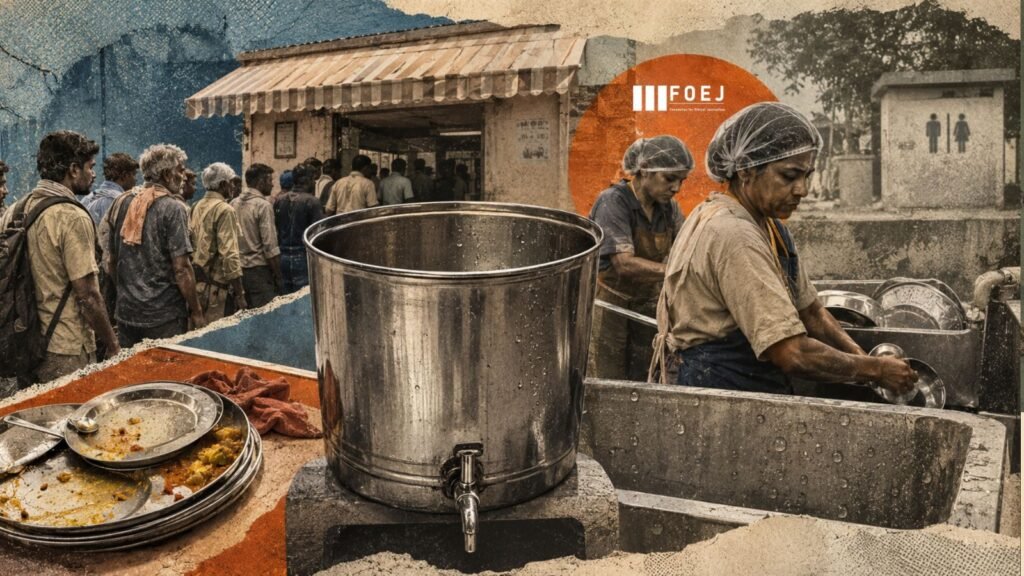
Last year on December 25, Delhi government inaugurated 45 Atal Canteens, marking the 101st birth anniversary of former prime minister Atal Bihari Vajpayee, with a plan to expand the network of 100 canteens in the upcoming days from the initial budget of 100 crore for its operations.
Delhi Urban Shelter Improvement Board (DUSIB) manages these canteens in Delhi. Each Canteen is designed to serve approximately 1000 meals per day, providing affordable and nutritious food to residents of JJ clusters, workers, and daily wage earners for ₹5. The plate typically includes roti, rice, seasonal vegetable, and pickle, ensuring basic nutritional needs
The canteens operate daily, offering food twice a day – lunch from 10:30 am to 02:00 pm and dinner from 6:00 pm to 9:30 pm.
Beneficiaries welcome the initiative
Jeevan Das, 56, an e-rickshaw driver, often visits the Atal Canteen located near the fish market in South-East Delhi’s Kalkaji for his afternoon meal. Das welcomes the initiative, saying that the initiative has brought a sense of relief for people like him who often spend a good amount of money for their food.
“I am extremely happy with the kind of service being provided. The government is doing a great job by providing a hearty meal at such an affordable price” he said.
He further added, “I am not only getting a filling meal, but also able to save some money.”
Das used to have his meal at a nearby hotel before the canteen opened, where each meal cost him between ₹50 and ₹70.
Satish Kumar, 25, another visitor, is a gig worker working in the Sheikh Sarai area. He visits the canteen near Jagdamba Camp, Sheikh Sarai phase 1, every night for dinner.
“I have been working in this area for the last two months. It’s been six months since the canteen opened, and I started eating here since then,” he said. “The food is good and it fills my stomach. At this price, what more can one ask for?”
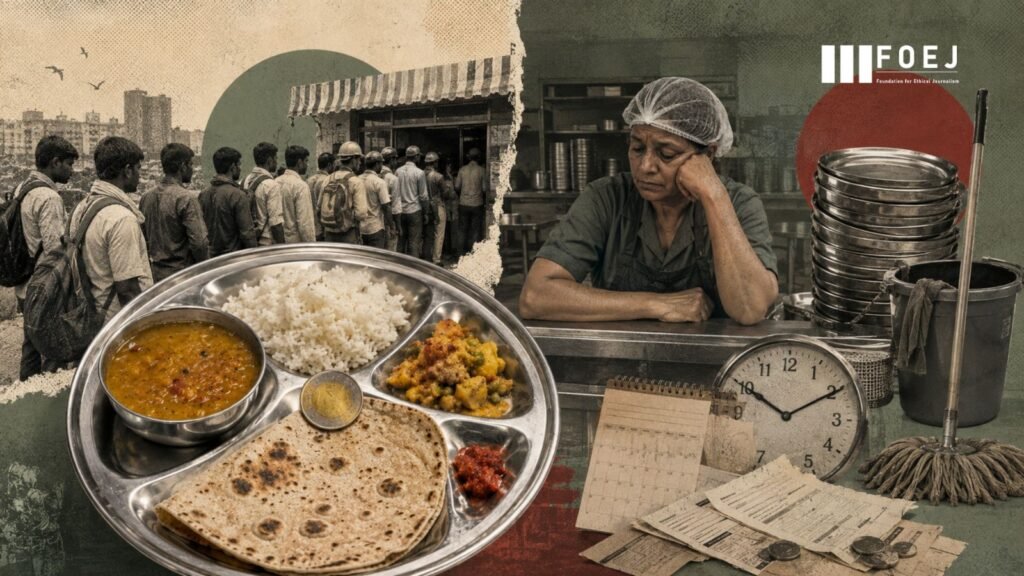
The initiative appears to be benefiting people like Kumar and Das, catering to the section of underprivileged and working class. For many, from daily-wage earners to gig workers, the canteens offer not only affordable meals but also a sense of relief amid rising living costs.
Most visitors praised the initiative, but some pointed out the area of concern. Sunil Kumar, a construction worker and a regular visitor at the canteen in Kalkaji, pointed out that the billing and token generation system at the canteen was flawed. He alleged that he was overcharged at the billing counter.
“I paid ₹10 for my meal ten days ago, one of the staff members at the billing counter charged me more than the government-prescribed price,” alleged Sunil.
Delayed salaries with Zero Week Offs
While the staff at Atal Canteens, serves thousands of plates every single day, helping in the canteen’s operations, and providing a sense of relief to many struggling families. But their own challenges/struggles largely go unnoticed. Working seven days without a weekly off and that too with the burden of delayed salaries. The staff said that it has become extremely difficult for them to work under such conditions. Delayed salaries and absence of weekly offs, both have placed financial and physical strain/burden on the staff.
Poonam Devi,30, who joined the canteen on Magal Bazar Road around 2 months ago said that managing daily expenses has become a new headache for her. She works as a cleaner and earns around Rs 8000 monthly, which she claims gets delayed every month. Her shift starts before the other staff members. She reaches the canteen in the morning at 10:00 and leaves at 03:00 in the afternoon, and comes back at 05:30 for her evening shift and stays till late night 10:30. She lives in a rented room in Sangam Vihar along with her family of four members, the room costs her Rs 2500 monthly. Her husband is a daily wage laborer.
She said, “I only make Rs 8000 monthly after working 30 days a month, my salary is often delayed. I get it after 50 days, ideally it should be given in 30 days, which is absolutely nothing in today’s time. Nearly half of my salary goes to rent, saving is like a dream for families like us. If I fall sick and do not go to work, my salary will be cut, which is something I can’t afford.”
According to her, the staff members at the Atal Canteens continue to face such issues because of lack of job opportunities elsewhere. “We all are working here so that we can run our households, that’s the only reason why we are working under such challenging situations,” Devi added.
Another employee, Ruchi Rajput, who has been working at Kalkaji canteen since it opened. Ruchi started working at the canteen after her husband moved to the village, following her father-in-law’s death. She explains that this is the first time that she has moved out of her house to make money.
“I have been working at this canteen for past six months now, and I am making
Rs 12000 monthly, there is no PF (Provident Funds), no ESI and no other social benefits schemes for the employees, if I take leave for even a single day my salary gets deducted,” says Ruchi. She recalls that when she had to visit her father-in-law before his death, she had to quit her employment for a month, leading to loss of income.
According to staff members, the salaries vary widely and arbitrarily, while the person collecting the token earns between Rs 15000 to Rs 16000, staff who serve food make Rs 12000, and the cleaner earns between Rs 6000 to Rs 8000 monthly. All these wages fall below Delhi’s revised minimum wages, which came into effect on April 1, 2025: Rs.18,456 for unskilled work, Rs.20,371 for semi-skilled, and Rs.22,411 for skilled.
The staff of multiple canteens said that the canteens do not close on Sundays and not even on the national holidays, which is simply a violation of the law.
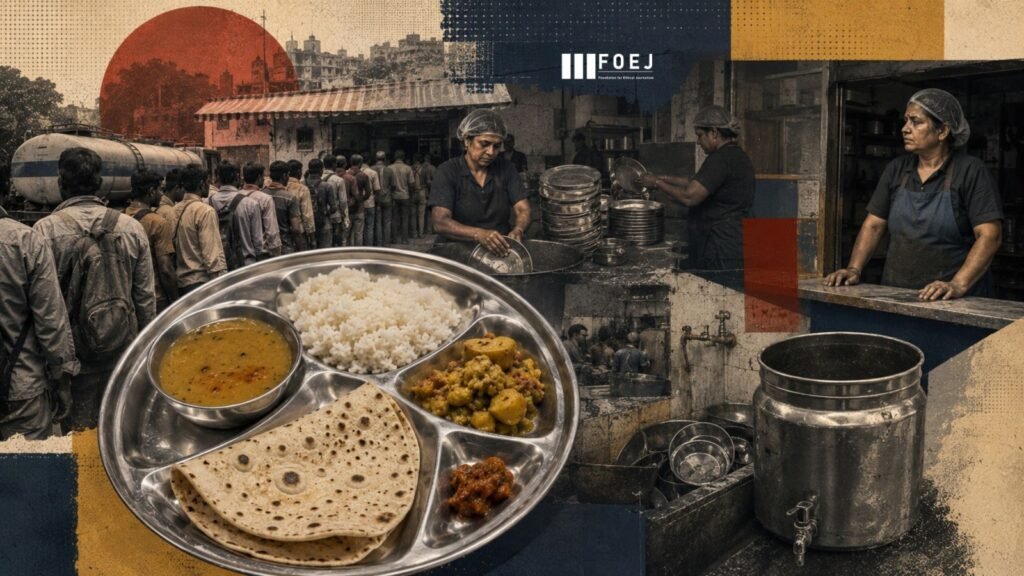
Section 26 of the Code on Occupational Safety, Health and Working Condition (OSHWC), 2020 which governs weekly and compensatory holidays. As per the rule, no worker is permitted to work more than six days in a week and requires compensatory holidays within two months for any weekly holiday a worker is denied.
Canteen Lacks Clean Drinking Water
Even after six months of operations, the canteens continue to lack proper drinking water arrangements. Visits to the facilities in Sangam Vihar and near Jagdamba Camp found no provision for potable water on the premises. As a result, visitors are either purchasing water bottles from nearby shops, often paying double the cost of their subsidised meal or carrying bottles from their working sites.
“Everything else is fine, but there is no drinking water at the canteen even after months of opening. The authorities/government has installed several cooling zones at multiple locations, offering cold drinking water to people, but they have not installed a single water cooler inside the canteen. Water is needed after the meal,” said Sabir Ahmed, a regular visitor.
“Now I will have to spend ₹10 to ₹20 to buy a water bottle, which is more than what I paid for my meal,” he added.
Though a temporary water arrangement has been made at the canteen near Kalkaji fish market. RO water is being supplied by the vendor through 20- litre water cans, as claimed by the staff.
“We have placed a temporary drinking water setup inside the canteen, visitors can drink water after their meal,” said Ruchi, a staff member.
However, several visitors raised concerns about both the placement and quality of the water being supplied.
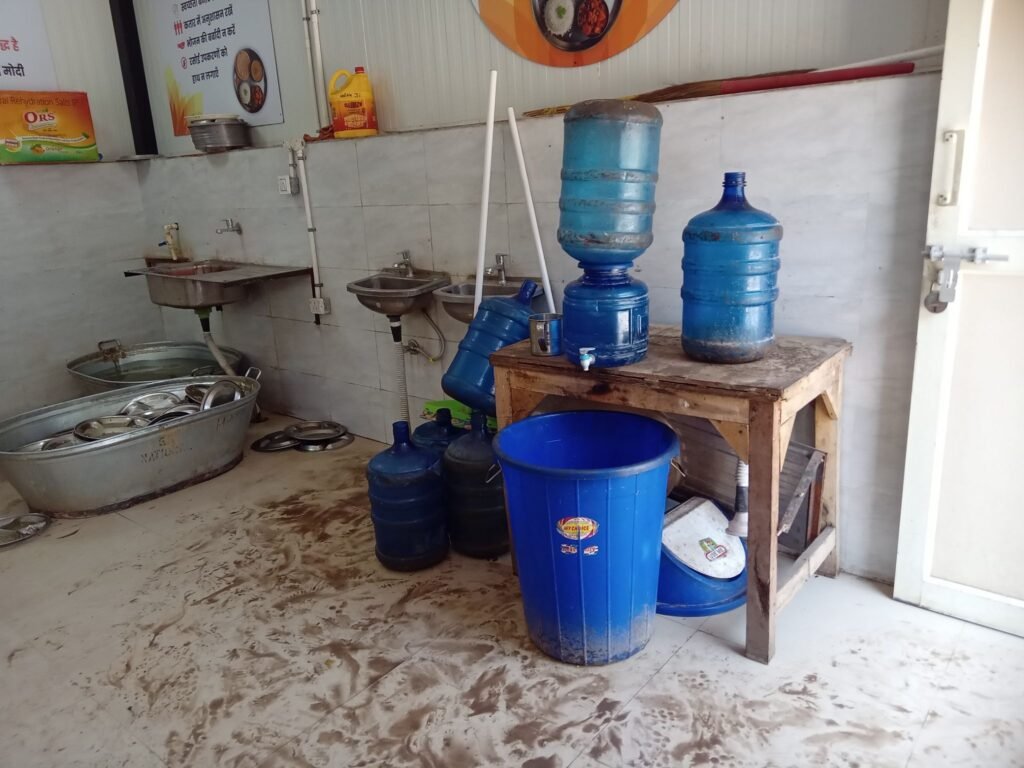
Sushila Devi, 45, who works as a domestic help in DDA flats in Kalkaji, said she comes to the canteen every day for lunch. “The food is fine, but the water is not good – it tastes salty and water cans are always dirty, the placement of cans also creates problems for people, water spills onto the floor making it slippery, increasing the risk of accidents.”
“Drinking water should be clean,” she added.
No washroom for Staff
The staff at the Atal Canteen, continue to work behind the counters for long hours without access to proper washroom facilities/toilets. The employees at the visited canteens said that they are forced to rely on the nearby public toilets, which are 10 to 15 minutes walk away from their workplace.
According to the staff members, the absence of basic sanitation facilities on the premises has made the daily operations inconvenient and at times uncomfortable. They said that the lack of accessible toilets poses challenges particularly during the rush hour, when leaving the canteen can disrupt the workflow.
“There is no washroom at the canteen as of now. The nearest public toilet is a 10-minute walk away, and another is about 15 to 20 minutes from here. During rush hours, it’s difficult to step away. By the time I return, a long queue has already formed,” said Ruchi Rajput, 47, a staff member.
“At present, there is no washroom at the canteen. There are two public toilets nearby – one is about 10 minutes walk away and another is about 20 minutes away. During the rush hours, it becomes difficult to step away from work. By the time I return, a long queue has already formed,” said Ruchi Rajput, a staff member at the canteen.
She further said that she somehow manages it during the day but it becomes difficult for her to use the toilet at night. According to her, one of the public toilets can only be reached after passing a liquor shop, which makes her uncomfortable and unsafe at times.
“During the day, I somehow manage. But in the evening, it becomes very difficult to use the nearby toilet because there is a liquor shop on the way, it makes me feel unsafe,”she added.
The lack of washroom access also raises concerns about the workplace standards, especially in food service settings, where hygiene is seen as a critical factor.
The Staff of Atal Canteen at the Sangam Vihar, are relying on the washroom inside the police station adjacent to the facility since its operations.
Poonam Devi, 30, who has been working at the canteen for the past two months said, “We currently are using the toilet inside the Sangam Vihar Police Station adjacent to the canteen. We have raised the issue with our seniors, and they say work is underway, soon we will have an attached washroom.”
No proper water supply
The Atal Canteens not only lack the basic sanitation facilities on its premises but also face an inadequate water supply for daily operations such as dishwashing and cleaning. Staff members said that since the start of summer the irregular water supply has added to operational challenges, occasionally forcing temporary canteen closures.
Most of the visited canteens depend on water tankers for their daily needs. Delays or disruptions in the supply often result in unwashed utensils and unclean floors, making it difficult for the staff to continue operations.
According to the staff members, water is supplied by the Delhi Jal Board (DJB) through tankers at the canteen on Mangal Bazar Road, that arrive once a day.
“DJB supplies water to the canteen, but we don’t have a sufficient storage capacity at the canteen. We only have one tank, which is around 700 litres, and that is not enough for our requirements. We either need additional storage tanks or a proper 24-hour pipeline water connection, ” said a staff member.
Another employee, who spoke on the condition of anonymity said, “ A couple of months ago, we had to keep the canteen closed for a day, because there was no water to clean the dishes and floor, as the supply was disrupted.”
Hygiene issues, long queues, and food shortage
Ground visits to multiple Atal Canteens revealed that while the initiative has been successful in attracting high footfall, basic standards of hygiene and crowd management remain a challenge. During the peak meal hours, overcrowding and inadequate cleanliness were evident, highlighting gaps that need improvement.
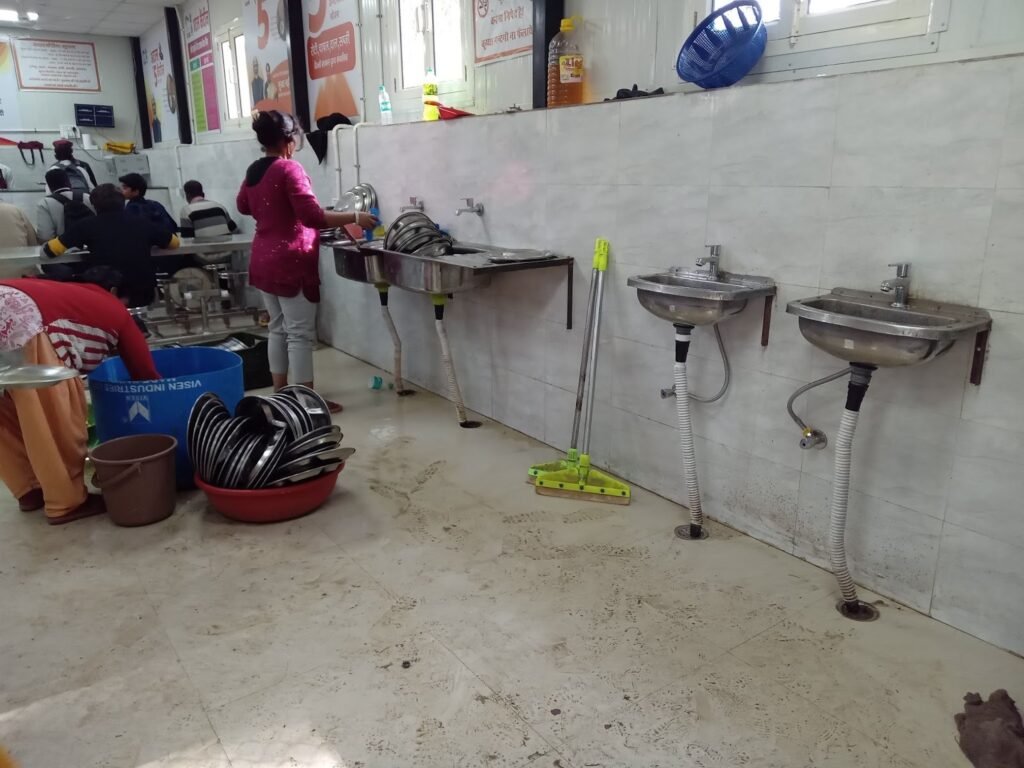
During the visit staff members of Atal Canteens on Mangal Bazar Road and near Jagdamba Camp, were seen serving the meals without gloves and food cap. The floor was wet and unclean, and the placement of the washbasin and dishwashing area inside the canteen raised hygiene concerns among visitors.
“It does not feel good/right to me, when the dishes are being washed at the same place where people are eating their meals. Water often spills onto the floor, making it slippery, increasing the risk of someone slipping,” said Prakash Kumar, a visitor.
During peak footfall hours long queues are formed, adding pressure on the staff members to manage the crowd and frustration among visitors.
“I almost waited for 30 minutes in the queue to get the meal. Even after that long wait, there was hardly any seating available. The space is not sufficient for the number of people coming here for the subsidised food. More tables and seating arrangements should be added,” said Pankaj Kumar, a visitor.
“We are a team of five members,” said Sunita Singh, a staff member. “One manages the token counter, three serves the food, and one handles cleaning and washing utensils. It becomes difficult for us to manage the crowd during peak hours. We do our work and manage the crowd at the same time, there should be an additional member/person to manage the crowd.”
“People often start arguing over their position in line, and we have to intervene and resolve it,” she added.
Sushil Kumar, 18, who came to Delhi from UP’s Gorakhpur along with his four friends for the physical test at Board Security Force Camp on Bangal Bazar road, heard about the canteen and decided to give it a try, but did not get the meal.
“I reached the canteen at around 1:30 pm with my friends, by the time we reached the food was almost over, only I could manage to get some rice, which was not enough to fulfil my hunger,” Kumar said.
A Plate and History
Delhi’s experiment with subsidised cooked food is not an innovation. It finds its roots in Tamil Nadu’s model of Amma Canteen. In February 2013, the AIADMK government in Tamil Nadu under then Chief Minister J. Jayalalithaa launched Amma Unavagams (Mother Canteen), with the aim to provide hygienic, low-cost meals to the poor and working class. Municipal run canteens sold idlis for Rs 1 and pongal and a variety of rice for Rs 5.
In 2017, Arvind Kejriwal led Aam Aadmi Party government borrowed the idea and launched its first and only canteen under the name Aam Aadmi Canteens at Delhi’s Lok Nayak Jai Prakash Narayan Hospital, promising meals at around Rs 10.
Later on, in December 2020, the former BJP Member of Parliament Gautam Gambhir launched the first Jan Rasoi, a community kitchen in East Delhi’s Gandhi Nagar. The kitchen offered cooked food for just Rs 1 during lunch hours.
Union Development Minister Ashish Sood was contacted via email and called for comment but did not respond.