



The Mecca Joint Defence Agreement was signed on August 7, 2026 between Saudi Crown Prince Mohammed bin Salman, Turkish President Recep Tayyip Erdoğan and Pakistani Prime Minister Shehbaz Sharif. This pact is given the face of an “Islamic NATO” by the regional media. It is bound by the principle of collective defence which is similar to the NATO’s Article 5. This states that an attack on any one of the states shall be seen as an attack on all. However, an objective strategic analysis suggests that rather than a hard military alliance, the agreement is simply a political and transactional security insurance policy. The agreement arose from changing geopolitical alignments rather than a convergence of ideologies -proximity born not only from mutual vulnerabilities but also the need to retain them. As such, its underlying importance does not merely relate to the collective military capabilities of its three signatories but instead can be attributed more broadly to the strategic logic that has emerged amongst these states and brought them together at a time of increasing uncertainty in their immediate security contexts.
The context for understanding the Mecca Agreement cannot be divorced from the geopolitical reality of where and when it occurred. American partners in the region have grown increasingly aware of the dangers of overreliance on one foreign protector as a result of decades of seesawing US foreign policy towards West-Asia and perceptions in Washington that strategic attention was pivoting away from it towards East Asia. In particular, Saudi Arabia has also increasingly realised that it needs to have a varied security portfolio while developing domestic defence capabilities. This calculation has been underpinned by experiences of regional conflicts. However, the larger confrontation between the United States, Israel and Iran combined with deadly strikes by non-state actors and ongoing instability throughout the region have underscored vulnerabilities of Saudi critical infrastructure, especially energy. Meanwhile, the agreement shows how political realism has slowly won out over more recent diplomatic rifts. Tensions that have shaped Saudi-Turkish relations after the murder of Jamal Khashoggi in 2018 have increasingly been placed in the backseat to economic and strategic interests.
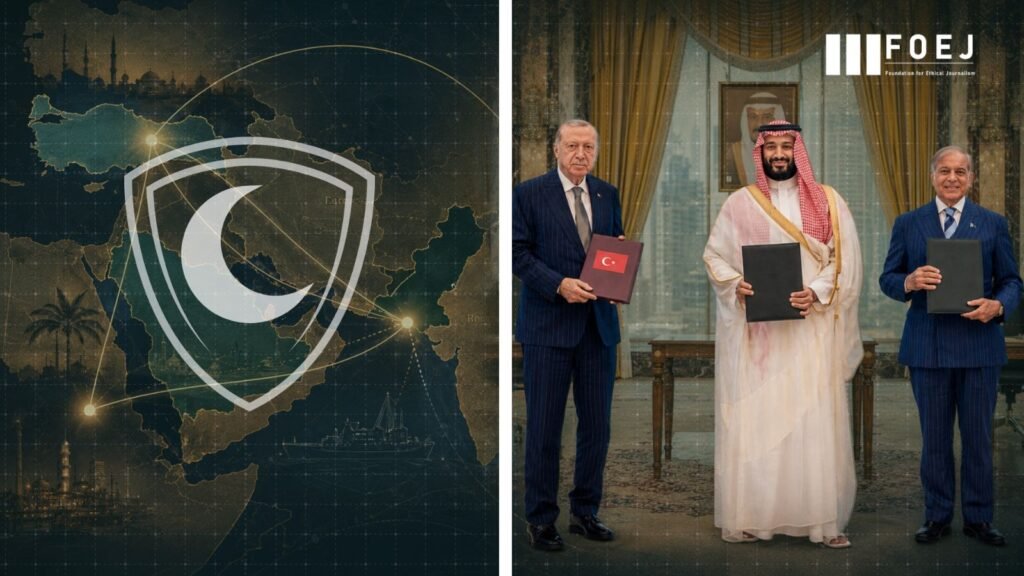
The Mecca Agreement gets its strength not from pooling together the resources of all three states but from their individual capabilities. Saudi Arabia carries handsome financial resources along with a major strategic foothold in energy markets. Such an economic strength lays the foundation for massive defence procurement and industrial investment. On the other hand, Türkiye is going to act as a provider for advanced defence-industrial bases because it has become world’s 11th largest arms exporter with exports hitting $10 billion in 2025 which is driven by local production of combat drones, naval platforms etc. Lastly, Pakistan becomes an asset-provider by having a battle-tested military and nuclear-weapon status. A combination of these capacities and capabilities of all three-states could be formidable prima facie. This potential complementarity may be more significant than a merely symbolic thought of an alliance against the own ideological context as a religious identity.
However, the structural audit reveals significant functional differences amidst the belligerent headlines in some quarters that refer to the Mecca Pact as ‘NATO-like’. This might appear like a very narrow range at face value. The premise of collective defence is based upon long-held tenets of the UN Charter regarding the inalienable right to self-defence by States that stop short at practical elements like defence-industrial cooperation, intelligence sharing, training and joint exercises. Focusing on defence-industrial localisation is particularly important because it could in effect help Saudi Arabia consolidate its own military-production capabilities while becoming more dependent on Turkish technology. In the long run such collaboration could build deeper interoperability and ties between the three militaries.
Yet the deal is missing many characteristics that make NATO a unique defence partnership. No permanent military command structure, comparable to NATO’s permanent standing joint army, assigned to a common structure. Also, even for Pakistan mutatis mutandis, there is no formalised nuclear sharing arrangement. Individual member states might therefore retain sovereign discretion in deciding on the scale or nature of their military response during a crisis, so that collective defence provision is not necessarily as clear-cut and straightforward. In fact, this strategic ambiguity might be deliberate because it provides the three states with the benefits of collective deterrence without the full political and military costs entailed in a formal alliance. This exclusionary clause tends to cement this policy: protection is withdrawn if a member acts as principal aggressor on the other side of the conflict or allows any third party over which it has control to conduct offensive strikes from its territory. This prevents one member from intentionally or unintentionally embroiling the others in an unnecessary conflict.
But the emergence of the Mecca Pact challenges neighbouring and world powers to recalculate their strategic equities. Iran is likely to regard the deal with some wariness. The existence of such a voluminous number of aspiring regional powers in one space could arguably be referred to as the preface to the Sunni-centred litmus test for an axis aimed at countering Iranian influence. And here comes a joke with Pakistan. Due to the fact that it shares land border with Iran and overlapping regional interests, Islamabad has remained cautious from getting into any type of direct confrontation with Iran. This suggests that Pakistan will act as a barrier from turning the group into a staunchly anti-Iranian one.
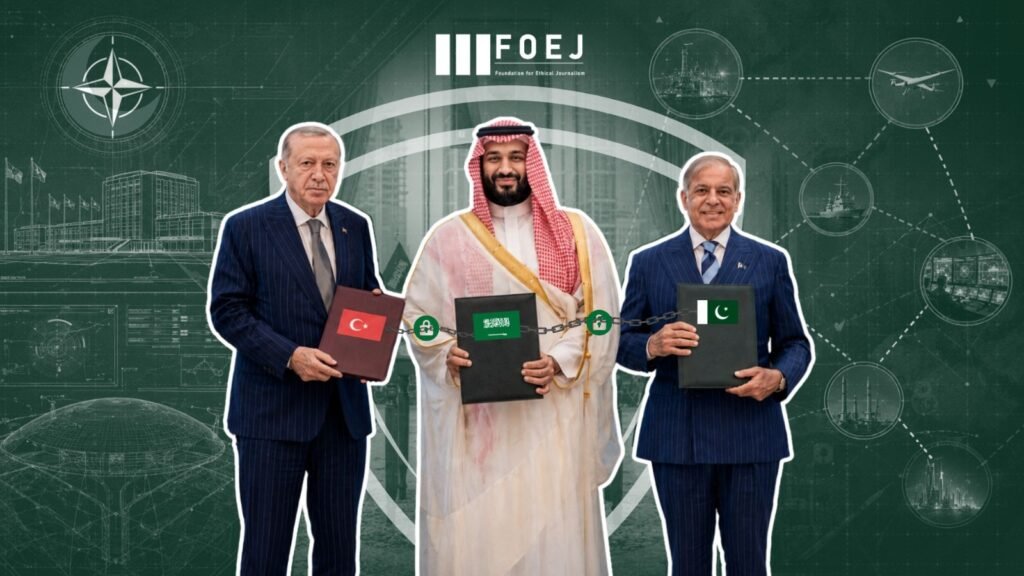
New Delhi is expected to keep following the developments for deeper Turkish-Pakistani defence cooperation owing to two reasons. Firstly, it would be more accessible for Pakistan to acquire sensitive military technologies and secondly, it would give Islamabad more space to take-up the Kashmir issue. However, India’s collaboration with Saudi Arabia in economic and energy domain acts as a crucial balancing. As, Riyadh is quite interested in clubbing together with New Delhi, it is less likely that this pact would be morphed unto another weapon of South Asian strategic competition
The Mecca Joint Defence Agreement pact does not have centralised power in any form. This should not be compared to the NATO- a formal alliance with institutional architecture and legal commitments. However, the deeper significance is different as the formulation results in a more multipolar security order of West Asia. Saudi Arabia, Türkiye and Pakistan together combine financial, technological and military resources which will help them in exerting power against any uncertainties. The agreement does not translate to a “Sunni-led Islamic NATO” or anything close to it. In fact, it can be seen as a general movement that provides them with strategic autonomy in the region along with transactional partnerships and diversified security arrangements.