



The Paradox of Perception
While international rankings suggest that free speech in India has declined since 2021, a worldwide study finds that Indians believe it has improved. India ranked 24th in free speech out of 33 countries, according to The Future of Free Speech, a U.S.-based think tank.
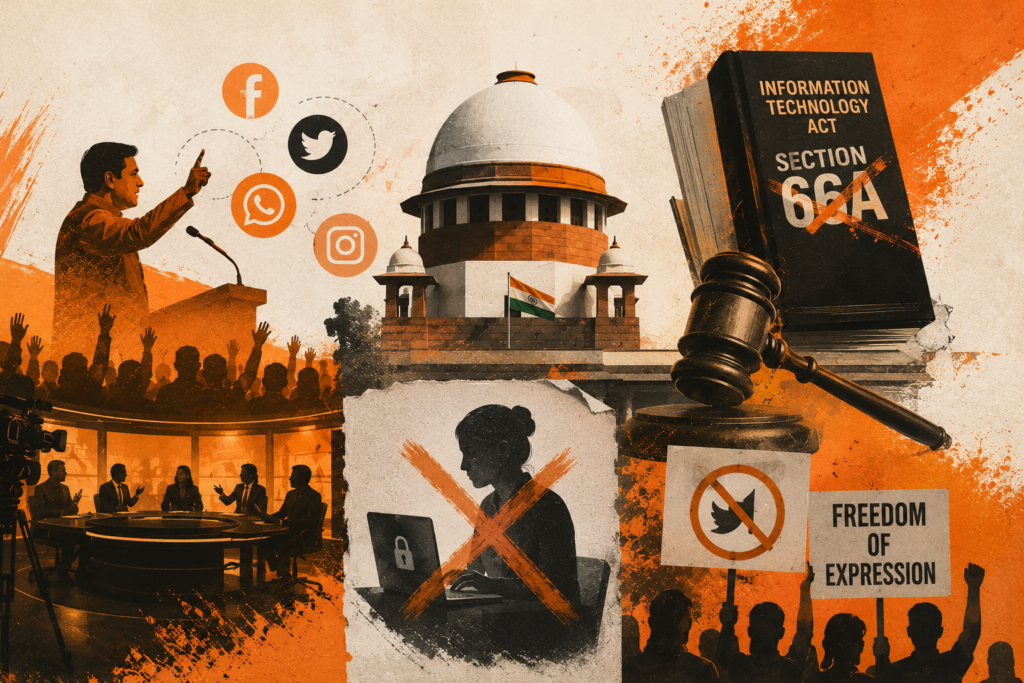
However, 37% of Indian respondents supported the idea that governments should prevent criticism of policies, the highest among all countries surveyed.Recently, the Supreme Court stated that hate speech wrecks “the moral fabric of India”. This brings up a fundamental constitutional question: how should a democracy protect free speech while preventing speech that openly targets communities?
What the Law Permits: The Shreya Singhal Standard
The speeches made by political personalities, television debate programs, messages forwarded via WhatsApp, and social media are some of the sources that influence public opinion. However, legal actions against hate speech continue to be initiated across the political spectrum. This distinction was clearly highlighted by the Indian Supreme Court in Shreya Singhal v. Union of India. When the Court struck down the provision under Section 66A of the Information Technology Act, it held that vague terms such as “offensive” and “annoying” conferred excessive powers on authorities and created a chilling effect on free speech. Emphasising that criticism and dissent are essential to democracy, the Court reaffirmed that freedom of expression extends fully to digital platforms and social media. The only instances when the right to freedom of expression can be curbed are when speech incites violence or disturbance to public order. Even after the Shreya Singhal ruling, concerns regarding online censorship persist in India due to the adoption of new digital regulations.
Hate Speech as Lived Reality
Beyond these procedural debates, courts have repeatedly acknowledged that hate speech is not a theoretical problem but a lived reality. In recent observations, the Supreme Court noted that divisive speeches undermine fraternity, which is one of the Constitution’s core values.
The data also reflect this growing concern. A 2025 report by the India Hate Lab documented more than 1,300 hate speech incidents targeting minorities, a noticeable increase from previous years. While such reports are debated politically, they indicate a larger social reality: inflammatory rhetoric is no longer confined to the margins.
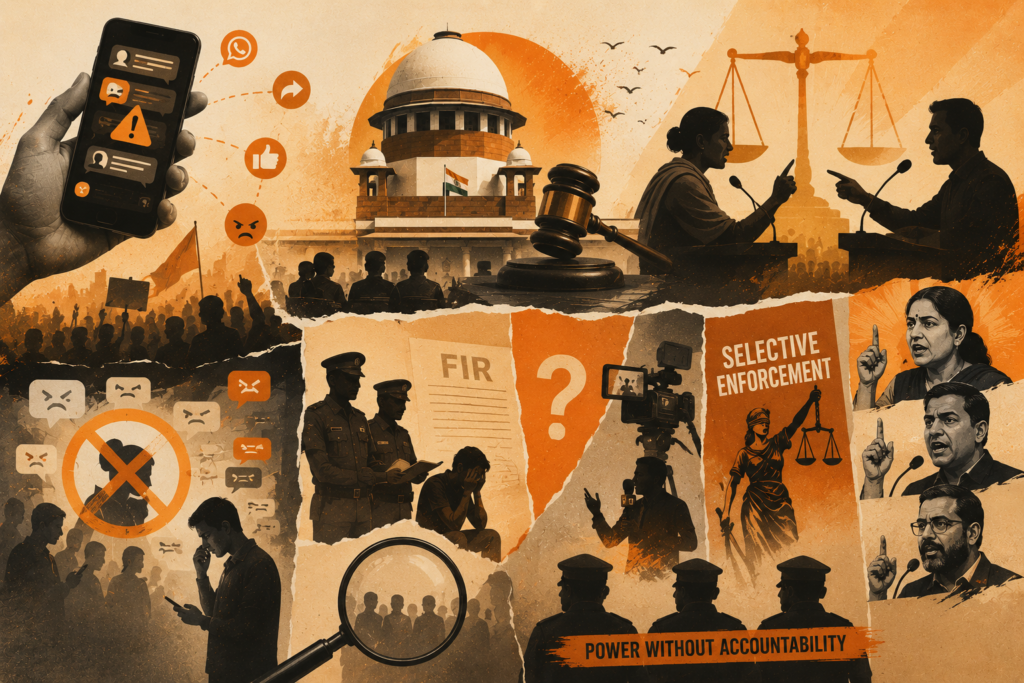
Social media has further intensified this problem. Most Indians with smartphones have seen this kind of message, often from someone they know and trust, which portrays minorities as threats. These messages often avoid openly abusive language, making regulation more difficult while deepening social hostility.
As recent debates around the NCRB’s delayed and incomplete crime data show, statistics alone cannot measure justice.
When hate crimes are underreported and weak prosecutions disappear behind numerical records, the law risks becoming a tool of control rather than a tool of constitutional accountability. Even the Supreme Court’s own six-year engagement with hate speech litigation, from “Corona Jihad” narratives to Dharam Sansad speeches, reflects the institutional difficulty of balancing free expression with constitutional fraternity. Strong judicial observations have not always translated into consistent enforcement or structural reforms.
Selective Enforcement: Who Gets Prosecuted and Who Does Not
When politically connected figures make inflammatory statements, enforcement either stalls, gets redirected, or disappears. The controversy involving former BJP spokesperson Nupur Sharma further exposed the unequal and politically charged nature of hate speech enforcement in India. While hearing petitions related to multiple FIRs against her, the Supreme Court sharply criticised both her remarks and the television culture that amplified them, observing that her statements had ignited tensions across the country while also questioning the selective inaction of law enforcement authorities.
The debate has intensified further after the Supreme Court redirected petitions against Assam Chief Minister Himanta Biswa Sarma to the Guwahati High Court, while also indicating that several pending hate speech cases may be closed. Together, these developments raise serious constitutional concerns regarding selective enforcement and the growing normalisation of hate speech in public discourse.
This selective enforcement works both ways. Consider the Bombay High Court challenge involving comedian Kunal Kamra and the government’s Sahayog portal, where the petitioners argued that online content regulation mechanisms bypassed the safeguards recognised in the Shreya Singhal judgment. Petitioners described the framework as an “assault on free speech.” Satirical remarks, journalists’ opinions, and students’ statements regularly attract FIRs. Communal speeches that visibly inflame public sentiment frequently do not.
The contrast between these two realities is not incidental. Sharma’s televised remarks, by the Supreme Court’s own assessment, ignited tensions across the country. Kamra’s online satire triggered a government regulatory mechanism that the courts later questioned as bypassing constitutional safeguards. It reveals exactly who the law moves swiftly to protect and who it moves swiftly to silence.
Power Without Accountability
The absence of a clear legal definition of hate speech in India further complicates enforcement. This ambiguity raises a crucial question: should those in positions of power and influence be held to a stricter standard precisely because their words carry greater weight and reach?
Past Supreme Court decisions have made clear that the government cannot be held directly responsible for every statement made by its ministers. Yet the question remains whether public officials, who shape national discourse and command vast audiences, should bear heightened accountability for rhetoric that targets communities or inflames divisions.
What Other Democracies Can Teach India
Different democracies resolve this tension differently. Germany’s NetzDG compels platforms to remove hate speech within 24 hours or face fines up to €50 million, a law shaped directly by its historical experience with unchecked propaganda. The United States takes the opposite position: under the First Amendment and the Brandenburg v. Ohio (1969) standard, even offensive or discriminatory speech is protected unless it constitutes direct incitement to imminent violence. South Africa, perhaps the most instructive comparison for India, prohibits speech that amounts to advocacy of hatred on grounds of race, religion, or ethnicity when it rises to incitement to cause harm, a standard that balances free expression against constitutional equality, much as India’s Article 19(2) attempts to do. The difference is that South Africa applies this framework with greater institutional consistency.
Not a Missing Law but a Missing Will
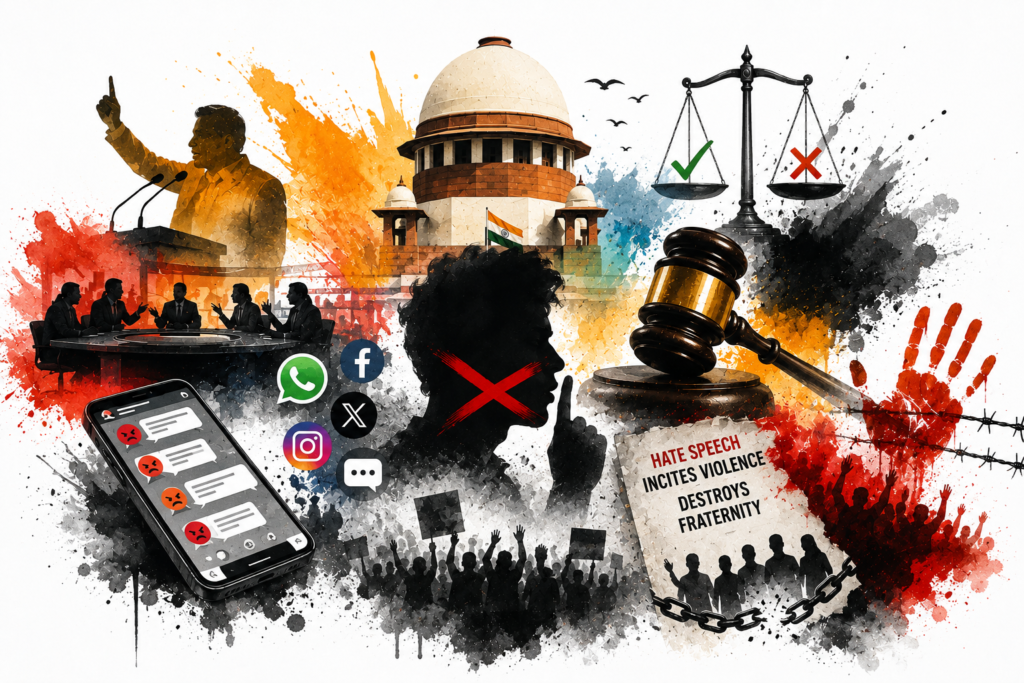
India’s problem, then, is not a missing law but a missing will to enforce the one it already has. That will is tested most plainly by India’s own existing provisions. Sections 153A and 153B of the Indian Penal Code sanction speech linked to communal hostility and incitement, yet both provisions have been invoked more frequently against minorities and dissenters than to political figures whose speeches most clearly inflame communal sentiment. Ultimately, only fair and unwavering enforcement of the law can ensure that legal protections serve their intended purpose for all citizens.
If we look at history, it’s clear that vague restrictions on speech are usually applied first to people with unpopular opinions. Laws against sedition, criminal defamation, and even internet shutdowns have often faced criticism for this very reason. Regulations on hate speech can also become politically selective, depending on what governments decide is “dangerous” as opposed to just “nationalistic” or “cultural.”
That’s why it’s so important for the Supreme Court to draw a clear line between advocacy and incitement. In a democracy, we have to allow sharp criticism, satire, unpopular opinions, and even political speech that some people might find offensive. Democracies aren’t built on keeping everyone comfortable; they’re built on the ability to disagree. But speech that directly calls for violence, demonises whole communities, or creates conditions where certain groups are targeted for harm can’t be defended in the name of liberty.
Free speech is meant to protect people who disagree, not those who use words to intimidate or threaten others. The deeper problem in India is not the absence of laws but their ineffective implementation. India already has multiple legal provisions addressing hate speech under the Indian Penal Code and other statutes. The Supreme Court recently observed that there is “no vacuum” in the law regarding hate speech regulation.
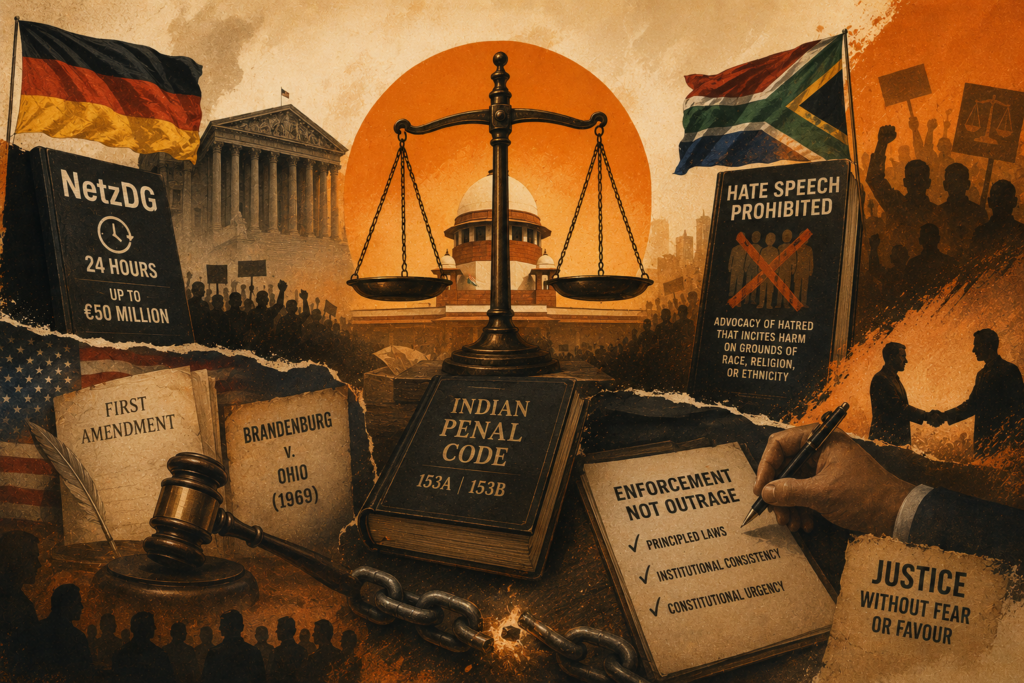
India does not lack laws. What India lacks is the courage to enforce them without fear or favour. The true test of a constitution-based democracy lies in its ability not to suppress disturbing speech, but to distinguish between a comedian who is ridiculing power and a leader who is referring to a community as a danger to the country. Laws that target direct incitement, the dehumanisation of communities, and speech with a demonstrable connection to violence are both constitutional and necessary. India has already made such decisions, and anyone watching can see it.
The real danger lies not only in hate speech itself, but in a system where enforcement increasingly appears selective and politically uneven. If constitutional freedoms are to survive in an increasingly polarised public sphere, India will need more than outrage and prosecution; it will require principled laws, institutional consistency and a judiciary prepared to defend liberty and equality with the same constitutional urgency.