



In the hidden corners of Delhi’s vast sanitation network, where the city’s waste disappears out of sight, workers like Sudhir and Jitender carry out some of the city’s most dangerous and invisible labour. Their work keeps the city running, its drains flowing and neighbourhoods livable, yet their own lives largely remain invisible.
Through their stories a deeper picture emerges, one shaped by caste, marked by economic hardship, and hazardous working conditions, but also by a quiet determination to build a different future for their children.
Sudhir, who goes by his first name, has been working as a contractual sewer cleaning worker with the Delhi Jal Board (DJB) for nearly a decade now. Sudhir originally comes from a small town in Haryana, was born and raised in Delhi after his family migrated from there. He, along with his father, is the primary breadwinner, supporting a family of seven, his wife, children, and sisters.
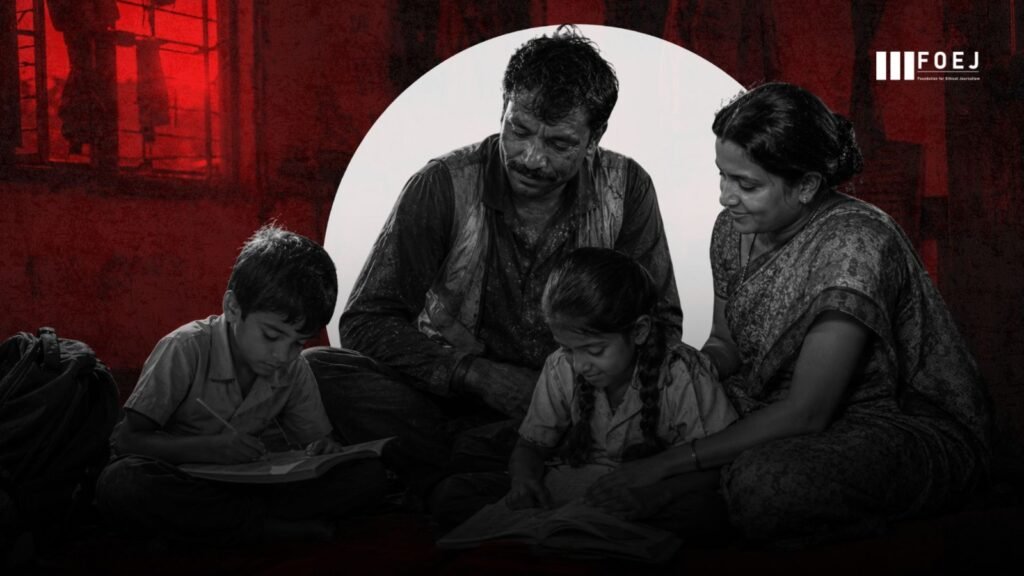
Sudhir expresses his frustration over the working conditions of the sanitation workers like him. He says “despite years of service, little has changed on the ground. We still go down in the sewer to clean it, without proper safety gears.”
“Contractor and the board (DJB), both only care about getting the work done; no one looks at our salary or our rights,” he says.
As a child, Sudhir believed in equality, but during his schooling days when he first became aware of the caste divisions in society and learned that he belonged to the Valmiki community, a Dalit community, historically pushed into sanitation work for generations.
What he studied in the school books slowly became the reality, a reality that often reveals itself in small but painful moments of everyday life.
Sudhir recalls an incident, asking for drinking water while working in a residential colony. “People often make us wait; sometimes they simply deny or give us water in a separate container (a plastic glass or plastic bottles), and that makes me feel sad and isolated,” he says. In one instance, after using a utensil, the woman asked him to take it away with him instead of returning it.
“Brother, you keep it. We don’t want it back,” said the lady.
Such memories linger not just as an insult, but as a reminder of how deeply caste-based discrimination continues to shape daily interactions.
Jiterder, another sanitation worker, a self-employed sewer and septic tank cleaner, shares the similarities. Supports a family of six, including three children aged 6, 9, and 11. Jitender came to Delhi around 10 years ago in search of employment. He now lives in a rented house that costs him ₹10,000 monthly.
He says that he tried many other jobs before coming to this occupation, but low income and uncertainty in other sectors led him to this work.
“I tried many other jobs,” he says, “but the salaries were too low.”
He eventually returned to sanitation work, not out of choice, but necessity.
There is a determination in Jitender’s voice when he talks about his children’s education. He recently shifted them from a government school to a private school in the hope of giving them better opportunities.
“I want my children to study and be educated so they never ever have to do this kind of work,” he says.
Sudhir also shares the same dream for his children. For both men, education represents a possible way to escape the occupation that has trapped generations before them
But survival in the present remains uncertain.
Sudhir talks about a system marked by both a lack of accountability and delayed wages. “While the official salary for semi-skilled labourers in Delhi is said to be around ₹20,000, he says, “he has never received that amount.”
“I have never seen those ₹20,000 till today,” he says. According to him, most sanitation workers receive salaries between ₹14,000 and ₹16,000, and that is often after long delays.
“We often receive the salary after the 15th of the month, and when we ask the contractor for our wages, it feels like we are asking for a loan from him.”
This delay affects every aspect of life. Families often rely on borrowed money for their basic expenses like groceries, rent, children’ s school fees, and daily expenses, expecting to repay debts after salaries arrive. When wages are delayed, debt accumulates further.
Sudhir claims that contractual workers receive no provident fund (PF), employee state insurance (ESI), and other medical benefits.
“We are only getting exploited by the employer,” he adds.
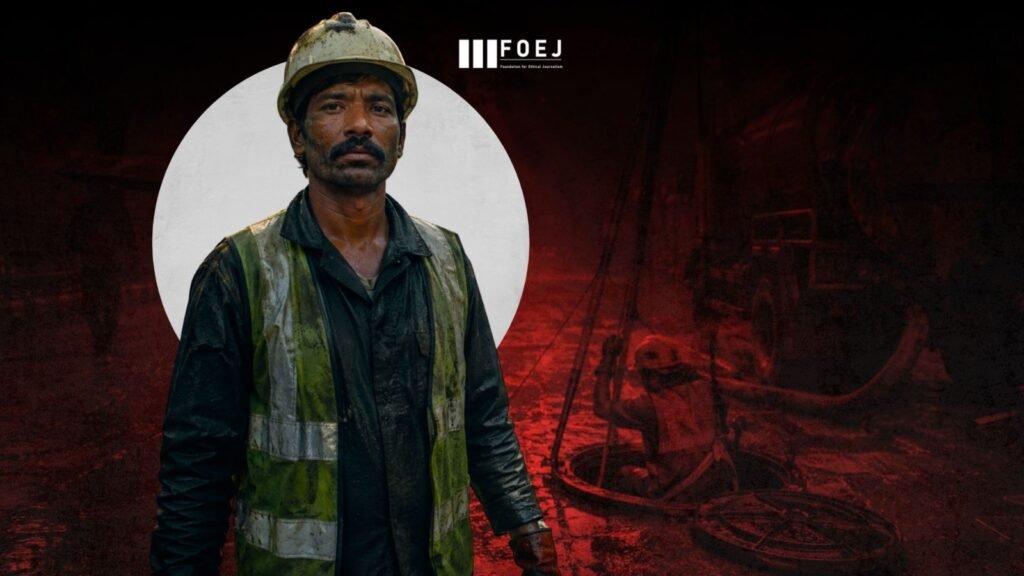
Being an independent worker, Jiterder largely faces similar challenges, his income is irregular, and the cost of safety equipment falls entirely on him.
“The full safety kit is around ₹16,500, and if we plan to buy it, we will have to buy it ourselves,” says Jitender. “Sometimes we rent the equipment from the market for ₹1,000 a day, which can be more than what we earn.”
Jiterder says that for many workers, bearing the cost of safety equipment is unaffordable, forcing them to enter sewers and septic tanks without proper protective gear and exposing them to serious risks.
The dangers are constant for workers like Sudhir and Jitender.
Sudhir recalls injuring his right hand while closing a heavy sewer lid, an accident which left him with a plaster cast for weeks, but he soon returned to the work because missing work meant losing income, something he couldn’t afford.
Jitender describes the risks inside the septic tanks and sewer lines. He says that the sewers and septic tanks are often filled with toxic gases, which cause long-term respiratory problems, infections, skin diseases, and even deaths.
“This work is very dangerous,” he says. “There is infection, dirt, and many health risks, I would not recommend this work to anyone.”
Although manual entry into sewers and septic tanks is legally prohibited under the Prohibition of Employment as Manual Scavengers and their Rehabilitation Act, 2013, both workers admit that emergencies often leave them with little choice.
“I know entering into sewers is legally prohibited but I still go inside when there is no other option left, if I don’t do it then how will I survive?” asks Jitender.
Before entering a sewer, workers often rely on makeshift precautions in the absence of proper equipment and safety systems which includes leaving the sewer lid open for some time to allow the toxic gases to escape and lowering a lit candle into the sewer to check the oxygen availability inside.
Training, the workers say, is almost nonexistent.
“We have not received any formal training, we learn cleaning the sewer by watching our senior workers,” tells Sudhir.
Despite the hazardous nature of the work, the sanitation workers receive no structured training, regular health check-ups, or long-term medical monitoring
The exclusion often continues outside the workplace.
Jitender describes that exclusion often reveals itself even outside the workplace, he recalls such memories/incidents where people made him sit outside their homes, handing water in disposable plastic glasses separately from others. Such incidents highlight deeply rooted caste based discrimination in the society.
At the same time, he also acknowledges that not everyone behaves this way. “Some people treat us respectfully, they sit, and share their food with us,” says Jitender. But this inconsistency itself becomes a gentle reminder of his social positioning.
The lack of job security creates an additional layer of anxiety for Sudhir. As a contractual labour, he often spends his days worrying about his employment, which according to him can end at any given point of time.
“We are working at the mercy of the board(DJB). If they tell us not to come tomorrow, we can’t do anything.” says Sudhir.
His frustration extends beyond the workplace to the system itself.
“The government has closed its eyes, they don’t want to see our conditions,” he says.
“Sanitation workers keep the city clean, prevent people from diseases, and yet no one cares about us, not even the government.” Sudhir added.
Despite the danger, stigma, and financial instability, both men continue to work because of the lack of opportunities they have. Yet their aspirations go beyond survival. For both men education represents hope, dignity and the possibility of a better future for their children.
Sudhir and Jitender stories are not isolated. There are thousands of sanitation workers across India, many from the Dalit and other marginalized communities, forced to perform hazardous sanitation labour under precarious conditions.
Their conditions reveal a system where essential work is undervalued, leads to discrimination, worker safety is often compromised, and caste continues to shape opportunities and social positioning.
Yet, there is also resilience in these stories, a refusal to accept this reality as permanent, and a determination to ensure that the next generation does not inherit the same occupation.
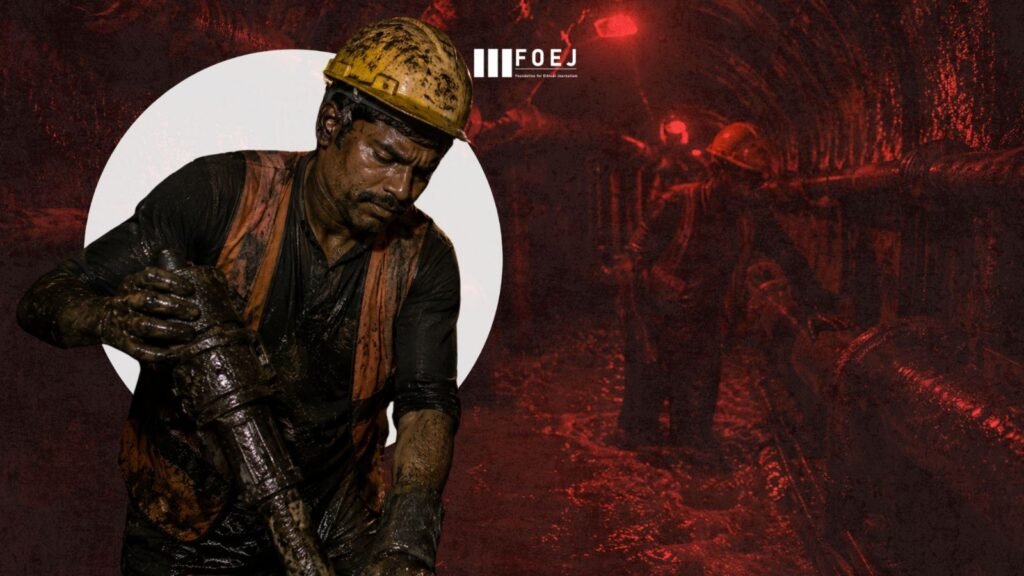
Deaths Between March and May 2026: Data by DASAM
On May 22, Dalit Adivasi Shakti Adhikar Manch (DASAM), organised a press conference, highlighting the continued dangers faced by the sanitation workers across the country.
According to DASAM, at least 36 sanitation workers died between March and May 2026 while cleaning sewers, septic tanks, drains, and sewage chambers in the country. The deaths were reported from different parts of the country such as Bihar, Chhattisgarh, Madhya Pradesh, Delhi, Haryana, Rajasthan, Uttar Pradesh, Maharashtra, and Tamil Nadu.
Most of the deceased workers reportedly were employed through informal contractor systems, and belonged to Valmiki communities, other marginalized caste groups, and migrant labour backgrounds.
Speakers at the event alleged that workers were sent into toxic confined spaces without proper safety, oxygen cylinders, gas detectors, and harnesses.
They also highlighted the recurring “rescue-chain” pattern, which was one of the reasons for deaths. Rescue-chain can be understood as, where workers attempting to save collapsed colleagues also lost their lives due to toxic gas exposure.
Dharmendra Bhati, president of the Municipal Workers Lal Jhanda Union affiliated with CITU, said that the growing dependence of the Delhi Jal Board on the contractual sanitation labour has worsened the condition for the workers.
He said that “the government claims that the cleaning has been mechanised, but the ground reality is completely different, claiming that workers still enter hazardous spaces without proper protection.”
Bhati further alleged that the number of permanent labourers in the sanitation department in DJB has sharply declined over the years, while contractual workers continue to work without minimum wages, regular health check-ups, safety gears, and social security benefits.
The event took place amid concerns over the implementation of the Prohibition of Employment as Manual Scavengers and their Rehabilitation Act, 2013, which bans hazardous manual scavenging practices in the country.
In January last year, the Supreme Court directed authorities to eliminate manual scavenging in six metropolitan cities, including Delhi and Mumbai, while criticising the Union government over slow implementation.
The event was also attended by the lawyer and human rights activist, Kawalpreet Kaur. While speaking at the event Kaur described the deaths as “completely unacceptable” despite existing laws and repeated court directions.
She alleged that under the contractual labour system the workers only get exploited, neither civic agencies nor private contractors take responsibility for workers’ safety. Kaur argued that sanitation workers should be recognised as frontline workers and provided permanent employment and living wages.
While speaking at the event, Mohsina Akhter, National Coordinator of DASAM, said that deaths reflect serious concerns at multiple levels, be it “structural caste discrimination, unsafe working conditions, lack of government accountability, and weak implementation of existing laws.”
She also highlighted the serious long-term health risk faced by the sanitation workers, including respiratory illnesses, trauma, and reduced life expectancy.
Government data on deaths linked to hazardous sewer and septic tank cleaning between 2017 and 2026.
On March 17, Minister of State for Social Justice and Empowerment Ramdas Athawale, informed the Lok Sabha that as many as 622 sanitation workers have died due to hazardous cleaning of sewer and septic tanks across India between 2017 and 2026.
In a written reply to a question by Samajwadi Party Member Of Parliament Iqra Choudhary. Athawale, through the state-wise data presented in the Parliament, stated that full compensation was given to 539 families, whereas 25 families have received partial compensation.
As per given data, 52 of the affected families never received any compensation, and six cases were closed without any resolution.
At 86, Uttar Pradesh was among the states that recorded the highest number of fatalities, followed by Maharashtra at 82, Tamil Nadu at 77, Haryana at 76, Gujarat at 73, and Delhi 62.
There is no further information available on how much a family received as compensation
However, independent organisations, such as DASAM reported significantly higher death tolls, highlighting the gap between official records and the ground reality. According to DASAM, 116 workers engaged in manual scavenging had died in 2024, and 158 alone died in 2025.
Athawale also stated that a “fresh survey” that took place under the Prohibition of Employment as Manual Scavengers and Their Rehabilitation Act, 2013, has found “no manual scavengers” in any district across the country and the ministry stated that sanitation is an “occupation-based activity rather than caste-based”
Although, around 58,098 manual scavengers, including 32,473 in Uttar Pradesh, had been identified during the two surveys conducted in 2013 and 2018, he said.