



The nature of human conflict is undergoing a fundamental shift. For centuries, the outcome of battles depended on physical strength, industrial capacity, and the sheer volume of firepower. Today, victory increasingly depends on algorithmic speed, data processing, and autonomous decision-making. We are moving rapidly from the era of conventional, human-directed weaponry into the age of intelligent systems.
Artificial intelligence (AI) has emerged as the defining military technology of the 21st century. It is not merely a new class of weapon, but a foundational capability that magnifies the power of every existing asset, from infantry units to satellite constellations. Recent frictions and proxy confrontations between Western powers and states across West Asia (the Middle East) have served as an active laboratory for these emerging technologies. From the skies over the Levant to the shipping lanes of the Red Sea and Persian Gulf, software-driven warfare is no longer a theoretical concept, it is a daily operational reality.
This article argues that artificial intelligence is fundamentally transforming every stage of modern warfare including intelligence gathering, tactical combat, cyber operations, and information warfare. While these systems offer unprecedented speed and precision, their deployment across the volatile geopolitical fault lines of West Asia and the West accelerates the pace of combat to a degree that challenges human control, raising profound ethical, legal, and strategic dilemmas for the future of global security.
The Evolution of Warfare: From Industrial Age to AI Age
To understand the significance of AI in contemporary conflict, one must look at how military paradigms have shifted over time. Historians often categorize modern conflict into distinct generations, each defined by a technological or organizational revolution.
First-Generation Warfare: Characterized by massed manpower and line-and-column tactics, relying heavily on smoothbore muskets and centralized state control.
Industrial Warfare (Second and Third Generations): The Industrial Revolution introduced massive firepower, rifled artillery, machine guns, and mechanized vehicles. Success required massive industrial output, where nations sought to attrit their enemies through sheer material dominance, culminating in the total wars of the 20th century.
Precision-Guided Weapons & Network-Centric Warfare (Fourth Generation): The late 20th century saw the introduction of microelectronics and lasers, giving rise to precision-guided munitions. This evolved into network-centric warfare during the Gulf War and early 2000s, where data links connected sensors to commanders and shooters, making operations faster and more accurate.
The Arrival of AI-Powered Military Systems: We are now entering an era where networks do not just transmit data they interpret it.
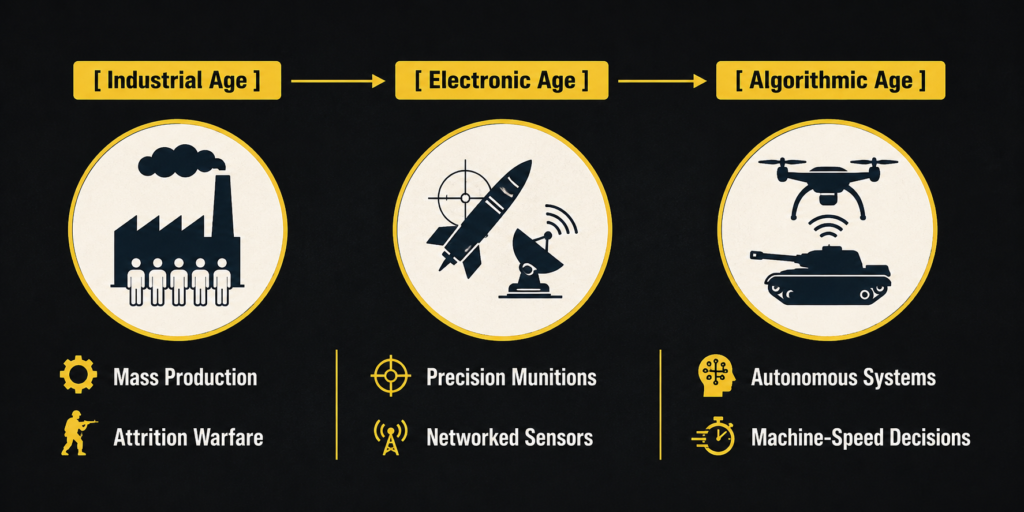
Each past revolution focused on expanding physical reach or accelerating human actions. The AI revolution is different: it targets the cognitive process itself, shrinking the time required to understand, decide, and act down to fractions of a second.
Why AI Has Become a Military Priority
The push to integrate AI into defense frameworks stems from a combination of data saturation and operational necessity. Modern battlefields are awash in information. Satellites, high-altitude drones, ground sensors, and intercepted communications create a massive influx of data that easily overwhelms human analytical teams. AI algorithms excel at sorting through this noise to find meaningful intelligence instantly.
Furthermore, the rise of drone warfare and highly complex cyber threats leaves very little time for traditional human deliberation. When low-cost loitering munitions or hypersonic missiles are inbound, the window to intercept them is measured in seconds. Humans simply cannot process threats or coordinate counter measures fast enough without automated assistance.
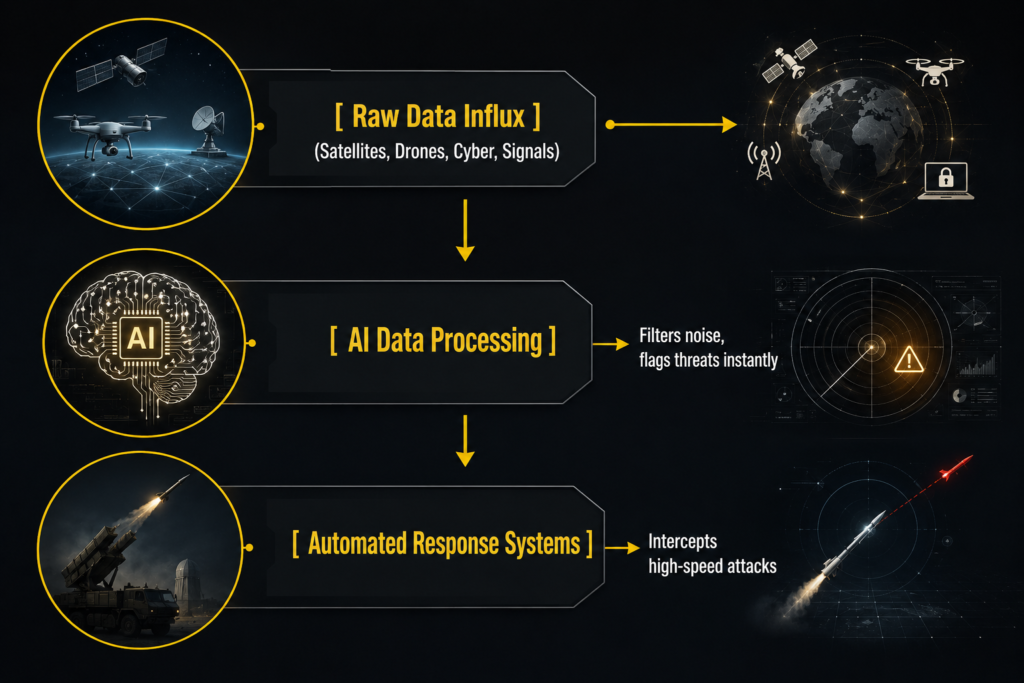
Consequently, an intense algorithmic arms race has developed among major global and regional powers:
The United States and NATO: Focused on maintaining technological superiority through initiatives like the Department of Defense’s Replicator program, aiming to field thousands of cheap, autonomous attritable systems.
China: Pursuing “intelligentized warfare,” heavily investing in AI to offset Western conventional advantages.
Israel:Operating at the cutting edge of battlefield AI integration, using automated target generation and predictive systems in active urban environments.
Iran: Compensating for conventional military limitations by integrating AI into its domestic drone and missile programs, alongside cyber operations.
Russia: Actively testing electronic warfare and autonomous algorithms in regional conflicts to counter Western-supplied precision weapons.
AI in Intelligence, Surveillance, and Reconnaissance (ISR)
Intelligence, Surveillance, and Reconnaissance (ISR) is the area where artificial intelligence has had the most immediate and profound impact. Traditionally, imagery intelligence required teams of human analysts to pore over satellite photos to count tanks or identify new construction. Today, computer vision algorithms scan thousands of square miles of high-resolution satellite imagery in seconds, automatically identifying troop movements, newly dug trenches, missile launch sites, and changes at airbases.
In tactical environments, AI-enabled drones deploy live object recognition and vehicle tracking. By running localized neural networks on small, onboard chips, a drone can track a specific vehicle through dense urban streets or rugged terrain without needing a constant high-bandwidth connection to a human operator.
Signals intelligence (SIGINT) benefits similarly. AI platforms ingest massive volumes of radio interceptions, electronic emissions, and radar signatures. They can map out an adversary’s air defense network or automatically translate and flag specific keywords in encrypted communications.
Crucially, this blends with Open-Source Intelligence (OSINT). Algorithms scrape public social media feeds, commercial satellite images, and uploaded video clips to verify events on the ground, cross-reference coordinates, and assist in automated geolocation.
Regional Context and Deployments
Israel-Gaza and Regional Flashpoints: The Israel Defense Forces (IDF) have utilized advanced AI target-generation systems, such as The Gospel (Habesor) and Lavender. These systems process vast quantities of data from surveillance feeds, phone records, and social media to classify individuals and locations as military targets far faster than human teams can.
Iran-Israel Tension: Western and regional intelligence agencies rely heavily on predictive AI analytics to monitor Iranian missile storage locations and proxy movements across Syria and Iraq, flagging anomalies that suggest an imminent launch.
The Russia-Ukraine War (Comparison): This conflict serves as a massive peer-to-peer baseline, where both sides utilize commercial AI software, like Palantir’s Gotham platform, to fuse satellite data, drone feeds, and commercial imagery into a live digital map of the front lines, directing artillery strikes within minutes of target detection.
AI-Powered Drone Warfare
Unmanned Aerial Vehicles (UAVs) have evolved from remotely piloted surveillance platforms into highly independent, lethal combat systems. The current state of the art spans several categories:
Reconnaissance & Attack Drones:Traditional platforms equipped with AI assistance to simplify piloting and automate sensor targeting.
Loitering Munitions (“Kamikaze” Drones): Systems that fly over a designated area, search for specific radar signatures or vehicle shapes, and dive-bomb the target autonomously once confirmed.
Drone Swarms: Groups of small UAVs that communicate with one another rather than relying individually on a ground control station, adjusting their formation and distribution of tasks dynamically.
The underlying technology relies on autonomous navigation and automated target recognition (ATR). By utilizing edge computing, these drones can navigate via visual terrain mapping even when GPS signals are completely jammed.
This shifts the operational dynamic from human-in-the-loop (where a human must explicitly pull the trigger) to human-on-the-loop (where the system operates autonomously but a human can intervene) and, increasingly, human-out-of-the-loop (completely autonomous execution from launch to strike).
AI and Missile Defense
Modern missile defense is a game of millimeters and milliseconds. When salvos of ballistic missiles, cruise missiles, and low-altitude drones are launched simultaneously, a tactic frequently seen in West Asian escalation cycles, the air defense network faces a data bottleneck.
AI plays a vital role in upgrading these platforms by improving early warning radar processing. It filters out environmental clutter (like birds or weather anomalies) to detect the true thermal and radar signatures of inbound threats. Once detected, predictive algorithms instantly calculate the threat prioritization based on projected impact zones, determining which targets pose the greatest risk to civilian centers or military infrastructure.
The system then automates interceptor allocation, deciding whether a Patriot, David’s Sling, or Iron Dome battery should fire, and at what angle, to achieve a successful interception. By eliminating the delay of manual calculation, AI reduces system response times from minutes to fractions of a second, which is critical for surviving saturation strikes designed to overwhelm air defenses.
AI in Cyber Warfare
The digital domain is an active, ongoing front line between Western nations and West Asian adversaries. Cyber warfare operates at a speed and scale that makes human management impossible without automation.
On the defensive side, AI excels at automated threat hunting and predictive cybersecurity. Instead of waiting for a known virus signature to trigger an alert, machine learning models establish a baseline of normal network behavior. If an authorized user suddenly accesses thousands of sensitive military communication files at 3:00 AM from an unusual IP address, the AI flags and isolates the account instantly, neutralizing the threat before it can spread.
Offensively, AI is used to discover zero-day vulnerabilities (previously unknown software flaws) in adversary systems far faster than human hackers can. It can also generate adaptive malware that mutates its own code to evade detection while spreading through critical infrastructure, government networks, or tactical military communication loops. This continuous, automated fencing matches Western defense networks against sophisticated state-sponsored cyber units from countries like Iran, creating a constant struggle for digital dominance.
Electronic Warfare and AI
Electronic Warfare (EW) centers on controlling the electromagnetic spectrum through radar jamming, signal interception, GPS spoofing, and communications disruption. Historically, EW was a game of pre-programmed frequencies; an engineer built a jammer tuned to a specific enemy radar frequency, and if the enemy changed frequencies, the jammer became useless until reconfigured
AI introduces cognitive electronic warfare. Algorithms monitor the electromagnetic spectrum in real time, sensing when an adversary alters their radar or communications signals. The AI instantly analyzes the new waveform, identifies the pattern, and generates an optimized jamming signal on the fly.
This capability is vital in regions like the eastern Mediterranean and the Persian Gulf, where Western naval assets and regional state actors constantly attempt to blind each other’s sensors and spoof GPS signals to divert drones or commercial shipping.
AI in Battlefield Decision-Making
Beyond sensors and individual weapons, AI is altering command and control through advanced decision-support systems. These platforms act as automated staff officers for military commanders. By processing thousands of disparate inputs including weather data, troop exhaustion levels, ammunition counts, and enemy radio traffic AI systems can suggest optimal military options, predict likely enemy movements, and simulate complex battle scenarios before troops ever cross the line of departure.
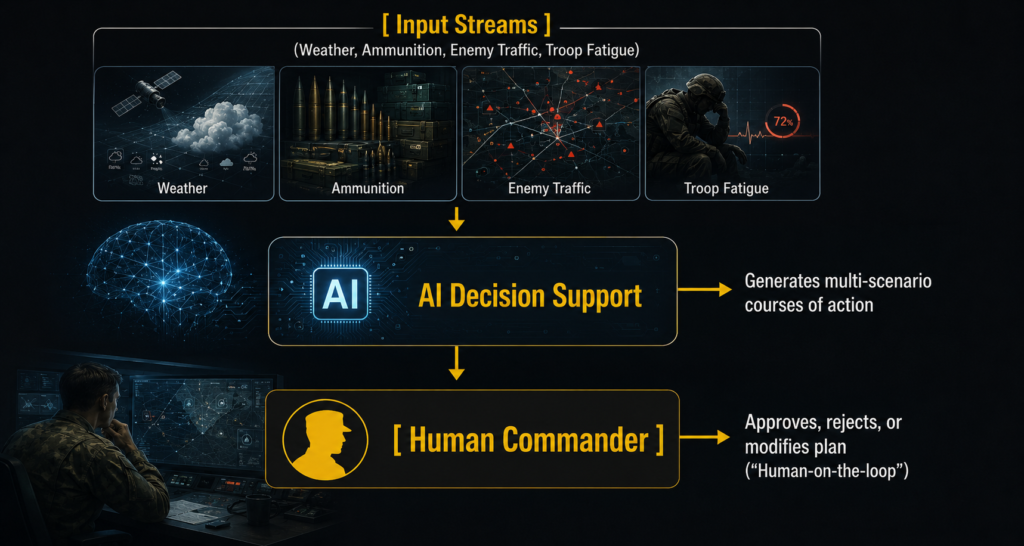
This dynamic preserves the concept of the human-on-the-loop. The AI does not make the final decision to launch an offensive; instead, it presents a curated selection of courses of action, detailing the statistical probability of success and projected casualty rates for each choice. This allows commanders to maintain strategic oversight while making decisions at a speed that can unbalance an adversary’s command structure.
Information Warfare, Propaganda, and Deepfakes
Modern conflicts are fought as much in the information space as they are on physical battlefields. AI has weaponized information by making the creation and distribution of propaganda cheap, fast, and highly targeted.
Deepfake Videos & Synthetic Voices: Generatively creating highly realistic videos or audio clips of political leaders or military commanders surrendering, ordering a retreat, or claiming false civilian massacres to induce panic.
AI-Generated News & Imagery: Fabricating hyper-realistic images of battlefield atrocities or fake news articles styled to look like legitimate journalism, distributed across the web within minutes of an incident.
Social Media Botnets: Large, coordinated networks of automated accounts driven by LLMs (Large Language Models) that engage in real-time arguments, boost specific divisive narratives, and shape public opinion in Western or West Asian societies.
This psychological warfare aims to erode public morale, manipulate international opinion, and create confusion on the battlefield. During rapid escalations in West Asia, these tools are deployed to muddy the waters, making real-time verification of strikes, casualties, and operational outcomes incredibly difficult for journalists and governments alike.
AI in Military Logistics and Medical Support
While combat systems attract the most attention, AI has quietly revolutionized the tail end of military operations: logistics and medical support. Armies run on supplies, and AI-driven supply chain optimization ensures that fuel, food, and ammunition arrive exactly when needed.
Through predictive maintenance, sensors embedded within combat vehicles, fighter jets, and naval vessels monitor component wear. Algorithms predict exactly when an engine part or rotor blade will fail, alerting logistics units to ship a replacement before the equipment breaks down in the field.
In field medicine, AI assists in medical triage and resource allocation during mass casualty events. Algorithms process patient vitals to prioritize treatment order, while autonomous casualty evacuation systems including unmanned ground vehicles and specialized medical transport drones are being developed to extract wounded soldiers from active hot zones without risking additional aircrews.
Ethical and Legal Challenges
The rapid integration of AI into warfare creates significant ethical dilemmas and challenges traditional international frameworks. The primary question centers on autonomy: Should a machine ever be permitted to make life-or-death decisions without human intervention
If an autonomous drone strikes a civilian structure due to an algorithmic error, establishing accountability becomes difficult. Is the liability held by the field commander who deployed it, the software engineers who trained the neural network, or the state that authorized its acquisition? Furthermore, AI models suffer from algorithmic bias and data poisoning.
If a target-generation algorithm is trained on flawed intelligence data, it may repeatedly misclassify civilians as active combatants, leading to systematic violations of International Humanitarian Law (IHL) and the Geneva Conventions, which demand distinction, proportionality, and military necessity.
While bodies like the United Nations actively debate the regulation of Lethal Autonomous Weapons Systems (LAWS), major global powers remain hesitant to sign binding treaties that might restrict their technological edge, leading to a complex regulatory landscape.
The AI Arms Race: West Asia and Western Countries
The geopolitical friction between the West and West Asia has accelerated a highly competitive defense tech ecosystem. Rather than relying solely on legacy defense contractors, states are building partnerships with agile defense tech startups and investing heavily in domestic research.
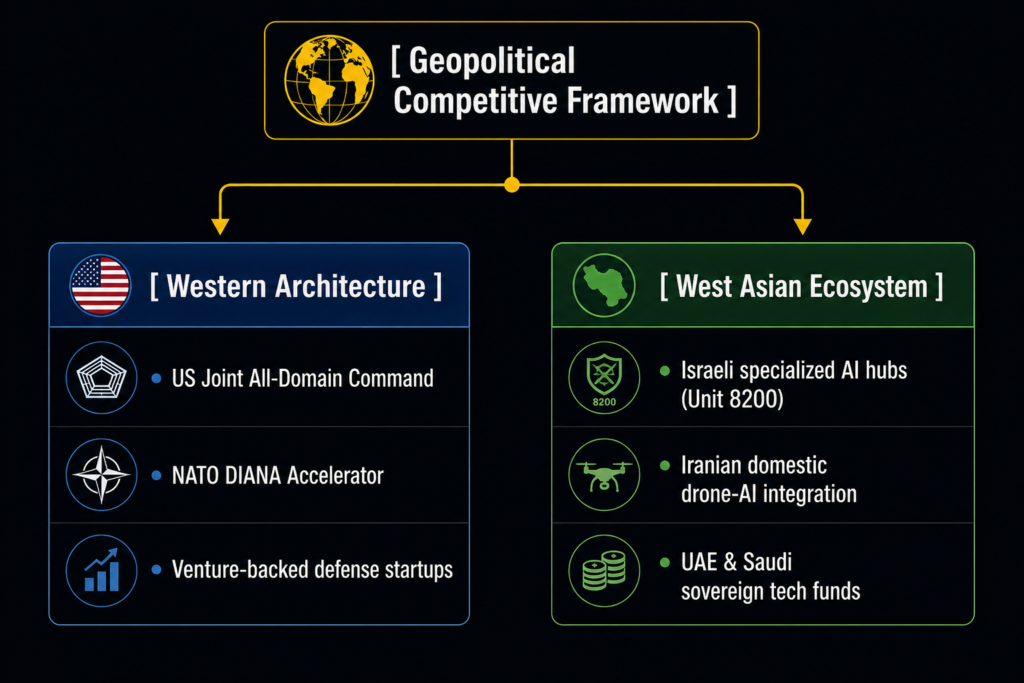
The United States leads the Western architecture, focusing on standardizing data across all military branches through its Joint All-Domain Command and Control (JADC2) initiative, supported by NATO’s DIANA accelerator program.
In West Asia, Israel operates as a critical hub, closely fusing its elite military intelligence units (like Unit 8200) with a robust commercial tech sector to deploy field-tested software. Iran, facing strict international sanctions, focuses on cost-efficient innovation, optimizing asymmetric warfare capabilities by embedding basic AI guidance packages into mass-produced drone fleets.
Concurrently, wealthy Gulf states like the United Arab Emirates and Saudi Arabia are establishing sovereign AI ministries and multi-billion-dollar investment funds, intending to transition from technology importers to self-sufficient developers of defense technologies.
The Future of AI Warfare
Over the next decade, the integration of AI will move past isolated systems and toward fully unified, multi-domain operations. We will see the deployment of fully autonomous drone swarms capable of overwhelming air defenses through coordinated, algorithmic pack tactics.
In the air and at sea, human-machine teaming will become standard practice. AI-driven fighter aircraft, operating alongside manned platforms as “loyal wingmen,” will take on high-risk suppression missions.
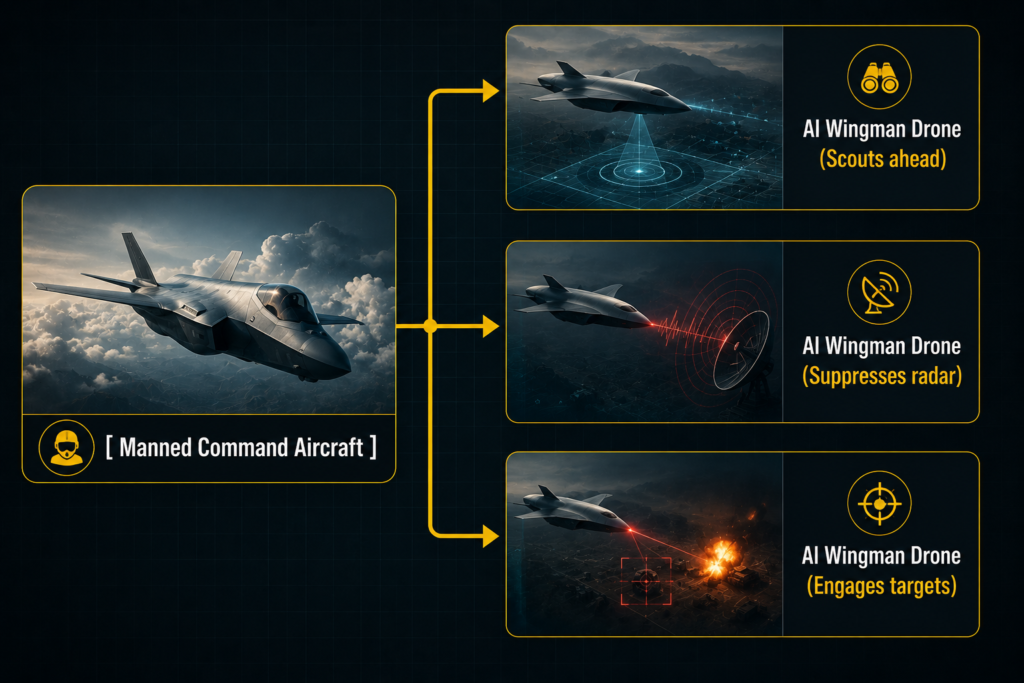
Similarly, robotic ground vehicles and autonomous submarines will patrol hazardous border zones and strategic maritime chokepoints, such as the Strait of Hormuz.
As quantum computing matures, Quantum AI will likely decipher current encryption methods instantly while optimizing battlefield logistics at scales unimaginable today. The future battlefield will be faster, less transparent, and increasingly managed by software running at speeds that push human cognition to its limits.
Artificial intelligence has transitioned from an experimental concept to the central pillar of modern military power. By transforming intelligence analysis, drone autonomy, missile defense, and cyber operations, AI provides unmatched operational speed and precision. However, this transition introduces significant strategic vulnerabilities.
The compression of decision-making time increases the risk of accidental escalation, while the rise of deepfakes and algorithmic target generation challenges existing legal and ethical frameworks. Ultimately, stability in this new era will not be determined by technological capability alone. It will depend on how effectively the international community can build robust guardrails, establish clear liability standards, and manage the delicate balance between human judgment and algorithmic execution.