



Disclaimer: The views and opinions expressed in this guest contribution are solely those of the author and do not necessarily reflect the views, policies, or editorial position of FOEJ. Publication of the article does not constitute endorsement by FOEJ.
How long does a person have to stay silent before a nation finally listens? This is the question that has been on my mind for weeks. Every day, we hear news about elections, political discussions, international tensions, and economic news. Information spreads on social media so quickly that news of yesterday has already faded in today’s reality. Yet, in all this noise one person decided to act quietly. There was no propaganda. No violence, and no hatred. Just a man on hunger strike.
And I couldn’t help but think that maybe we have been exposed to noisy protests for so long that we no longer notice silent protests.
This person is Sonam Wangchuk.
For most of us Indians, Wangchuk is the inspiration for the character Phunsukh Wangdu in the movie 3 Idiots. But calling him a movie character will not give him his due. He is an engineer, innovator, educational reformer, environmentalist and most importantly, a citizen who always chose serving over being popular.
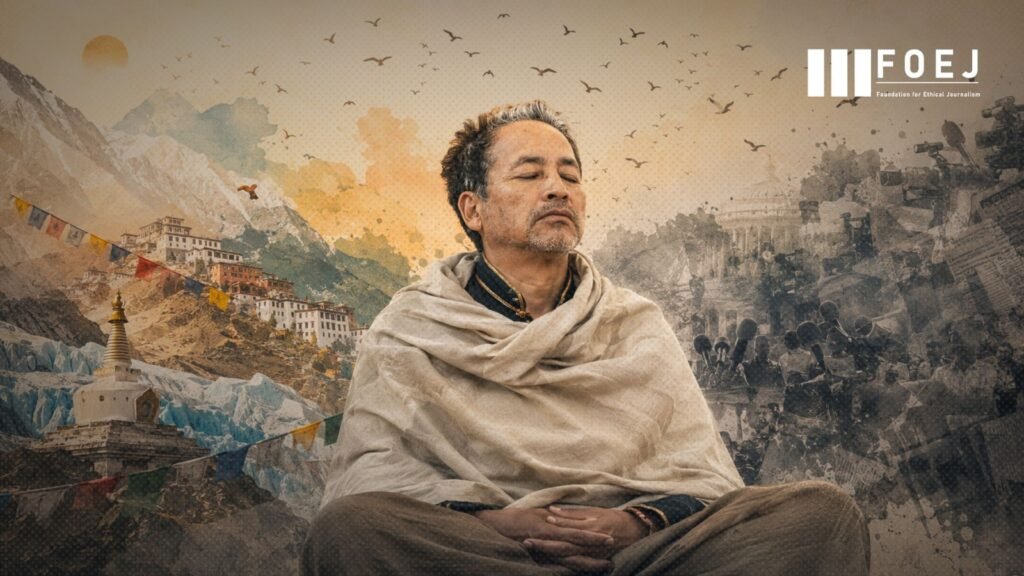
While many public figures try to gain fame and recognition, Wangchuk devoted his decades of life to solving issues in the difficult environment of Ladakh. He established SECMOL (Students’ Educational and Cultural Movement of Ladakh), an institute which revolutionized education by promoting practical learning over mugging up things. His ground-breaking Ice Stupa project provided an innovative answer to the problem of water shortage by creating artificial glaciers that would melt when the farmers would need water. All these efforts have won him the prestigious Ramon Magsaysay Award along with other recognitions from around the world.
While reading about his work and achievements, one question crossed my mind.
How much more should a man do for society to start paying heed to his worries?
Sonam Wangchuk is no longer looking for any kind of accolades and recognition in today’s time. He has taken a path which is one of the oldest forms of peaceful protests – the hunger strike.
Why?
This question certainly requires far more attention than what it usually gets.
It is not only a protest against the perceived flaws in the NEET examination but also a representation of a much deeper issue that relates to fairness, accountability, and transparency in India’s education system. The NEET is more than an entrance examination for lakhs of students as it is the key to all their efforts towards aspiring to become doctors through years of hard work. The issue of paper leak has left the entire student community in shock and doubt as far as the integrity of one of the most fiercely competitive exams in the country is concerned. Though people can have different views regarding what the students are demanding including holding those accountable who were in charge of the exam, the frustrations of the students cannot be ignored.
At times, I wonder why we start talking about crucial matters when a person’s well-being begins to suffer? Why is it necessary for us to pay a price for sacrificing our wellbeing to have our say?
The past has proven to us that India has been known to honor the power of passive resistance. Gandhi has shown us that morality is far more compelling than mere physical force. Hunger strike is not only the refusal to eat; it is a strong expression of our conscience. It does no harm to others. It makes us take a moment and think.
Isn’t this the essence of democracy?
In a democratic country, to ask questions is not to be disloyal. To disagree is not to rebel against the authorities. Bringing up matters like accountability or governance is never to be considered as the opposition to your own country.
This is exactly why people can understand and sympathize with Sonam Wangchuk’s protest.
He is not holding any weapons. He carries conviction. He does not ask the citizens to fight. He asks them to think. And that might be the reason behind his strength of protest. However, I also feel that each movement needs to stay connected to constitutional principles. Protest in a democracy is a constitutional freedom, but finding answers requires discussion from both ends. There are certain duties of the government related to development, national security, and administration. The citizens have a right to raise issues. The actual problem does not lie in picking up sides; it involves continuous conversation and not discussion break-downs.
Perhaps, that is where the true strength of Indian democracy actually lies not in reaching a consensus, but in healthy dissent. While keeping myself informed about Sonam Wangchuk’s health, I could not stop feeling that it was rather ironic. A person who spent many years trying to save glaciers is now busy saving attention to what he feels is important.
Isn’t that worth pondering over?
Political opinions will always vary. While some will agree with him, others will oppose. And that is how a democracy works.
I have no idea how history will evaluate this movement. I have no idea whether every single request will be fulfilled in the end. But one thing I know for sure. A democracy must never become so focused on sound that it fails to hear the silent bravery of people who opt for peacefulness rather than struggle. For there may come a time when the loudest voice in a nation is not the one screaming from the streets. It is the one quietly whispering,
“Will you finally listen?”