



A students’ union is not merely about elections; rather, it is an important institution for leadership development, democratic awareness, and the protection of collective rights. The progress made towards restoring students’ union elections at Aligarh Muslim University and Maulana Azad National Urdu University (MANUU) has raised a fundamental question for Jamia Millia Islamia: when students at other universities can struggle for their representation, how long will Jamia’s students remain deprived of an elected representative body?
Students’ Union: A Training Ground for Leadership
Leadership does not emerge suddenly; it develops through experience, dialogue, disagreement, collective struggle, and the acceptance of responsibility. A students’ union provides young people with precisely these opportunities. Through it, students learn to present their problems in an organised manner, question the administration, work with people holding different viewpoints, and remain accountable to their fellow students.
The purpose of universities is not merely to award degrees but also to prepare aware citizens who understand their rights, respect the rights of others, and form independent opinions on social issues. Therefore, a students’ union cannot be confined merely to political activity or electoral competition. It is also a means of student representation, administrative accountability, and the training of future leaders.
In the history of Aligarh Muslim University, personalities such as Arif Mohammad Khan, Azam Khan, and Mohammad Ali Ashraf Fatmi are known for their association with student politics. Similarly, the Jawaharlal Nehru University Students’ Union (JNUSU) has been associated with prominent political figures such as Sitaram Yechury, who served as its president, while the Delhi University Students’ Union (DUSU) has provided a platform for leaders such as Arun Jaitley and Ajay Maken, both of whom served as its presidents. These examples do not mean that every student leader will enter national politics or that every union will be successful. Rather, they demonstrate that students’ unions can provide young people with a practical platform to develop leadership skills, engage in democratic debate, and learn the responsibilities of public life. Their importance for society is even greater because representation and democratic training in educational institutions are connected to the broader social future.
Jamia Millia Islamia: From 2006 to the Present
The students’ union at Jamia Millia Islamia was abolished on 31 March 2006. Since then, demands for its restoration have emerged at different times, but a permanent electoral system has not been restored. In October 2017, Hindustan Times reported that students had formed a Joint Action Committee to restore union elections and had submitted a memorandum to the Vice-Chancellor. The report also mentioned legal complications.
By 2026, this deadlock had continued for almost two decades. The administration may have concerns regarding discipline and violence in student politics. These concerns cannot be ignored, but the question is whether depriving students of elected representation is the solution. Transparent electoral codes, impartial monitoring, and an effective grievance redressal system can be established to prevent violence, threats, and electoral malpractice.
When teachers, employees, and other sections of Jamia Millia Islamia have their own associations and representative organisations, why have students been deprived of their own elected union? If teachers and employees have the right to organised representation to resolve their problems, protect their rights, and raise a collective voice, why are students not entitled to the same right? Issues related to fees, hostels, libraries, scholarships, examinations, and educational facilities directly affect students’ lives. Therefore, their own elected representation in these matters is essential. Teachers’ or employees’ associations cannot fully replace the role of understanding and representing students’ problems. The real question is this: when representative associations exist for other sections of Jamia Millia Islamia, why has a transparent and workable system not been established for students that ensures their democratic representation while also maintaining discipline on campus?
AMU and MANUU: A Hope for Change
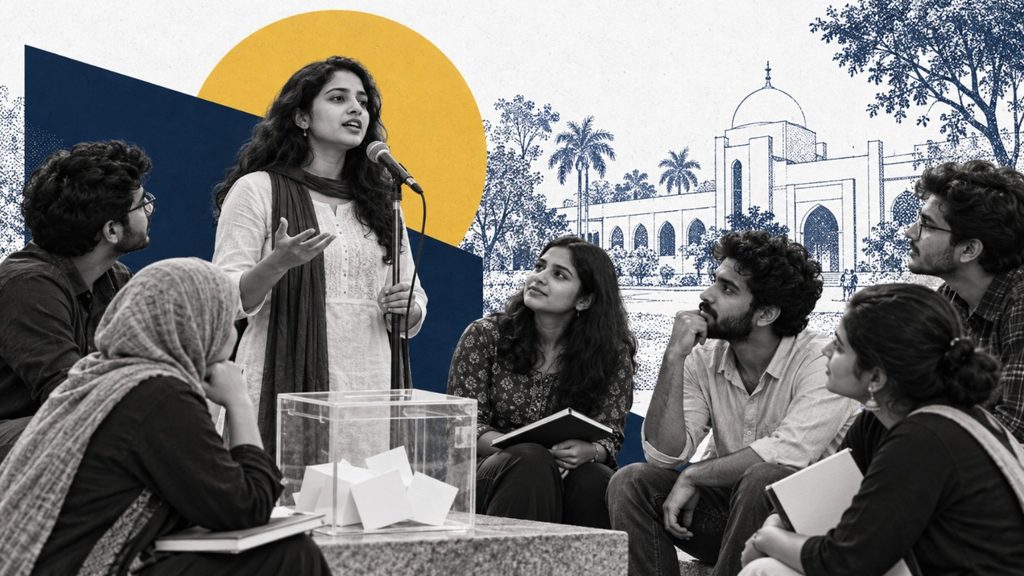
The last students’ union elections at Aligarh Muslim University were held in November 2018. After that, no new elections could be held for almost eight years. During this period, students continued to register protests from time to time, but eventually, the university administration announced that elections would be held on 5 November 2026. This announcement came after a 19 day hunger strike by student Yasir Fahad. He began an indefinite hunger strike on 21 September 2026, with the primary demand that a date for the students’ union elections be announced.
This development highlights the fact that when students unite for their legitimate demands, struggle in an organised manner, and make continuous efforts to achieve their goals, pathways to change can be created. Coming together on common demands despite differences of opinion, and raising one’s voice peacefully, systematically, and effectively, can become a source of strength for any student movement. Peaceful protests, collective signature campaigns, formal negotiations with the administration, legal action, and highlighting the issue through the media can also play an important role in achieving this objective.
On the other hand, the administrative process for the 2026–27 students’ union elections has moved forward at Maulana Azad National Urdu University (MANUU). Steps related to the formation of election committees and the election notification were taken in September, while the elections will be held on 15 October.
It is worth remembering that the progress towards restoring the students’ union and holding elections at MANUU is not merely the result of an administrative decision; a long struggle by students lies behind it. Former MANUU Students’ Union president Mateen Ashraf, presidential candidate Talha Mannan from the year in which the elections were cancelled, and Swaleh Wakeel, the current presidential candidate representing the MANUU Students Collective, have played prominent roles in this struggle. Their efforts remind us that the struggle for students’ democratic rights does not end with raising a demand; it also requires continuous effort and steadfastness.
A comparison of the three universities reveals a clear difference: at AMU, an election date was announced after a gap of almost eight years; at MANUU, the electoral process moved forward after approximately two years; whereas at Jamia Millia Islamia, a permanent electoral system has not been restored since 2006. The purpose of this comparison is not to portray the struggle at one university as inferior to that at another, but to understand the seriousness of the prolonged deadlock at Jamia Millia Islamia.
The Question of Muslim Leadership and Political Representation
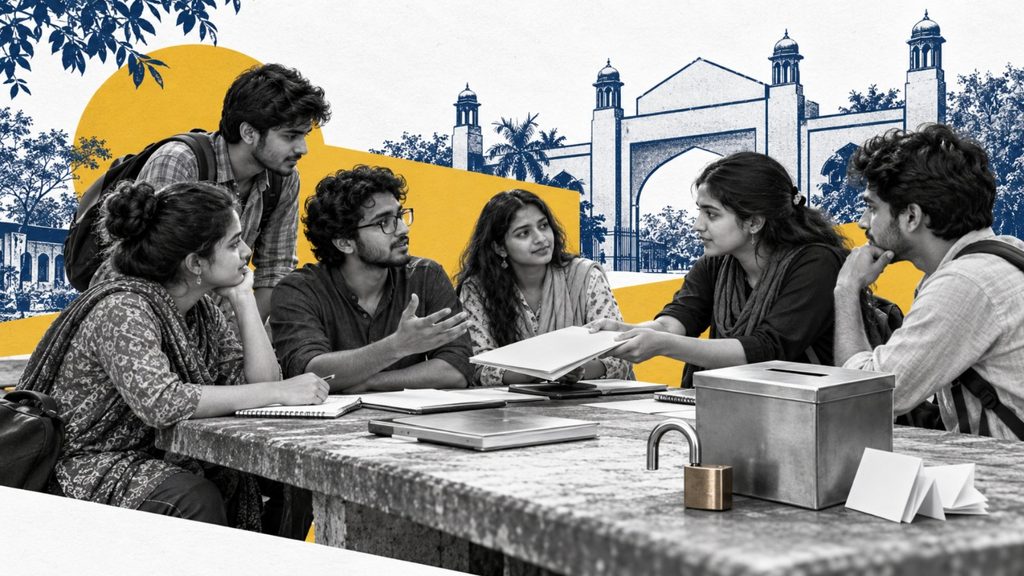
The issue of student representation in universities also has a broader political and social context. In India, there has been continuous debate about minority rights, the autonomy of educational institutions, freedom of expression, and political representation. In such an environment, the question of elected student representation in universities with a Muslim historical background assumes particular importance.
However, the question remains: did the government suspend students’ union elections at these universities as part of a common plan to prevent Muslim leadership from emerging? Answering this question requires an examination of concrete evidence and relevant decisions. Alongside this, it is also important to ask to what extent the absence of elected student leadership weakens students’ collective voice and what effects this situation produces.
An elected union can present students’ collective views on fee increases, hostel problems, educational facilities, and administrative decisions. In its absence, students’ voices may become fragmented among different groups and individual efforts. Individual protests and applications are important in their own right, but they do not necessarily replace the collective and accountable representation of an entire university.
Protests, Dissent, and Student Representation
The movements held at Jantar Mantar in Delhi also provide an important reference point for this discussion. In July 2026, protests took place over student issues and examination-related disputes, during which demands for the resignation of Union Education Minister Dharmendra Pradhan were also raised. Later, leaders associated with the movement described the minister’s resignation as a success of their struggle. Before another proposed protest in October, incidents involving heightened security measures in Delhi and the preventive detention of some activists and students also came to light.
While connecting these incidents to the situation at Jamia Millia Islamia, it is important to understand that the demands, circumstances, and outcomes of every movement are different. Nevertheless, these examples demonstrate that organised, clear, and sustained public pressure can bring an issue to wider attention. The lesson for JMI’s students is not that they must necessarily adopt the same methods, but that they should make their demand part of public debate through evidence, collective support, and continuous effort.
The student protests at Jamia Millia Islamia in April 2026 against the programme titled “Yuva Kumbh”, organised in connection with the completion of one hundred years of the RSS, also brought the questions of ideological disagreement and representation on campus into focus. According to a report published by The Indian Express on 28 April, security was increased during the programme, and police and CRPF personnel were deployed.
If students disagree with the ideological background of a programme, they should have the right to express their concerns peacefully. At the same time, transparent and uniform rules must be followed for all activities. The fundamental question here is whether Jamia Millia Islamia has an elected body that can present the different viewpoints of students, seek explanations from the administration, and transform disagreement into organised democratic dialogue. The strength of a democratic union does not lie in the monopoly of a single ideology, but in representing students with different viewpoints.
The Consequences of Not Having a Students’ Union
The absence of a students’ union can have several possible consequences. First, it creates a gap in collective student representation, making it difficult to present common problems in an organised manner. Second, administrative accountability may weaken because elected representatives can inform their fellow students about the issues discussed, the responses received, and the steps to be taken next. Although the mere existence of a union does not automatically guarantee transparency, the electoral process gives students an opportunity to question their representatives and assess their performance in subsequent elections.
Third, young people may be deprived of practical training in dialogue, negotiation, organisation, respect for disagreement, and collective responsibility. Fourth, when organised democratic channels for disagreement become weak, the possibility of informal power structures and the influence of unelected groups may increase. These possibilities draw attention to the need to take the existence and functioning of a students’ union seriously.
It would not be correct to say that a university cannot function properly at all without a students’ union. Academic departments, examinations, libraries, and administrative offices can continue to function even without one. However, the continued administrative functioning of an institution and the existence of democratic student representation are two different things. A union is not a substitute for the administration; rather, it can serve as a democratic link between students and the administration.
What Can Be Done to Restore the Union at Jamia Millia Islamia?
Emotional appeals alone will not be sufficient to restore the students’ union at Jamia Millia Islamia. For this purpose, a common platform should be formed comprising different departments, hostels, student organisations, and independent students. Its objective should not be to declare any single organisation the representative of the entire university, but to build consensus on restoring elected representation.
The next step should be to formally ask the administration, in writing, to clarify the current legal and administrative position. If there is a legal obstacle, the relevant order and possible ways of resolving it should be made public. Students can also present a workable electoral framework that includes eligibility criteria for candidates, election expenditure, action against violence and threats, grievance redressal, and transparent monitoring.
Contacting teachers, former students, journalists, and education experts; disseminating documented information through the media; and seeking legal advice when necessary can strengthen this campaign. A clear timeline and a system for regularly monitoring progress are also essential so that the demand does not remain limited to a single protest or a few days of activity. Every student should have the opportunity to contribute according to their health, academic responsibilities, and circumstances; no single individual should be expected to carry the entire burden of the movement.
The Longer the Silence, the Greater the Struggle
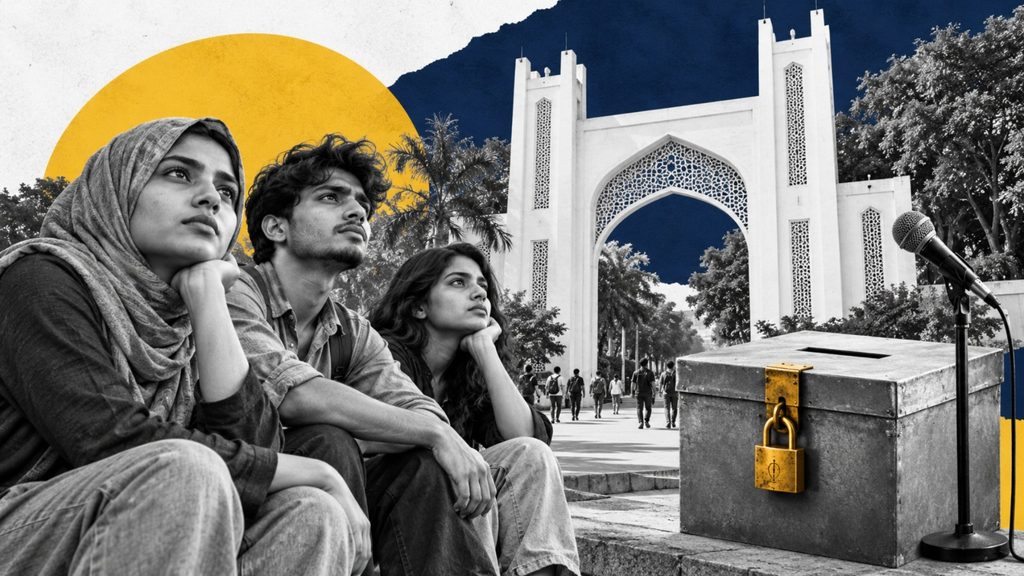
The longer a right remains denied, the greater the need for organised struggle, broad collective support, and sustained effort to regain it. For example, if the door of a building has remained closed for years and its lock has become rusty, merely turning the key once may not be enough to open it; the correct key and an appropriate method may be required. Similarly, if students’ union elections have not been held at an educational institution for a long time, raising the demand once does not necessarily resolve the problem. Students will have to unite, present their demand in an organised manner, and maintain continuous communication with the administration. Just as the correct method is necessary to open a closed door, strong organisation, a clear strategy, and sustained struggle are also necessary to end a prolonged deadlock.
The students’ union at Jamia Millia Islamia was abolished in 2006. Several generations have graduated during this period, yet the question of restoring an elected union remains unresolved. Rather than lamenting the past, it is now more important to consider how further delays can be prevented. The experiences of AMU and MANUU give JMI’s students an opportunity to adopt a clear and sustained strategy suited to their own circumstances.
There is still time to restore the union at Jamia Millia Islamia, but in view of the nearly two decades of deadlock, the effort must also be serious, broad-based, and continuous. If every student keeps thinking that someone else will take the first step, someone else will protest, or someone else will put their education and future at stake, who will initiate the collective struggle? The solution is not for every student to put their health at risk or resort to confrontation. The solution is for some to work on the legal aspects, some to gather evidence, some to organise students, and others to establish contact with teachers, former students, and the media.
Perhaps every student at Jamia Millia Islamia thinks that a voice should be raised for the restoration of the students’ union. At the same time, however, they may also think that someone else will make the beginning. As a result, everyone knows what should happen, but it remains undecided who will take the initiative, how it will be taken, and how others will be brought together. Is Jamia’s biggest problem that it does not have a students’ union, or is it also that there is no permanent and mutually agreed mechanism for taking collective initiative to restore it? Will students continue to wait for an individual or an organisation to take the first step, or can they unite around a common democratic demand despite belonging to different ideologies and organisations?
If every generation continues to remain silent, thinking that too much time has already passed, this deadlock could extend to thirty, forty, or even fifty years. Future generations may then ask what JMI’s students did to restore their rights when students at other universities were struggling for their representation. History bequeaths problems to every generation, but it also gives them an opportunity to resolve those problems. If the present generation makes an effort to end this deadlock, future students may remember it for paving the way towards the restoration of democratic representation.
Students at Jamia Millia Islamia should not think that twenty years have passed and nothing can be done now. Instead, they should think that twenty years have passed and there is no room for further delay. The answer to this prolonged silence does not lie in a single hero or a temporary protest, but in unity, a clear demand, a legal and democratic strategy, and sustained collective struggle.
However, at this point, several more questions require attention. Is the Jamia Millia Islamia administration willing to present a clear timeline for restoring the students’ union? If there are legal or administrative obstacles to holding elections, can their details not be presented to students? Can student organisations not reach an agreement on the minimum common demand for restoration, rising above their differences? Can teachers, former students, and other sections of the university not play a supportive role in this process? And can JMI’s students propose a union that is not merely a means of achieving electoral victory, but also remains accountable to students after the elections?
Another question is also important: should the restoration of the students’ union be viewed merely as the return of a tradition from the past, or should it be considered an opportunity to create a more transparent, responsible, and effective representative body suited to present-day issues? If elections are restored, how will ideological differences among candidates be transformed into positive dialogue? What rules will be in place to prevent violence, threats, financial influence, and personal attacks during election campaigns? Who will evaluate the performance of elected representatives, and how will students be given the right to question their representatives? Considering these questions in advance is essential because restoring the union is only the first step; maintaining its democratic and responsible role is equally important.
And the most fundamental question is this: will Jamia’s students simply accept their deprivation as an old problem, or will they take collective responsibility for resolving it? Will every generation continue to wait for someone else to initiate this struggle, or will the present generation contribute according to its resources, abilities, and circumstances? Is it necessary to wait for an extraordinary leader to organise the students’ voice, or can small, sustained, and coordinated efforts for a common purpose lay the foundation for major change?
The question before Jamia Millia Islamia today remains the same: will its students get the opportunity to present their voice through elected representatives? And if this right should be restored, who will take the first practical step towards it, who will transform that step into a collective movement, and who will ensure that the demand does not disappear into silence again after a temporary protest? The answer cannot emerge through waiting alone, but through organised, peaceful, and sustained democratic efforts.