



History remembers only those whose interpreters remain alive. Mahatma Gandhi, Jawaharlal Nehru, Bhagat Singh, Subhas Chandra Bose, and Rani Lakshmibai, to name only a few, are remembered with great reverence, while many other remarkable personalities of India’s freedom movement have been marginalized in historical narratives. One such figure is Bi Amma.
Bi Amma’s Early Life and Educational Vision
Abadi Bano Begum, popularly known as Bi Amma, was born in Uttar Pradesh and was one of the foremost Muslim women leaders of the Indian freedom movement, yet she remains underrepresented in history. She was a public political leader during British colonial rule in India whose speeches and anti-colonial struggle inspired thousands of Indians in resistance to colonial domination.
She played a vital role in the struggle against British rule, representing the intersection of religion, nationalism, and social reform. She fostered Hindu-Muslim unity, encouraged women’s political agency, and devoted her life to India’s freedom.
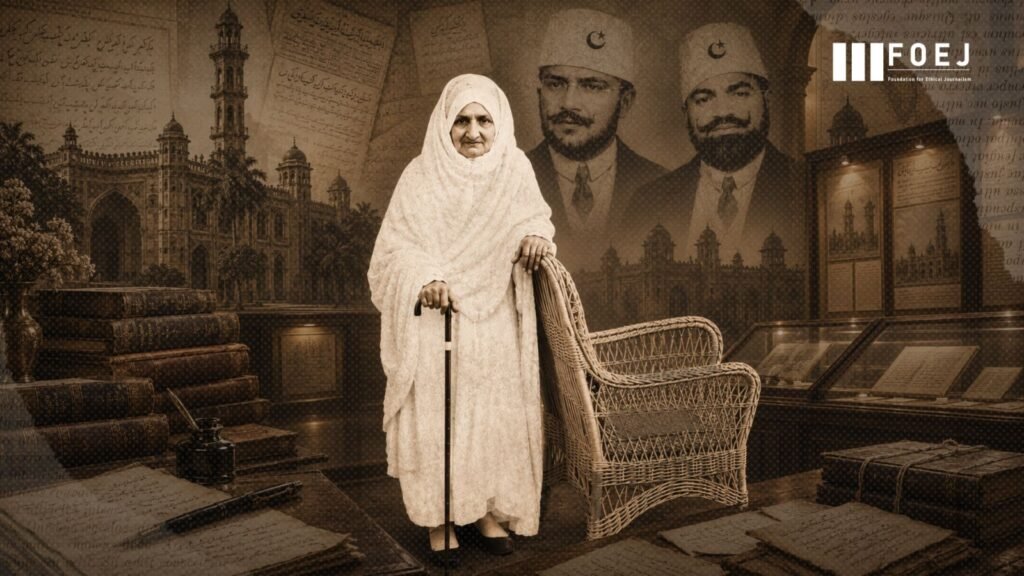
With no formal education, Bi Amma pawned her jewelry to educate her sons: Maulana Muhammad Ali Jauhar and Maulana Shaukat Ali, two prominent Muslim leaders and pioneers of the Khilafat Movement. She made financial sacrifices to secure a modern English education for her sons. Despite strong social opposition to English education, she defied convention and ensured that her children would acquire a modern education at Aligarh Muslim University and the University of Oxford. Maulana Shaukat Ali received his higher education at Aligarh Muslim University, while Maulana Mohammad Ali Jauhar, after graduating from AMU, was admitted to Lincoln College, Oxford, England, to study modern history.
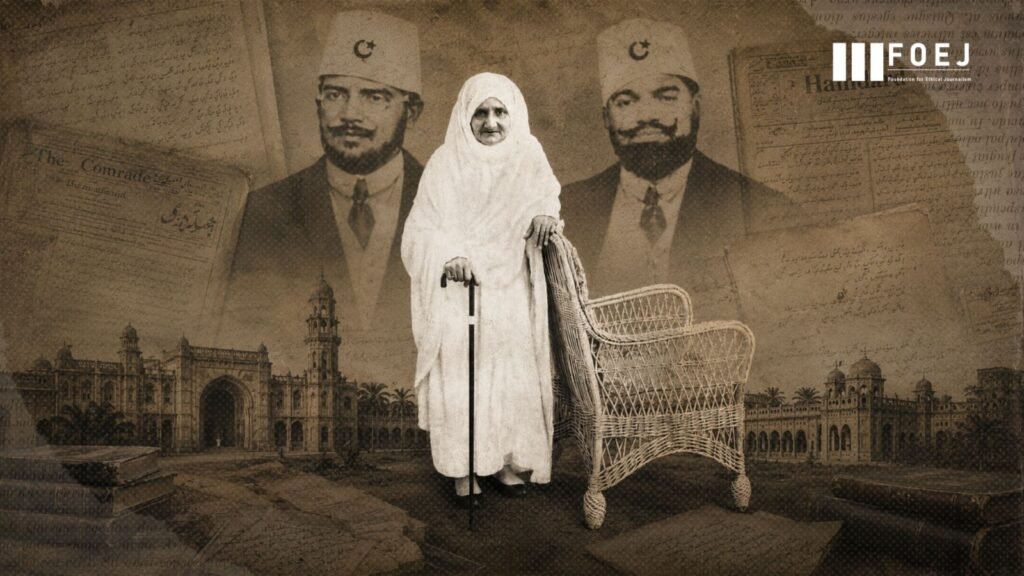
Mohammad Ali Jauhar was a trenchant critic of the British government and its imperial and colonial ideologies. Through his prolific writings in the English-language weekly “The Comrade” and in the Urdu-language daily “Hamdard,” he played a pivotal role in fearless journalism, advanced anti-colonial thought, and fought for the country’s freedom and independence.
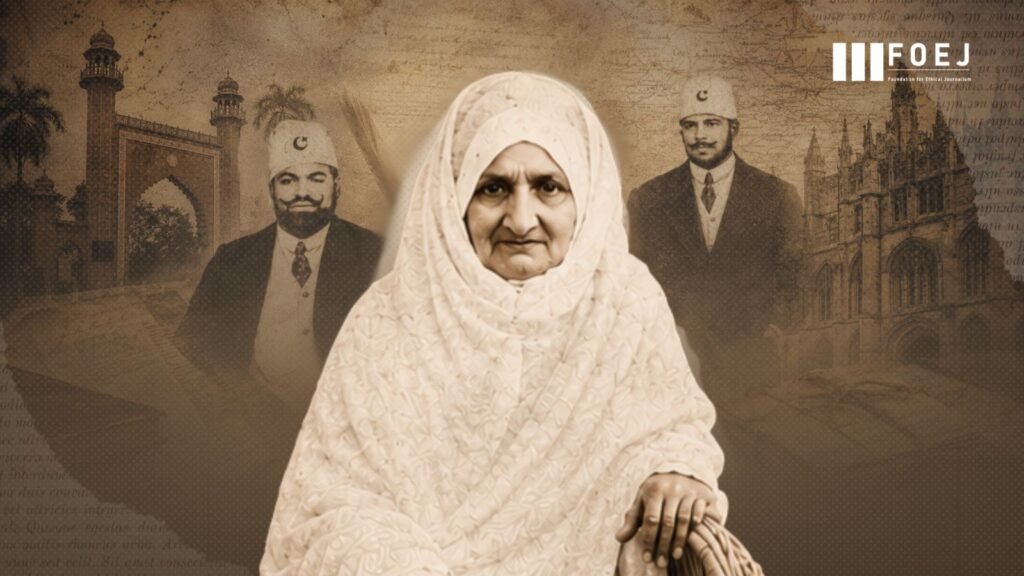
Education and social awareness were necessary to decolonize the Indian mind because colonialism was not confined to political subjugation but also sought to impose psychological domination, which convinced the colonized people of their own inferiority, as Ngũgĩ wa Thiong’o argues in his foundational text “Decolonising the Mind.” He writes: “The real aim of colonialism was to control the people’s wealth… But its most important area of domination was the mental universe of the colonized, the control, through culture, of how people perceived themselves and their relationship to the world.”
Political Resistance and the Struggle for National Unity
“Divide and rule” was a foundational strategy of British colonial rule. On the basis of religion, region, and language, the British fostered division, enmity, and communal tensions among Indians. The visionary Bi Amma understood this British policy. Defying this policy, she promoted unity among Indians and argued that solidarity across religious communities was essential; freedom cannot be obtained otherwise.
Resistance is the most effective weapon to deconstruct the colonial mindset. Bi Amma’s decision to step into the public sphere while maintaining her dignity dismantled the stereotypes that Muslim women in purdah are passive victims. She, through her public political speeches, inspired courage and nationalism, challenging British authority. She challenged stereotypes that confined Muslim women to the domestic sphere and called for active participation by ordinary people, especially Muslim women, to end British rule. Although she came from an ordinary social background, she left a lasting message of political consciousness for the freedom movement.
Bi Amma Through Feminist and Postcolonial Perspectives
The feminist theorist Simone de Beauvoir argues that gender inequality has historically excluded women from the socio-political and intellectual domains and limited their participation, but Bi Amma emerged as a significant exemplar of feminist resistance who broke the socio-cultural barriers that prevailed during her lifetime. Women were expected to be confined to the domestic role and were excluded from public spaces such as social, political, and leadership spaces.
Modern feminist scholars often argue for women’s agency and autonomy—that they should be independent of male authority in decision-making. Bi Amma remarkably exercised agency, making decisions independently.
Edward Said, in “Orientalism,” argues that colonial discourse portrays Eastern societies as inferior, irrational, and incapable of self-government. The British colonial narrative portrayed Indian women as confined within orthodox norms; nevertheless, Bi Amma effectively challenged this narrative by traveling extensively and addressing political gatherings.
The concepts of “cultural hybridity” and “third space” by Homi K. Bhabha provided a useful framework for understanding the political identity of Bi Amma as she combined Islamic values with Indian nationalism; in purdah, she traveled across the country and delivered public speeches for freedom. Rather than treating religion and nationalism as mutually exclusive binaries, she generated a “third space” where religious practice and nationalism coexisted and worked effectively towards decolonization.
Gayatri Chakravorty Spivak, in her influential essay Can the Subaltern Speak?, asks.
Bi Amma’s life responds with fearlessness and bravery. Yes, a subaltern can speak publicly against the very system that suppresses them, yet history often forgets subaltern voices.
Bi Amma’s struggle offers more than the story of an extraordinary life. It presents an intersection where anti-colonial resistance, feminist courage, and postcolonial identity meet. She faced the confinement imposed by both orthodox society and colonial power, yet she resisted both.