



The 100 day war in West Asia, started on February 28, 2026, by joint US-Israel offensive and marked by assasination of Ayatollah Ali Khamenei, has severely disrupted the global energy market. With the Strait of Hormuz blockade of 14 weeks, Brent crude was hanging between $95 and $97 per barrel in June, after the Indian basket averaged $110 in previous months.
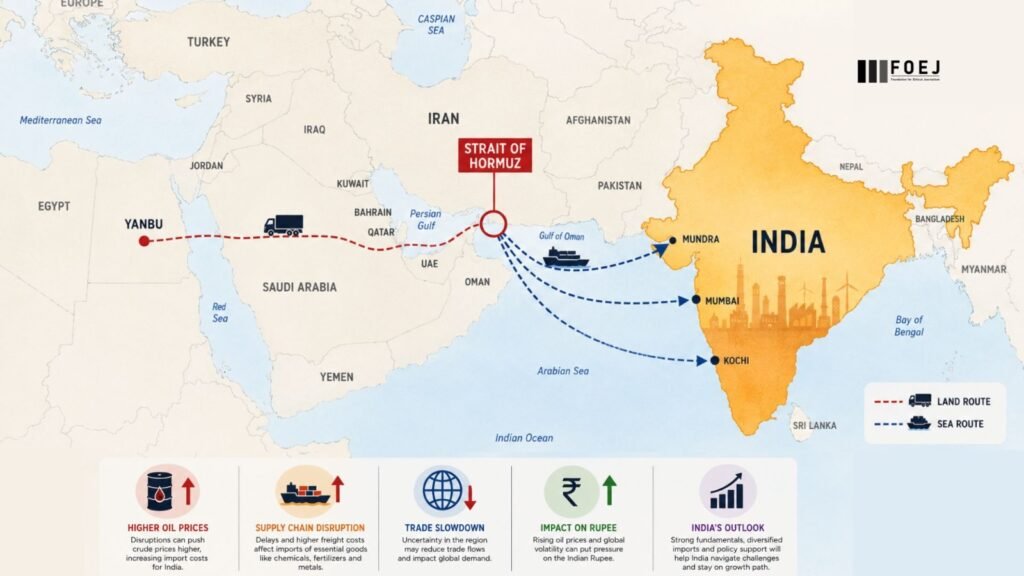
India, which imports over 85% of its crude oil and relies on the Strait of Hormuz for 45% of oil and 90% of LPG imports, faces an acute balance of payments threat. Beyond security risk highlighted by an Indian casualty in drone strike in Kuwait International Airport, the crisis directly challenges India’s recent growth, which clocked 7.7% in FY26, with real GDP reaching upto Rs 323.12 lakh crore.
Monetary Defense and Policy Decoupling
At its June 2026 meeting, the Reserve Bank of India’s (RBI) Monetary policy committee (MPC) unanimously kept the repo rate unchanged at 5.25% and maintained its neutral stance. The standing Deposit facility remains at 5.0% and the Marginal Standing facility stands at 5.5%.
To stabilize the rupee which depreciated from 89.95 in January to a record low of Rs 96.96 before recovering 95.24, the RBI bypassed rate hikes in favor of the capital account reforms. These include expanding the Fully Accessible Route (FAR) for government securities, relaxing Foreign Portfolio Investor (FPI) limits, and drawing on foreign exchange reserves, which fell from $728 billion to under & 689 billion by mid May. This approach is different with peers like bank Indonesia, which implemented a 50 basis point hike to defend its currency.
Fiscal Strain and Growth Revision
The energy shock has triggered significant revision across major forecasting bodies, alongside ballooning fiscal deficits. High import costs are projected to drive fertilizer subsidies to Rs 3.8 lakh crore, more than double budgeted Rs 1.7 lakh crore, while cooking gas subsidies will exceed Rs 12,085 crore. Under a primary conflict scenario through June, these burdens will push the FY27 fiscal deficit from 4.3% to 4.49% of GDP.
Domestic Challenges
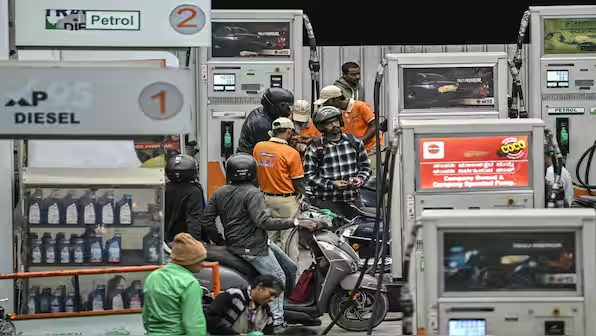
For years, the Indian government kept domestic fuel pump prices largely steady for the consumers. However, the prolonged pressure of Brent crude reaching near $95 to $97 a barrel has forced the government’s hand.
State owned fuel retailers were permitted to execute multiple retail price hikes for petrol and diesel, directly increasing daily commuting and domestic transport cost. Slow economic growth and high prices have forced households to freeze non-essential spending.
The agricultural sector, which supports the majority of India’s rural population, is facing a severe supply chain choke. Following the escalation, 17 cargo ships carrying India bound fertilizers became stranded in the Persian Gulf. To rescue the agriculture supply, the government has had to draft plans to dock the ships, unload the fertilizer, and then transport it overland by road to Yanbu port in Saudi Arabia before shipping it back to India.
While Prime Minister Modi urged farmers to slash chemical fertilizers use by 50% and move to natural farming to conserve foreign exchange, economists warn that a rapid transition without massive state aid is mathematically untenable. It risks slashing crop yields, heavily dropping farmer incomes and sparking domestic food price hyperinflation.
Rising prices are demanding private final consumption, which previously drove FY26 growth alongside a 10.7% expansion in manufacturing. The May 2026 RBI Urban Consumer Confidence Survey reflects this diminished the current situation Index dropped to 90.7, employment sentiment fell to minus 14.4, and net discretionary spending perception turned negative at minus 0.8. These trends indicate a temporary domestic slowdown before an anticipated recovery to 6.7% in FY28.