



A reconstruction of the twelve days that began on a garden path in New Delhi: Operation Blue Star’s long shadow, the killing, the transfer of power, the massacres, and the funeral of a Prime Minister.
A garden path, 9:08 a.m.
Indira Gandhi stepped out of her bungalow at 1 Safdarjung Road shortly after 9 a.m. on Wednesday, 31 October 1984. She had flown back from Orissa the night before, at about 8:30 p.m., after two days of campaigning.
This morning’s first engagement was gentler. The British actor Peter Ustinov and an Irish television crew were waiting next door at 1 Akbar Road, her office, to film an interview. The two bungalows sat in one compound, joined by a narrow cement path broken by a wicket gate known as the “TMC gate”.
She walked ahead of her party. Head Constable Narain Singh held an umbrella over her against the sun. Behind came Assistant Sub-Inspector Rameshwar Dayal, her attendant Nathu Ram and her special assistant, R.K. Dhawan.
Two Sikh policemen stood at the gate. One, Sub-Inspector Beant Singh, had guarded her for years. The other, Constable Satwant Singh, she barely knew. As she greeted them, Beant raised his service revolver in what onlookers took for a salute.
Ustinov later put the time at 9:08 and 27 seconds. Within seconds the Prime Minister of India was lying on the path.
The road to Amritsar
The shots on the garden path had their origin 450 kilometres away, in the Golden Temple at Amritsar, five months earlier.
Through the late 1970s and early 1980s, Punjab’s main Sikh party, the Shiromani Akali Dal, pressed demands rooted in its 1973 Anandpur Sahib Resolution. These included a more federal constitution, Chandigarh as Punjab’s sole capital, a larger share of the Ravi and Beas waters, and recognition of a distinct Sikh identity. Indira Gandhi’s government regarded the resolution as separatist in intent; Akali leaders insisted it sought autonomy within India.
In August 1982 the Akalis launched a mass agitation, the Dharam Yudh Morcha, in alliance with Jarnail Singh Bhindranwale, a fiery preacher who headed the Damdami Taksal seminary. Repeated negotiations with Delhi failed, and the initiative shifted to Bhindranwale.
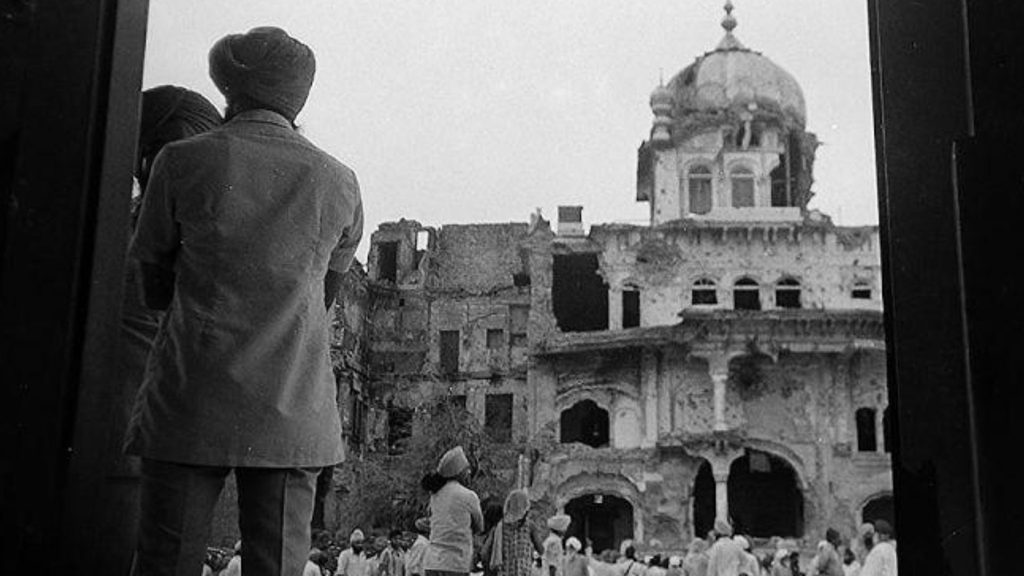
Killings mounted, and many were linked to his followers, though most were never solved. They included the newspaper editor Lala Jagat Narain in September 1981, and Deputy Inspector General A.S. Atwal, shot on the temple steps in April 1983. In December 1983 Bhindranwale moved into the Akal Takht, the seat of Sikh temporal authority facing the Harmandir Sahib. With help from a dismissed army general, Shabeg Singh, his men fortified the complex.
On 1 June 1984, Indira Gandhi authorised the army to clear the shrine. The complex was crowded with pilgrims marking the martyrdom anniversary of Guru Arjan Dev. Punjab was sealed under curfew and a press blackout.
On the night of 5–6 June, troops under Major General K.S. Brar attacked. When infantry could not break the defences, tanks fired into the Akal Takht. Bhindranwale and Shabeg Singh were found dead inside. The Sikh Reference Library, which held hand-written scriptures, was burned; the army blamed crossfire, while Sikh witnesses said it was set after the fighting.
The government’s White Paper counted 83 soldiers and 493 militants and civilians killed. Independent estimates run into the thousands.
For most Sikhs, including many who had opposed Bhindranwale, the assault was an attack on the faith itself. Sikh soldiers mutinied in several cantonments, prominent Sikhs returned state honours, and the Prime Minister became, for some, the personal embodiment of the injury.
Two guards at the gate
Both gunmen were Delhi Police personnel assigned to the Prime Minister’s residential security.
Beant Singh came from Maloya, a village on the edge of Chandigarh. He had served in her escort during the Emergency years and returned to 1 Safdarjung Road in January 1982. She regarded him as a favourite. Sources differ on his birth year, giving 1950 or 1959.
Satwant Singh, born in 1962 in Agwan village in Gurdaspur district, had joined the police in 1981–82. He was posted to her guard about a month before Blue Star, and had returned only days earlier from two months’ leave in his home district.
The two men had arranged to be at the gate together. The Supreme Court later found that Beant had swapped shifts with another sub-inspector. Satwant, normally assigned elsewhere, had asked for the sentry booth beside the gate on the pretext of dysentery, because it was near a latrine.
The shooting
Beant fired his .38 revolver at her from about three feet. As she fell, Satwant emptied his automatic carbine into her. ASI Rameshwar Dayal, behind her, was hit in the thigh.
The number of shots is reported differently. The court record lists 5 cartridge cases from Beant’s revolver and 25 from Satwant’s carbine recovered at the scene. The Monitor’s November 1984 account gave three revolver shots and 25 carbine rounds, 16 of which struck her. Later summaries commonly cite about 30 bullet wounds, attributed to the post-mortem team led by Dr T.D. Dogra.
She was not wearing the bulletproof vest she had been advised to use since June.
Arrest and the guardroom
Both men dropped their weapons. According to the Monitor, Beant said calmly in Hindi that he had done what he had to do, and the others could do as they wished. Indo-Tibetan Border Police guards took the two men to a guardroom.
Minutes later, more shots were heard there. Beant Singh was killed and Satwant gravely wounded. An intelligence source told the Monitor that Beant had lunged for a guard’s gun and Satwant had drawn a kirpan. The defence later disputed this, and the court found only that the two had been uninjured when taken into custody. Exactly what happened in that room has never been publicly established.
Why she was killed
The assassins issued no demands and made no attempt to escape. Every official finding, and every account sympathetic to them, identifies the motive as revenge for Operation Blue Star.
What the courts found
In August 1988 the Supreme Court found that Beant Singh, Satwant Singh and Kehar Singh had openly expressed resentment at the army action and held Indira Gandhi personally responsible. Kehar Singh was an older government clerk and the uncle of Beant’s wife. The court found the three had met to listen to inflammatory speeches and recordings about Blue Star.
The court accepted a sequence of events built largely on the testimony of Beant’s widow, Bimal Kaur:
- Beant took amrit, the Khalsa initiation, at a Delhi gurdwara on 14 October, and Satwant on 24 October.
- Kehar Singh and Beant held secret talks on 17 October.
- The two travelled to the Golden Temple on 20 October.
- After the assassination, Kehar Singh told a colleague that anyone who confronted the Panth would meet the same fate.
Justice K.J. Shetty described the motive as political rather than personal: a decision taken by an elected government had made the Prime Minister the target. A third accused, Sub-Inspector Balbir Singh, was acquitted for lack of reliable evidence. The court warned that anger over Blue Star could not by itself prove a conspiracy.
At his trial, Satwant Singh called for an end to communal violence and blamed Indira and Rajiv Gandhi for it.
The warnings
Security around her was tightened after Blue Star, amid several intelligence reports of a planned attempt on her life. According to the Monitor’s November 1984 investigation, all 150 members of her Special Task Force were re-screened and passed in late July.
Even so, the Director of the Intelligence Bureau, citing unfavourable intelligence, proposed removing all Sikhs from her security. She returned the file with a handwritten note: “How can we claim to be secular?”
Other accounts say Sikh guards were quietly moved and then reinstated on her instruction, with orders that no Sikh guard should be left alone beside her. Two months before her death, a foreign journalist asked whether she could still trust Sikh guards. She reportedly glanced at Beant Singh and said that with Sikhs like him around her, she had nothing to fear.
The Monitor also identified surveillance gaps. Satwant’s 1982 recruitment papers listed him as from Bareilly in Uttar Pradesh rather than Punjab, and no one had followed him during his leave in Gurdaspur, an area then under military control.
A special investigation team had cleared Dhawan in 1987, and no court ever found evidence of a conspiracy wider than the three men tried. Claims at the time of foreign involvement, including Soviet press allegations of CIA complicity, were never substantiated.
Five hours at AIIMS
Sonia Gandhi rode with her mother-in-law to the All India Institute of Medical Sciences, a few minutes’ drive away; they arrived at about 9:30 a.m.
The hospital was in flux. Dr Sneh Bhargava was taking charge as director that very day. In her memoir she wrote that Indira Gandhi was already dead on arrival, and that for the next several hours doctors kept up the appearance of trying to save her.
Surgeons P. Venugopal and M.M. Kapur led the effort in the eighth-floor operating theatre. She was put on a heart-lung bypass at around 10:30 a.m. and bullets were removed. Time reported that 88 bottles of blood were transfused.
Accounts differ on her blood group: Time recorded O Rh-negative, while Bhargava recalled the struggle to find rare B-negative. Venugopal later said that she could have survived the first shots had she been shielded or pulled to cover.
She was taken off the bypass around 2:20 p.m., the time now generally recorded as her death. The Week reported that the death certificate was signed around 2:30.
A succession before an announcement
Official confirmation waited for a successor. The President, Zail Singh, was on a state visit to North Yemen. The Home Minister and Home Secretary were out of Delhi, and Rajiv Gandhi was campaigning in West Bengal.
The BBC reported the shooting, and then the death, hours before Indian state media. All India Radio cancelled its programmes and played devotional music. Pranab Mukherjee, who flew back with Rajiv, wrote that he advised against announcing the death until a new government was sworn in
Zail Singh rejected the precedent of an interim Prime Minister. That evening at Rashtrapati Bhavan, he swore in Rajiv Gandhi, 40, together with five cabinet colleagues. Earlier, the President’s own car had been attacked by a crowd near AIIMS.
All India Radio’s 6 p.m. bulletin carried the news of both the death and the new Prime Minister. Doordarshan’s first report came on its evening news, read by Salma Sultan. Rajiv broadcast an appeal for calm that night. The government declared state mourning from 1 to 12 November.
The violence that followed
The assassination was the act of two men and an accomplice. What followed was something else entirely: the mass killing of Sikhs who had nothing to do with it.
The first assaults came on the evening of 31 October around AIIMS, where crowds attacked Sikh passers-by and burned vehicles. On 1 and 2 November the violence became systematic. Armed mobs, many carrying inflammable material, moved through neighbourhoods such as Trilokpuri, Sultanpuri and Mangolpuri. They dragged Sikh men from their homes and beat, stabbed or burned them to death. Gurdwaras, shops and taxi stands were set alight, and thousands of families fled to relief camps.
The army was not deployed in strength until 3 November, the day of the funeral. Army chief General A.S. Vaidya later told the Misra Commission that a brigade had been ordered from Meerut on the morning of 31 October and that help was available if asked for. It was not requested.
The death toll
In the Rajya Sabha, the Home Minister put the toll at 2,146 Sikhs killed in Delhi and 586 elsewhere. The Ahuja Committee later fixed the Delhi figure at 2,733, which became the accepted official number. Sikh organisations and rights groups put the total higher, at more than 3,000 nationally and up to about 4,000 in Delhi.
What the inquiries found
The commissions did not agree, and their disagreements are themselves part of the record.
| Inquiry | Years | Key findings |
| Marwah inquiry | 1984–85 | Looked at police conduct; wound up before completion |
| Misra Commission | 1985–86 | Found grave police lapses, indifference and some connivance; ruled out organised involvement by the Congress party, conceding only that some party workers joined on their own |
| Kapur–Mittal Committee | 1987–90 | Indicted 72 police officers for lapses |
| Jain–Banerjee Committee | 1987 | Recommended registering cases against named politicians; its work was stalled by litigation |
| Ahuja Committee | 1987 | Fixed the Delhi death toll at 2,733 |
| Nanavati Commission | 2000–05 | Found the attacks organised, and that local Congress leaders and workers had incited or helped the mobs; found no evidence against Rajiv Gandhi or other senior leaders |
Nanavati also found that the police failed to register separate FIRs or investigate properly. Of 587 FIRs, only a small fraction ended in conviction. Decades later, in December 2018, the Delhi High Court convicted former Congress MP Sajjan Kumar and sentenced him to life imprisonment for his role.
Teen Murti House
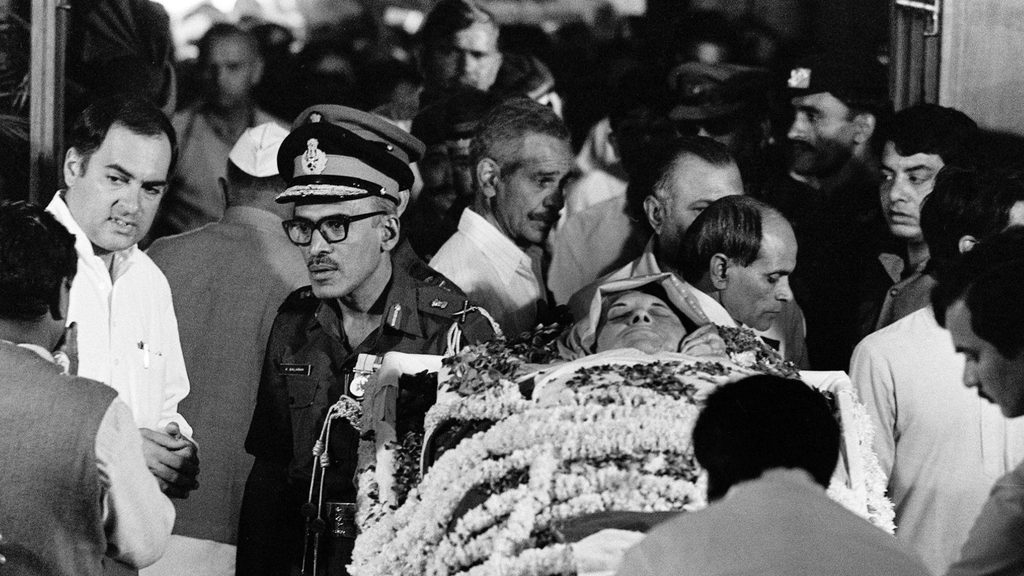
On the morning of 1 November her body was carried on a gun carriage from the hospital to Teen Murti House, with Rajiv accompanying it. The house had been built for the British Commander-in-Chief. It later became Jawaharlal Nehru’s residence for his entire premiership, and she had lived there with him for 16 years. After his death it became a museum.
She lay in state there from Thursday morning to Saturday afternoon, which is why sources speak of either two or three days. Time estimated that hundreds of thousands of people filed past the bier.
Newsreel shows police with shields straining against barriers and mourners laying flowers on the body. Foreign leaders also came to Teen Murti before the funeral, among them Pakistan’s President Zia-ul-Haq and Margaret Thatcher.
The lying in state coincided exactly with the worst two days of killing across the city. Doordarshan’s live broadcast from Teen Murti picked up groups in the crowd chanting khoon ka badla khoon se lenge, “we will avenge blood with blood.” Senior advocate Shanti Bhushan later stated in an affidavit that he heard the slogans on air while Rajiv Gandhi was present. A citizens’ chronology records that the slogans continued despite more than one attempt by the Prime Minister to stop them.
Saturday, 3 November: The Funeral
A capital under curfew
The funeral was organised in a city still burning. Delhi’s DCP (Traffic), K.K. Paul, later described the cremation ground as an open, low-lying patch of scrub and slush between Raj Ghat and Shantivan. The Central Public Works Department hurriedly turned it into an approach road, drop-off point and parking area. Minister Buta Singh oversaw the preparations and is said to have stayed on site for two days.
At a meeting that reached the subject only around 11:30 p.m. on 2 November, officials found that no vans could be found anywhere in Delhi to move the foreign delegations. With telephones down, Paul radioed Haryana’s Chief Secretary from his staff car for 15 air-conditioned coaches. Haryana Roadways buses arrived by 11 a.m. They carried Thatcher, Japan’s Yasuhiro Nakasone, France’s Laurent Fabius, Sri Lanka’s J.R. Jayewardene, Zia-ul-Haq and about a hundred others to the cremation ground.
The world in attendance
The BBC counted leaders from 94 countries. Among them were:
- Britain’s Margaret Thatcher, three weeks after surviving the IRA’s Brighton bomb, and Princess Anne for the Queen
- Soviet Premier Nikolai Tikhonov and US Secretary of State George Shultz
- Yasser Arafat, Kenneth Kaunda, Julius Nyerere, Samora Machel and Robert Mugabe
- Australia’s Bob Hawke and New Zealand’s David Lange
- The King of Bhutan, and China’s Vice Premier Yao Yilin
Ronald Reagan, days from re-election, did not come, and Vice President George Bush cited the campaign (Reagan Library). Fidel Castro’s absence was also noted in South Block. The gathering doubled as a summit: Shultz confronted Tikhonov over Soviet press claims that the CIA was behind the killing.
The procession
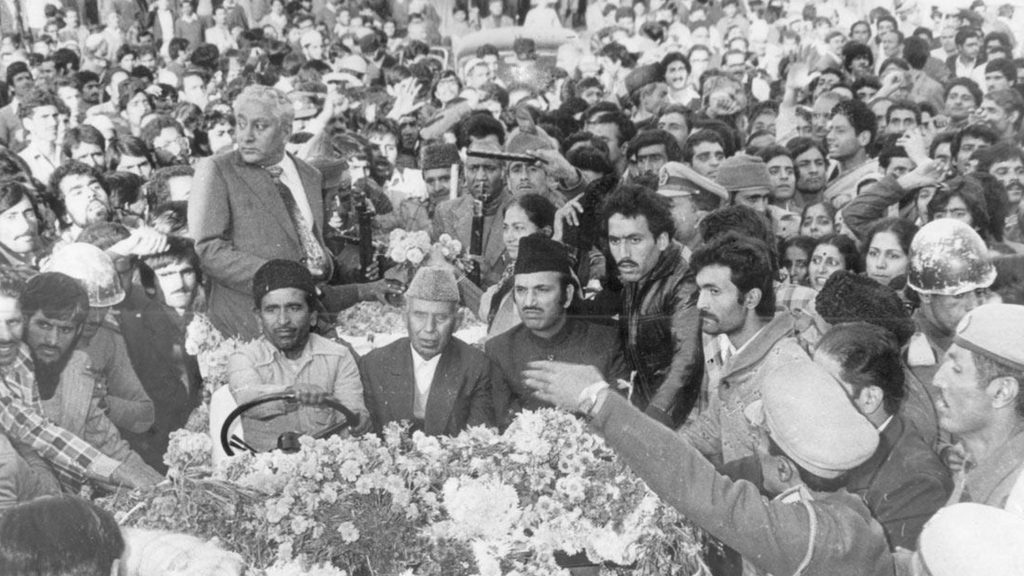
The curfew was relaxed a few hours before the cortège left Teen Murti in the early afternoon. Her body lay on an army gun carriage, banked with flowers and covered in rose petals, with her face visible. Three ropes ran forward from the carriage, hauled by the three services: red for the Army, dark blue for the Navy and light blue for the Air Force.
The procession passed Rashtrapati Bhavan, went down Rajpath and reached India Gate. There, for security reasons, the planned route past Connaught Place was abandoned for open ground toward the river. The journey covered about seven miles and took four hours.
Reporters disagreed about the crowds. Time and ITN counted a million or more along the route, with people throwing flowers at the carriage near India Gate. The BBC’s Brian Hanrahan saw thin lines and empty stretches, nothing like the throngs at Mahatma Gandhi’s or Nehru’s funerals; fear and restricted transport had kept many at home. During the procession, smoke from fresh arson was visible elsewhere in the city.
Shakti Sthal
Foreign leaders waited at the cremation ground. The family carried her onto the brick platform; Field Marshal Sam Manekshaw was among those who helped bear the body. The national flag was removed and a pyre of sandalwood built around her.
The rites were guided by Dr Goswami Girdhari Lal, head priest of Delhi’s Birla Mandir, who had also conducted Nehru’s last rites. He later recalled trembling throughout, and said Arafat wept like a child and Kaunda was also in tears.
Rajiv Gandhi carried the flame several times around his mother’s body before lighting the pyre. Ghee, camphor and spices were added to the fire. Sonia stood close by with Rahul, 14, who wore a white kurta with a towel around his neck like his father, and Priyanka, 12.
Also present were Maneka Gandhi and her son Varun; Indira’s estranged aunt Vijaya Lakshmi Pandit; and Amitabh Bachchan. ITN described Rajiv as calm, almost impassive, throughout.
The pyre was still burning that night. The curfew was reimposed, and Rajiv toured the worst-affected districts.
The ashes
On 5 November a priest gathered the ashes into 40 urns. These went by train and aircraft to the capitals of all 22 states and 9 union territories.
On 11 November the family took off from Hindon Air Base in an Air Force AN-12, escorted by two MiG-23s. Rajiv scattered the ashes over the Himalayas, from Gangotri, the source of the Ganges, to the area around Amarnath, as she had asked. That flight ended twelve days of state mourning.
Legacy
Indira Gandhi led India for nearly sixteen years, from 1966 to 1977 and again from 1980 to 1984. Her record includes bank nationalisation, the 1971 war that created Bangladesh, the 1974 nuclear test and the Green Revolution’s spread. It also includes the Emergency of 1975–77, which suspended civil liberties and jailed opponents, and the decision to send the army into the Golden Temple. Admirers and critics still argue over how to weigh them.
Her death reshaped Indian politics almost at once. Rajiv Gandhi, a reluctant politician and former airline pilot, called an early election and won more than 400 Lok Sabha seats in December 1984, the largest majority in Indian history.
On 19 November, her birth anniversary, he told a rally at the Boat Club that when a mighty tree falls, the earth around it shakes a little. Critics have ever since read the line as an excuse for the massacres. In July 1985 he signed an accord with Akali leader Harcharan Singh Longowal, who was assassinated within weeks; Punjab’s insurgency deepened for nearly a decade.
The courts closed the question of who killed her: Satwant Singh and Kehar Singh were hanged in Tihar Jail on 6 January 1989. The meaning of the killing remains contested. The Akal Takht declared the assassins martyrs of the faith in 2008. Beant Singh’s widow and father were elected to Parliament in 1989, and his son Sarabjeet Singh Khalsa won Faridkot in 2024.
Shakti Sthal, the patch of slush cleared in two days in 1984, is now a landscaped memorial beside the Yamuna. Her house at 1 Safdarjung Road is a museum, where a crystal channel marks the spot on the path where she fell. For many Sikh families, the memory of that week lies elsewhere: in Trilokpuri and Sultanpuri, and in the long wait for justice that followed.


