



Lately, Pakistan’s politics saw Imran Khan’s tenure as Prime Minister concluding in April 2022 after he was removed via a no-confidence vote, which resulted in widespread dissent and a plethora of legal cases against PTI leaders. In the lead-up to the February 8, 2024 poll, PTI was barred by the Election Commission and the courts from using its cricket-bat symbol, resulting in PTI candidates contesting the election as independents. A significant number of seats were won by de facto PTI members, but a coalition led by PML-N with PPP succeeded in establishing their government amid allegations of political pressure. (Al Jazeera)
Subsequently, a cross-border crisis in May 2025 shifted public attention toward national security. This was marked by India’s strategic deployment against terrorist infrastructure in what came to be known as Operation Sindoor. This momentarily restored popular legitimacy to the military and strengthened its claim as the primary guardian of the state, enabling further centralisation of power.
The political scenario of Pakistan has been shaped by power sharing between the civilian government and the military. This informal balance was made constitutional in November 2025 upon the enactment of the 27th Amendment through Pakistan’s parliament (Majlis-e-Shoora) and the signing of the bill by the president. These developments did not take place unexpectedly. It only made constitutional the arrangements that were formerly executed under informal mechanisms for decades. Consequently, the space for the civilian government to function became constrained and the military dominated the state’s politics.
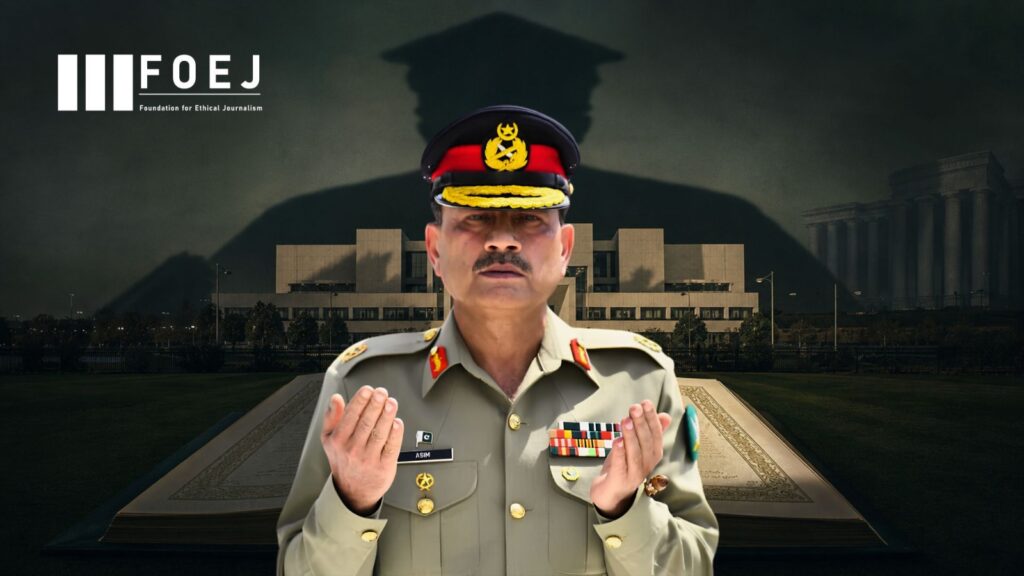
By looking at what this amendment does, it will be easier to understand why this matters in the long run. The amendment creates a new post of Chief of Defence Forces (CDF), currently held by Asim Munir, along with the post of Chief of Army Staff and establishes a Unified Command System which Pakistan never had in its institutional history. It simultaneously dissolves the office of the Chairman Joint Chiefs of Staff Committee (CJCSC), which symbolically allowed the civilian government to take part in decision-making in the strategic and nuclear affairs of the country. The reorientation of nuclear authority (from civilian to military), combined with the centralisation of power, poses a serious threat for a state prone to crisis escalation. The statute also mandates the creation of a Federal Constitutional Court (FCC), which leads to a diminution of authority. This is because the judicial selection process of the FCC grants substantial autonomy to the executive in appointing judges, thereby undermining judicial independence. Moreover, the amendment confers lifetime immunity to the president and the army chief, reduces judicial and civilian power and centralises military capabilities. All of these efforts aim to entrench Asim Munir’s authority and secure his position by legitimising military functions in governance.
These political arrangements limit the power of elected civilian leaders, which influences decision-making on critical issues such as national security or constitutional law. This decision-making often takes place outside parliament and encourages a politics of accommodation. Instead of fundamentally changing the system, parties tend to focus on existing policies and avoid conflict with powerful institutions. This creates a managerial style of politics that is focused on administration rather than reform. Critics argue that this results not only in the loss of policy prerogative but also in the hollowing out of democratic accountability itself. The problem intensifies when constitutional oversight is taken from the hands of an independent court and given to bodies heavily influenced by the executive, making judicial review ineffective and reducing checks on government power.
The amendment also alters how the state tackles politically restive regions. Decisions about governance in areas like Balochistan are heavily influenced by military and security concerns. This, in turn, prioritises law and order and securitised development while giving less space to civilian governance. While this setting can help in achieving short-term stability, it can promote the sidelining of grievances related to political marginalisation, lack of autonomy, resource exploitation, underdevelopment, and human rights abuses. A security-first strategy may postpone insurgency, but it may not resolve deeper structural problems without meaningful political inclusion.
The logic of implementing the amendment will also reflect on Pakistan’s foreign policy, especially towards its neighbour Afghanistan. The reason for this is that Pakistan’s policy on Afghanistan has long been influenced by the deep state. Strengthening the military’s role through the amendment will likely reinforce that pattern. Decisions on diplomacy, dealing with non-state actors, or border management will be driven by security considerations rather than politically accountable deliberation. When the options available to civilian diplomats are limited, foreign policy becomes less responsive to public or parliamentary scrutiny. This results in a security-first foreign policy that is less accountable and transparent.
There is another aspect related to credibility. Democracies are said to derive legitimacy not merely from order but also from accountability. When a constitutional amendment is enacted with the aim of reducing judicial independence and granting immunity to military leaders and a few political elites, international partners such as donors and democratic states, Pakistan may be viewed with scepticism. Economic negotiations with organisations such as the IMF and engagement with Western countries often depend on confidence in governance. When the constitution appears to be amended in favour of a single institution, which is the military in this case, it raises questions about the stability and reliability of the policymaking process. This can make external bargains more conditional or politically constrained.
However, one should not confuse legality with inevitability. What has been made legal matters, but so does political practice. The judiciary can assert independence, laws can be amended and popular politics and mass mobilisation can disrupt the existing framework. Nevertheless, the repercussions of undoing constitutional changes and correcting a political structure that embeds unelected power are severe. A political consensus would be required to abrogate the amendment. However, the very structures such as media, judiciary and political parties that could produce such consensus are constrained. Political scientist Paul Pierson describes this phenomenon as path dependence which is a social process grounded in a dynamic of increasing returns. (Paul Pierson)
If Pakistan wants to avoid the downside of this new balance of power, there are two areas through which the harm could be reduced. First, strengthening the participation of provinces by granting them real fiscal and administrative authority would reduce the temptation to treat provinces as problems to be managed by force. Second, the appointment of judges through a transparent and fair process could at least partially restore public trust in the judicial system. Implementing this requires political will, as the power arrangement is highly centralised, making it harder for leaders to push for political reform.
The passage of the 27th Amendment is a definitive moment. Pakistan’s military has moved from direct military intervention to a more institutionalised and legalised form of governance. Whether this political settlement brings stability, intensifies authoritarianism or produces resistance will depend on the choices of actors such as politicians, judges, civil society and citizens. For now, the amendment draws a clear line. The question is whether this line will be redrawn by politics or popular demand.