The Supreme Court on Monday, 2 November 2026, refused to hear a fresh plea against festive airfare hikes of up to 700%, with Justice Vikram Nath telling the counsel: “Don’t travel by air. Next case.” The one-line dismissal came in the middle of the Diwali travel rush, two days after the Centre notified new aviation rules that give it power to step in on fares only in “extraordinary situations” — and not before 1 January 2027.
What happened in court
Counsel for the petitioner argued that air travel has become an essential service and that fare increases of as much as 700% violate Article 14 of the Constitution, which guarantees equality before the law and equal protection of the laws. The bench did not engage with the argument and moved to the next matter.
The remark is striking because the same judge has led the court’s year-long scrutiny of airfares in a separate, still-pending public interest litigation. Monday’s dismissal does not end that case. It signals that the court wants the issue handled inside the existing PIL and the Centre’s new rules, rather than through fresh petitions.
The brush-off drew criticism online. Commentators argued that in a country of India’s size, flying is often the only practical way to make long, urgent journeys home — for a funeral, a medical emergency or a festival.
Diwali 2026: fares at four to five times normal
The plea reached the court as Diwali (8 November) and Chhath fares hit record highs. On the busiest routes out of Mumbai, a one-way economy seat cost four to five times its usual price — more than a flight from India to London on the same day.
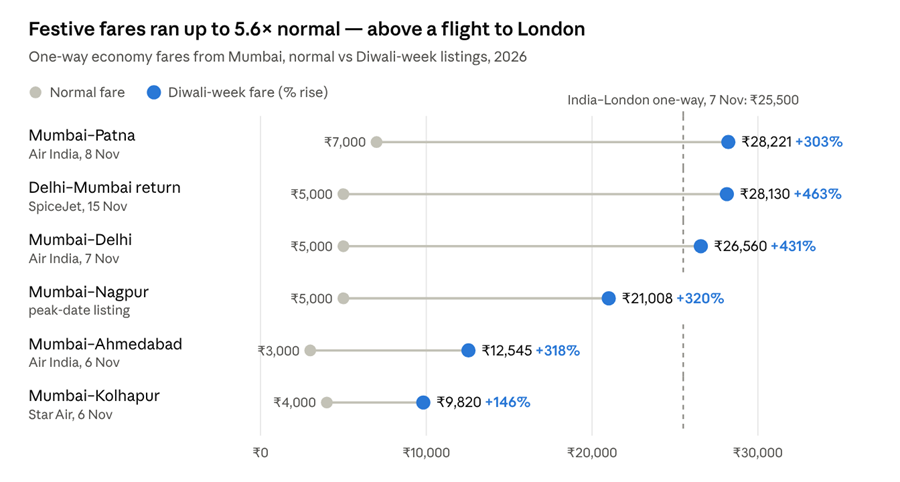
Free Press Journal fare analysis, 31 Oct 2026; London fare from the same report. Normal fares for Patna, Nagpur and Ahmedabad are implied from the reported % rise.
The petitioner’s 700% figure is higher than any route in this sample, where the steepest rise was about 460%, but the direction is not in dispute. The cheapest Mumbai–Patna seat on Diwali eve was ₹23,333, while one-way tickets to Bangkok, Dubai, Colombo or Singapore cost ₹15,000–22,000. Airlines point to higher jet-fuel costs, a weaker rupee and airspace disruption from the West Asia conflict. The squeeze is spilling into New Year: Mumbai–Goa on 30 December is listed at ₹13,469, against a usual ₹3,500.
The case that is still alive
The main challenge to airline pricing is a PIL filed by social activist S Laxminarayanan, which has been before the court for almost a year. It asks for an independent regulator, or binding guidelines, to control unpredictable fare swings and ancillary charges by private airlines.
The petition makes three main complaints:
- Opaque dynamic pricing. Algorithm-driven fares can jump sharply within hours, with no disclosure of how prices are set.
- Add-on charges. Seat selection, meals and other extras inflate the final price beyond the headline fare.
- Less baggage for the same ticket. It flags the cut in free check-in allowance from 25 kg to 15 kg.
Over eleven months of hearings, the bench has moved from strong words to a firm deadline for the government:
| Date | What happened |
| 2 Nov 2026 | Separate plea on 700% hikes dismissed: “Don’t travel by air” |
| 31 Oct 2026 | Bharatiya Vayuyan Niyam, 2026 published in the Gazette |
| 16 Oct 2026 | SG Tushar Mehta says rules are approved, to be published in two weeks; next hearing set for 16 Nov |
| 17 Aug 2026 | Centre hands over a draft and seeks three more weeks |
| 13 Jul 2026 | Court asks for the draft rules in a sealed cover |
| 15 May 2026 | Bench flags ₹8,000 vs ₹18,000 fares on the same route, same day; asks for “rationalisation” |
| 20 Jan 2026 | Justices Vikram Nath and Sandeep Mehta call festival fare hikes, including during Maha Kumbh, “exploitation” |
| 17 Nov 2025 | Court issues notice to the Centre and DGCA |
In May, the Solicitor General told the court the Centre was not disputing the problem and was treating the case as non-adversarial.
The new rules: transparency, not a cap
The rules the Centre promised the court are now law on paper, but they will not touch this Diwali or the year-end peak. The Bharatiya Vayuyan Niyam, 2026 was notified by the Ministry of Civil Aviation on 26 October, published in the Gazette on 31 October, and takes effect on 1 January 2027, replacing the Aircraft Rules, 1937. They are framed under the Bharatiya Vayuyan Adhiniyam, 2024, which replaced the Aircraft Act, 1934.
Fares stay market-driven, as they have been since deregulation in 1994. The fare provisions sit in Rule 192:
| Issue | Aircraft Rules, 1937 (until 31 Dec 2026) | Bharatiya Vayuyan Niyam, 2026 (from 1 Jan 2027) |
| Who sets fares | Airlines | Airlines, based on factors including operating cost |
| Standing price cap | None | None |
| Government intervention | DGCA could act on excessive or predatory pricing, or oligopolistic practices — Rule 135(4) | Centre may issue written directions in an “extraordinary situation” in the public interest; must be proportionate and time-bound |
| Trigger defined? | Named grounds (predatory, excessive, oligopolistic) | No definition of “extraordinary”, no numerical threshold |
| Disclosure at booking | Fare particulars | Total payable on site and ticket, broken into base fare, taxes and fees, plus cancellation charges and refund terms |
| Filing with DGCA | Tariffs filed and monitored | Tariffs and periodic operating costs submitted; DGCA monitors |
The most consequential change is what was dropped. The old rule named predatory pricing and oligopolistic practices as grounds for DGCA action; the new Rule 192 keeps tariff monitoring but does not carry those grounds over. Whether a festival surge counts as “extraordinary” is left entirely to the government — a question the court is likely to press on 16 November.
The government has capped fares before
The Centre has already shown it can cap fares when it chooses to. During IndiGo’s operational meltdown in early December 2025, when mass cancellations sent prices soaring, the Ministry of Civil Aviation imposed distance-based ceilings on all economy fares: ₹7,500 up to 500 km, ₹12,000 for 500–1,000 km, ₹15,000 for 1,000–1,500 km and ₹18,000 beyond Taxes and airport fees were excluded, as were business class and UDAN flights.
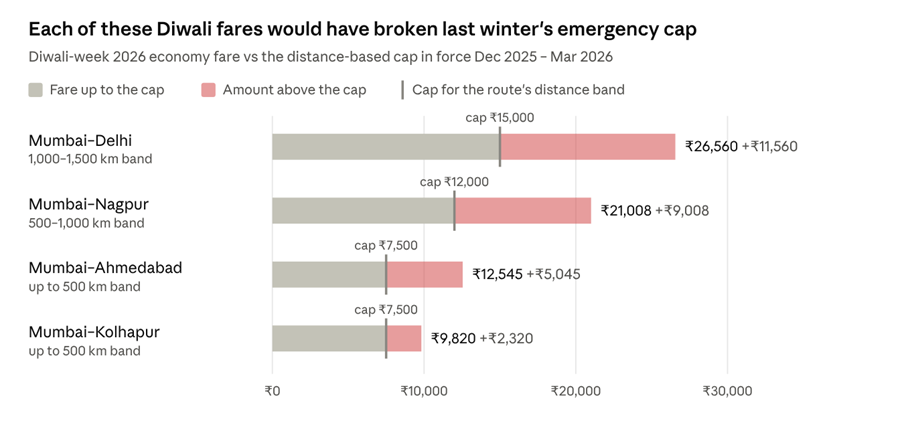
Caps: Ministry of Civil Aviation order, 6 Dec 2025 (Business Today). Fares: Free Press Journal, 31 Oct 2026. Delhi–Mumbai band as reported; other routes’ bands estimated from flight distance.
Those caps stayed in force until 23 March 2026, when the government said the situation had stabilised and airlines pushed for their removal, citing higher jet-fuel costs. That episode is effectively the model for the new rules’ “extraordinary situation” clause — a temporary, crisis-only power. A predictable festival surge, by contrast, is not obviously covered.
Who sets the price
India’s domestic market is highly concentrated, which is why the petition’s call for oversight carries weight. Two airline groups carry about nine of every ten domestic passengers, so on many routes a traveller’s real choice is between two pricing algorithms.
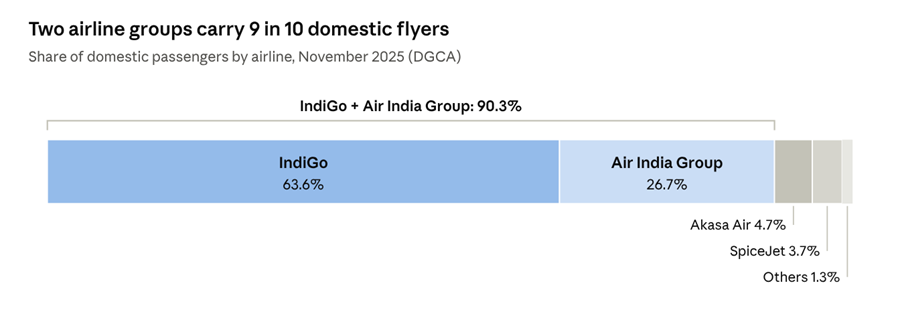
DGCA monthly traffic data, November 2025, via IANS and PTI. “Others” = remainder.
Domestic traffic reached 16.69 crore passengers in 2025, up just over 3%. This concentration is why the dropped reference to “oligopolistic practices” in the old rule matters: it was the one ground that let the regulator act on market structure, not just on a single crisis.
What to watch on 16 November
The Centre must place the notified rules before the bench at the next hearing on 16 November. Three questions are likely to decide whether the court accepts them:
- The gap. The rules start on 1 January 2027, leaving the Diwali–Chhath return rush and the New Year peak unregulated.
- The trigger. “Extraordinary situation” is undefined. The court may ask whether predictable festival surges qualify, or whether the dropped “predatory” and “oligopolistic” grounds should return.
- The petition’s other asks. The rules address disclosure, but not baggage allowances or an independent tariff regulator, both of which the PIL seeks.
For travellers, the practical change from January is visibility: a full fare breakdown, with cancellation and refund terms, before paying. Whether that is enough to stop a ₹5,000 ticket becoming ₹26,000 is what the court now has to judge.