



Shia, across the globe, commemorate the tragedy of Karbala throughout the sacred month of Muharram. There are a number of terms they use frequently which may be unfamiliar to non-Shias. Here, some key terms are intended to provide a clear understanding of the significance and practices of Muharram.
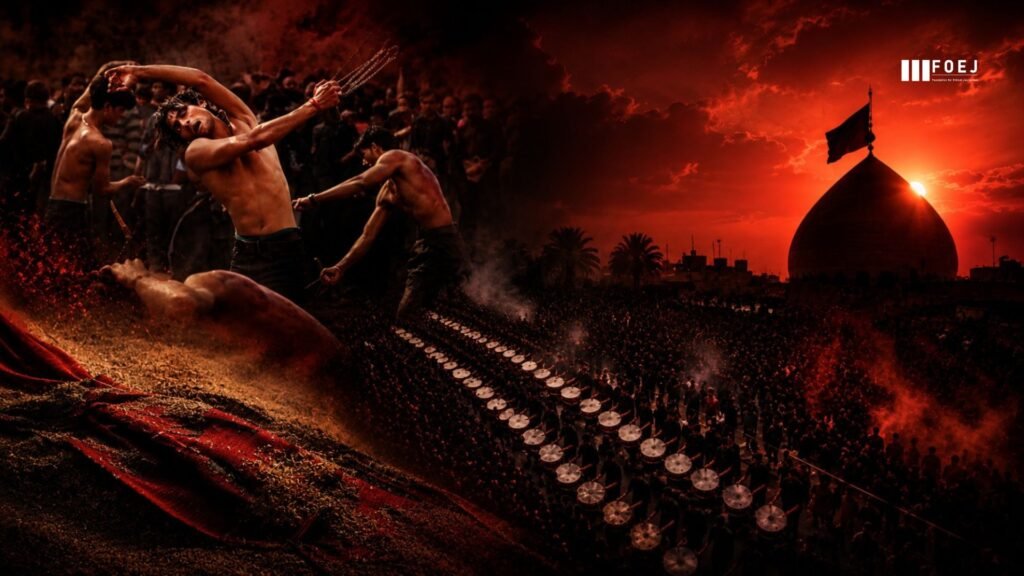
Muharram
Muharram is an Arabic word that comes from “ha-ra-ma”, which denotes something forbidden or sacred. In this month, since the pre-Islamic period, warfare and bloodshed were forbidden; that is why it is called the “sacred month”.
It is the first month of the Islamic calendar and one of the four months in which warfare was prohibited before the advent of Islam. Unlike most other parts of the Shia world, for Indian Shias, Muharram is not just one month but a period of two months and eight days of mourning, ending on the 8th of Shawwal, the 3rd month of the Islamic calendar. It is a month of mourning and remembrance of the valour of Karbala, the supreme martyr of Karbala, Imam Hussain Ali ibn Abi Talib (a.s.), alongside the other martyrs of Karbala who sacrificed their lives for the preservation of Islamic teachings at Karbala, a modern-day city in Iraq.
Majlis-e-Aza or Majlis
Majlis is an Arabic word which derives its root word from Ja-la-sa, literally meaning “sitting” or “gathering”. Thus, Majlis defines “a place for sitting or gathering” and, in Shia theological terminology, a Majlis-e-Aza defines an assembly of mourning for martyrs of Karbala primarily Imam Hussain. In the sacred month of Muharram, the first month Islamic calendar, a majlis–the central religious gathering of mourning–is organised in an Imambargah, a Hussainiyah or in a private home to commemorate the martyrs of Karbala and their virtues.
It starts with the recitation of verses of the holy Quran, precedes eulogy or elegy, and then an orator ascends the pulpit for delivering sermon, speech, ending on Masaib. Khateeb or Zakir (orator) is the central figure of Majlis. He or She begins with an Arabic sermon followed by Khetab (oration), in which the virtues of Islam and Ahlul bayt (peace be upon them) are addressed. Other issues of community and nation can also be the part of oration. The gathering ends on Masaib (the account of the tragedies, sufferings, and calamities endured by the Prophet Muhammad’s family (Ahl al-Bayt, elegy) following the Nouha and Matam (elegiac poetry, lamentation chants, and beating chest of oneself). The climax (girya) is the moment of collective weeping. The closing involves prayers and the distribution of tabarruk, which is distributed among the participants of Majlis at the end of the assembly. The whole majlis, generally, lasts about one hour.
In every Shia population, the Majlis is held throughout the first ten days of Muharram and in some areas, it continues till the forty days of the martyrdom of Imam Hussain and his companions in 61 AH at Karbala; 20th Safar, the second month of Islamic calendar. Most often, this mourning gathering is held during the night so that members of all occupations of the community can attend it while fulfilling their professional responsibilities.
The Majlis is more than a devotional gathering; it is also a community and assembly space for social solidarity to remain in touch with each other and assist in case of facing any persecution and it is a space where community identity is maintained and transmitted to the next generation.
The majlis is more than a devotional gathering; it also serves as a communal space that fosters social solidarity, enabling members to remain connected with one another and provide support in times of hardship or persecution. It is also a significant institution through which community identity is preserved and transmitted to subsequent generations.
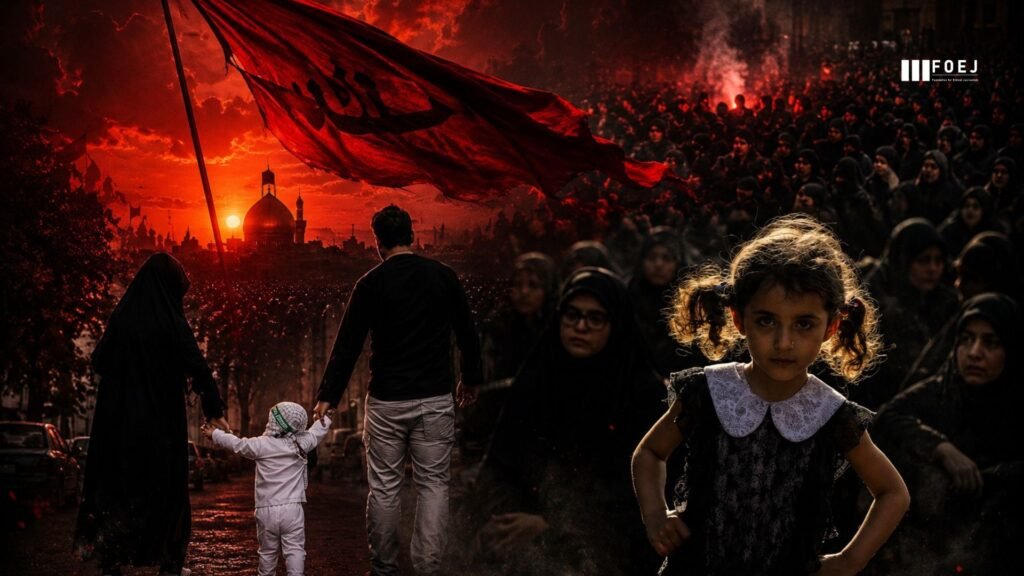
Imambargah/Hussainia
Literally, Imambargah is a combination of two words; Imam, which is an Arabic word meaning “leader” and “Bargah” which is a Persian word denoting “palace” or “court” while Hussainiyah is an Arabic substitute of it, a building dedicated to the religious gathering of Shia in Muharram for Majlis. The former is predominantly used among Asian countries, while the latter is widely used in Arabic-speaking countries, including Iran.
Nevertheless, it is built specifically for Majlis, but nowadays other religious gatherings are also held here, such as Mahfil (eulogy poetry in the honour of Ahlul bayt – peace be upon them), Nikah, and other community activities such as conducting lectures, classes, and social gatherings. The central part of the building is a hall that can accommodate hundreds or thousands of mourners. In modern times, it is designed with two separate entrances and halls or storeys: one for ladies and one for gents to listen to the same Majlis simultaneously.
The building, because it is designed for Majlis, has an interior design adorned with Muharram aesthetics: black banners written with Quranic verses and names of twelve Imams, quotations of Ahlul Bayt, an Alam often made of silver or gilded metal, decorative calligraphy, a taziya, and a picture of a prominent Shia religious cleric.
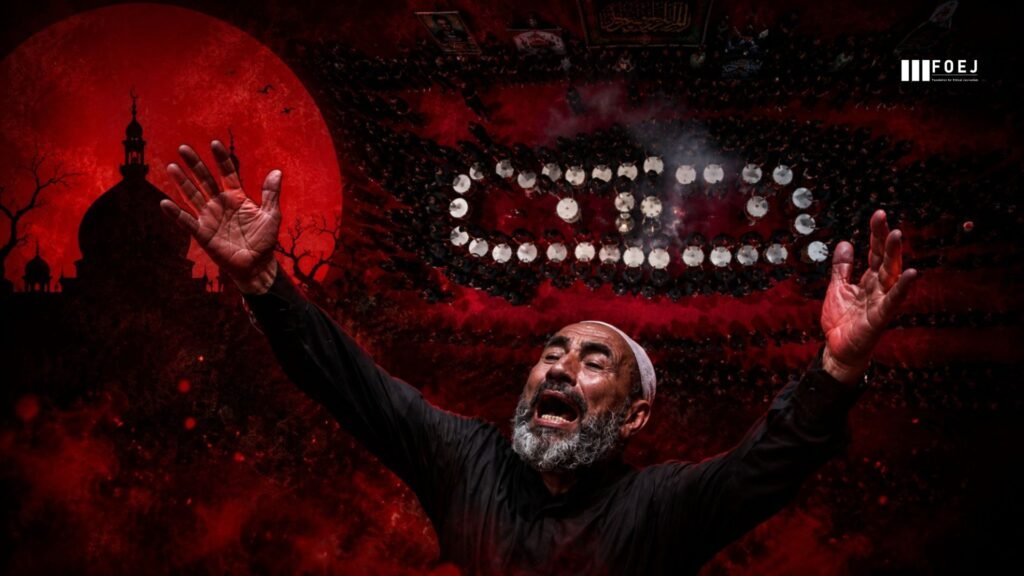
Karbala
Karbala is a combination of two Arabic words: “Karb”, meaning “agony”, and “Bala”, meaning “affliction” or “calamity”. In the Islamic history, the land of Karbala has been a land of agony and affliction for ages as it is narrated that many prophets passed through this land and faced trials.
Karbala is located on the bank of the Euphrates River, approximately 100 kilometres southwest of the capital city, Baghdad. Karbala, a city in modern-day Iraq, is home to two holy shrines of Imam Hussain and Hazrat Abbas, making it one of the holiest sites in Shia Islam. It is visited by millions of pilgrims throughout the year, particularly during Arbaeen, which marks the forty days after the martyrdom of Imam Hussain and falls on the 20th of Safar, the second month of the Islamic calendar.
For the followers of Imam Hussain, Karbala is more than the land of shrines; it has come to symbolise sacrifice, chivalry, and justice. It is the place where these words are put on immortality, possessing everlasting significance for all ages rather than being confined to a particular time.
Historically, upon the arrival of the caravan of Imam Hussain in 61 AH, Imam Hussain bought this land from the Banu Asad, who owned it and entrusted it to them, asking them to bury the martyrs’ bodies after they were killed by the army of Yazid, the tyrannical ruler of the time.

It was not merely a battle between Imam Hussain and Yazid but rather a conflict between two ideologies: righteousness versus falsehood, justice versus injustice, and lawfulness versus unlawfulness. The caravan of Imam Hussain consisted of members of the households of Prophet Muhammad, his companions, his admirers, and followers committed to the cause of Islam and humanity, ranging in age from six months (Ali Asghar) to 80 years (Habib ibn Mazahir); all of them sacrificed their lives to preserve the tenets of Islam. The central conflict arose over the question of allegiance to Yazid, as Imam Hussain, the grandson of Prophet Muhammad (pbuh), refused to accept Yazid as a legitimate ruler of Islam and sought to prevent bloodshed on the sacred land of Medina. Imam Hussain, thus, along with the members of the Prophet’s family, left Medina and reached the land of destiny and martyrdom, where they were killed after three days of thirst and hunger, despite the proximity of the Euphrates, blocked by the army of Yazid for them, which culminates in a genocide of the Prophet Muhammad’s family and companions.
The land was a vast desert, and with the scorching sun overhead and denial of the access of water of the river by the Yazidi army, seventy-two Muslims were killed there, and their bodies were left on the ground. The tents of the women and the children were also burnt down to kill the remaining members of the caravan, but they survived and were taken captive. The bodies of the martyrs were buried by the loyal members of the Banu Asad after the massacre.
The shrine of Imam Hussain stands on the proximate site where he was buried, and adjacent to it is the shrine of Abbas ibn Ali, the standard-bearer and half-brother of Hussain ibn Ali, who shared the same father but had a different mother. He was killed while attempting to fetch water from the Euphrates for the thirsty children in the camps on the day of Ashura, the tenth of Muharram.
Ashura
Ashura derives its root form from Asha-ra, which means “ten”. In Shia theology, then, it denotes the tenth day of Muharram. It is the day on which Hussain ibn Ali, along with his 72 loyal companions, including women and children, was killed on the plains of Karbala, a city in modern-day Iraq, by the army of Yazid, the ruler of the time, in 61 AH.
The genocide in Karbala did not start suddenly; rather, it started months earlier in the city of Medina, a city in modern-day Saudi Arabia, when Yazid assumed power as the Islamic caliphate and demanded a pledge of allegiance from all, particularly Hussain ibn Ali, the grandson of Prophet Muhammad, an authority in Islam. Denouncing Yazid’s action and his caliphate as an illegitimate ruler of Islam, Imam Hussain refused to pledge allegiance. When the matter escalated, he, along with his household, set out from Medina to Mekkah, where he was threatened with bloodshed in the sacred precincts of the Kaaba; he left Mekkah for Kufa, where a thousand supporters were waiting to pledge their allegiance to him, but they were suppressed and failed to fulfil their promises. Muslim ibn Aqueel, the trusted representative of Imam Hussain, was killed in Kufa. To prevent further bloodshed in Kufa, Imam Hussain left for Karbala, his destined path to eternal life.
On 2nd Muharram 61 AH, the caravan arrived at Karbala, set up tents there, and spent the following days in remembrance of Allah. Days after the arrival of the caravan, the army of Yazid started to approach Karbala; tens of thousands of armed fighters surrounded the small group of the household of Prophet Muhammad and cut off their access to water from the Euphrates River, denying them water for at least three days.
In the vast desert land of Karbala, there were only two groups: a small group of Muslims from the household of the Prophet and his companion, including a six-month-old child, including Ali Asghar, and an eighty-year-old man, including Habib ibn Mazahir al-Asadi; on the other hand, a large group of people were armed to kill unarmed people, women and children. On the morning of Ashura, after dawn prayer performed by the caravan of Imam Hussain, the battle representing universal injustice began. By the evening, all males were killed; their bodies were left on the ground. The camp of women and children was burnt to the ground, and chiefly Hussain ibn Ali’s sister Zainab bint Ali and his son Ali ibn Hussain were taken to Damascus.
Specifically, for Shia, Ashura is not merely a day of mourning. It is an embodiment of the principles of Islam and human dignity which are straightened. The whole story is encapsulated in a quotation by Imam Hussain: “Death with dignity is better than life with humiliation.”
On this day, Shias around the globe commemorate the event of Karbala in Imambargahs and organise a juloos (procession) on the allotted routes to expose the killer of humanity and Islam.
Azadari
Azadari is an Arabic word. It literally means “mourning”, “Lamentation”, “grief” and similar expressions of sorrow. In Shia terminology, it is an umbrella term which encompasses every activity and practice of mourning for Imam Hussain and his companion who were killed in the Battle of Karbala by the army of Yazid at 61 A.H. From individual mourning to public processions such as Taziya and Alam, Azadari includes every act undertaken to commemorate this tragedy.
It is a whole Shia culture represented through various acts and expressions including wearing of black clothing, attending Majlis(mourning gathering), reciting Marsiya (elegiac poetry) and noha (lamentation chants); beating chest (matam) as a physical expression of grief; organising juloos (processions); preparing and distributing tabarruk (blessed food) and setting up sabeel (free water and drinks); and the performing ta’ziya etc.
Zakir or Khatib
Zakir is an Arabic word meaning “one who remembers or commemorates”, and Khatib refers to a person who delivers a sermon (Khutba). The former is primarily used for the orator of the Majlis in Shia discourse, while the latter is a common term in Islamic theology used in various fields, such as the Khatib of prayers.
Both words are translated as ‘orator’ in English. The responsibility of an orator is to deliver the message of Karbala. He or she should be versed in Islamic theology, the history of Islam and Karbala, and oratorical skills to preach the message and bring the audience to collective weeping (Masaib), the central part of the Majlis.
In female mourning assemblies, there is a Zakira who narrates the events and tragedy of Karbala along with discussions on community issues.
Imam Husain
The full name is Husain ibn Ali ibn Abi Talib, the third Imam of the Shia community, preceded by Imam Hasan, the second Imam, and Imam Ali, the first Imam as well as a grandson of the Prophet Muhammad (PBUH). He was the son of Imam Ali, the first Shia Imam and fourth caliph of the Muslims, and Fatima al-Zahra, the daughter of the Prophet Muhammad (PBUH). His dignity can be summarised in a quotation by the Prophet Muhammad (PBUH): “Husain is from me and I am from Husain,” a statement that Shia Muslims cite to emphasise his deep religious and spiritual relationship with the Prophet.
In Shia theology, Husain is infallible, the divine guide and heir of Islamic leadership after the demise of the Prophet. These are the bases from which the Shia-Sunni division emerged. Without understanding this backdrop, the concept of the Battle of Karbala will be blurred. Imam Husain challenged the legitimacy of Yazid’s caliphate through his actions. Husain’s refusal to pledge allegiance to Yazid placed him and his family under threat. Therefore, the Imam left Medina.
On the 10th of Muharram, known as Ashura, Imam Husain and 71 members of the household of the Prophet along with his companions were killed by the army of Yazid at Karbala, a city in modern-day Iraq.
Marsiya
The Arabic word “ra-tha” is the root form of “Marsiya”, which literally means “elegy” or “funeral ode”. It is one of the greatest elements of the Majlis, narrating the tragic event of Karbala and expressing lament. Among the South Asian Shia community, it is recited before a Majlis starts, by an individual or a group of people. In the Urdu-speaking community, the Marsiyas of Mir Babr Ali Anis (1802–1874) and Mirza Dabeer (1803–1875) are enormously famous for their diction, vocabulary, and their detailed, mournful narration of the event of Karbala across centuries. The two are the most celebrated Urdu poets of the Marsiya tradition, and their literary art form forms an indispensable part of the Urdu language and literature curriculum.
The classical Urdu Marsiya is commonly written in a six-line stanza (Musaddas) with a strict formal structure: an opening (Matla’), portrayal of heroism, cavalry, and valour; a battle scene (razm); lamentation (bain); and a closing reflection.
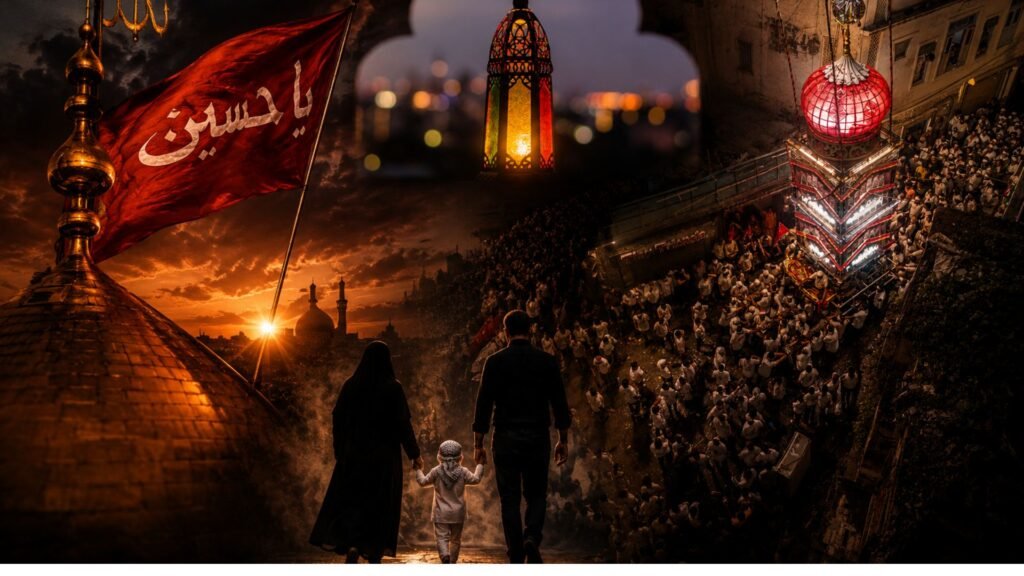
Noha
The literal meaning is “lamentation”. While Marsiya is recited at the opening of a Majlis, Noha is recited at its climax of a Majlis or during a procession. The pattern of Noha follows a strictly rhythmic and congregational act of mourning. A Noha reciter (Noha Khwan) recites or chants verses, and the congregation, while beating their chests rhythmically with open palms, repeats a refrain. The voice of the lead Noha reciter, the rhythmic beating of the chest, the collective call-and-response pattern, the synchrony of the refrain, and the rise and fall of the collective voice create an experience of communal grief.
Noha is composed on the same themes as Marsiya: the tragic event of Karbala, focusing on the tragedy of the Day of Ashura at Karbala and its aftermath, including the captivity of the Ahlul Bayt.
In the contemporary era, Noha is the most visible part of Azadari. Through the advancement of media, its recording has evolved significantly and become part of daily Azadari rites. Professional Noha reciters record their Nohas in studios with sophisticated musical arrangements, and these are widely listened to and shared across social media.
Matam
Matam and Noha are inseparable and closely intertwined. ‘Matam’ literally means “lamentation”, but in Shia theology, it refers to the rhythmic beating of the chest with an open palm as an expression of grief for Imam Husain and his beloved companions who were martyred at Karbala. This form of Matam is universally accepted and remains uncontroversial among all Shia clerics.
Under the broader category of Matam, there are more intense forms such as Zanjeer Zani or Qama Zani. The former consists of a chain fitted with blades, while the latter involves a knife or sword. These practices are highly controversial among many Shia clerics in Iran and Iraq. The late Ayatullah Syed Ali Khamenei ruled against such practices on the grounds that they cause bleeding or harm to the body or to Islamic tenets, while others permit them.
Alam
‘Alam’, literally, means a “flag”. In Shia discourse, it is a religious flag specifically attributed to the tragedy of Karbala; not all religious flags are called ‘Alam’. In an Imambargah or Hussainiyah (a sacred place where a Majlis is held), one can see an Alam standing on the floor, hanging on the walls, or hoisted on the roof.
During a Juloos (procession), an Azadar (a mourner of Imam Husain) carries it. Often, it is black in colour, symbolising grief, sorrow, and mourning, and bears inscriptions such as ‘Ya Husain’, ‘Ya Abbas’, and ‘Ya Sakina’, etc., in Arabic script. It is most commonly triangular in shape, although other designs can also be seen.
On the 8th of Muharram, it commonly commemorates the martyrdom of Abbas, the standard-bearer of Karbala. On the night of the 7th of Muharram, during a Majlis, the Zakir (orator) explains the significance of the Alam and recounts the life and virtues of Abbas, the loyal brother of Imam Husain.