



Husain ibn Ali and his 71 loyal companions were killed in the desert of Karbala on 10 Muharram 61 AH, known as Ashura. Among the survivors were Ali ibn al-Hussain, a 23-year-old man; women, chiefly Lady Zainab; and children. Lady Zainab, the daughter of Ali ibn Abi Talib and Fatima bint Muhammad, led the survivors and carried the mission of Karbala through one of the darkest periods in the history of Islam.
On the Day of Ashura, Husain ibn Ali sacrificed his life in the way of Allah, but what came next?
The survivors were taken captive, and it was the sister of Husain ibn Ali and a granddaughter of the Prophet Muhammad who carried the message of Karbala from the battlefield to a global audience, transforming the tragedy into a revolution. Without her courage, eloquence, and political consciousness, the mission of justice might have been buried beneath the plains of Karbala rather than becoming a timeless symbol of resistance against tyranny of all time.
Despite her significant role in spreading the message of sacrifice, justice, and humanity, Lady Zainab has remained marginalized within global scholarship. Nevertheless, contemporary and Muslim feminist scholarship increasingly recognizes her as a remarkable female leader who, within the Islamic framework, challenged the tyrannical ruler of her time, thereby breaking stereotypes about the passive role of Muslim women in Islamic history. Within Western scholarship, it is a widely accepted notion that Islam has confined women within the walls of the home, but the life of Zainab proves otherwise.
To understand the place of women in Islam, it is better to study the pre-Islamic Arabian history, the Holy Quran, and its interpretation through the action of the Prophet Muhammad towards women. Historically, some tribes practiced female infanticide, known as wa’d. Because of deep-rooted societal norms, such as the fear that a daughter might be captured during tribal war or because of poverty, they used to bury their newborn daughters alive. Whenever a pagan received the news of the birth of a baby girl, his face grew gloomy and he suppressed his rage. Whether to keep her in disgrace or bury her alive was the only choice; many tribes preferred the latter.
The Holy Quran, the words of Allah, strongly prohibits this practice: “Do not kill your children for fear of poverty.” (6:151) Elsewhere, he asks a striking question: “For what crime were they put to death?” (81:9)
There are numerous incidents in which the Prophet Muhammad publicly condemned this tribal practice among his companions. On the other hand, he repeatedly demonstrated exceptional respect for his daughter, Lady Fatima. Many authentic sources narrate that whenever she entered his home, he stood to welcome her, kissed her forehead, and sat her in his own place. This was not merely an affectionate gesture towards his daughter but also an affirmation of a woman’s honor within Islamic Sharia.
Contrary to Western perceptions of women in Islam, Lady Khadija emerged as an exemplary businesswoman whose commercial enterprise extended across Arabia. She embraced Islam and married the Prophet Muhammad, managed his business, and supported Islam economically and the Prophet Muhammad emotionally. This signifies that Islam does not confine women to the home but allows them economic and social independence.

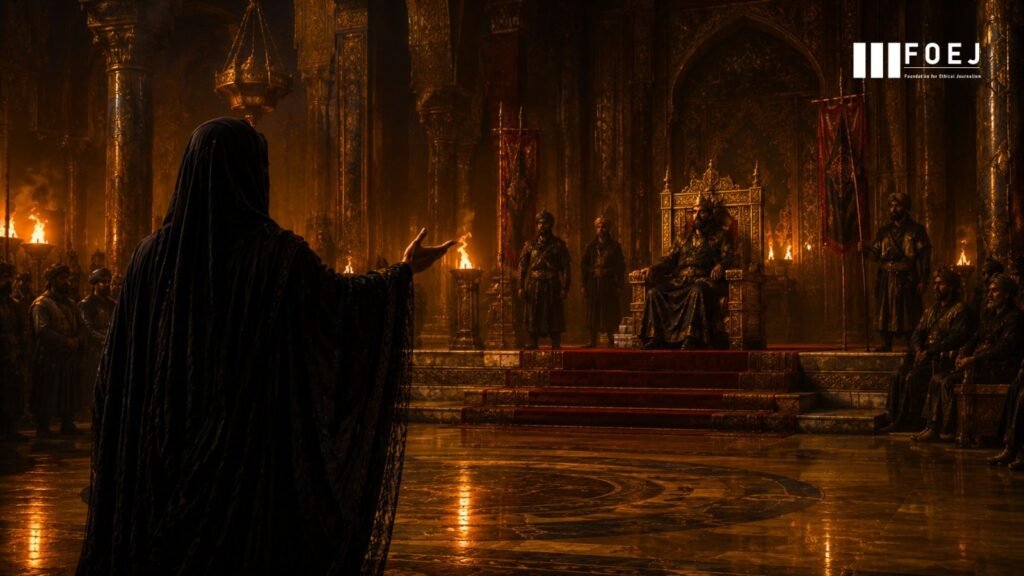
Lady Zainab was brought up by the people whose intellectual excellence, moral inspiration, and communicative skills were already deeply embedded. In the aftermath of the tragedy of Karbala, she stood against the very system that massacred her whole household, chiefly her brother Husain ibn Ali, Abbas ibn Ali, and her sons, Aun and Muhammad. She, as a strong woman, led the prisoners of Ahlul Bayt, protected Ali ibn Husain, and carried the message of Husain ibn Ali to the palace of Yazid, where she addressed the hundreds of dignitaries from across Yazid’s kingdom and spread the message of truth, justice, and humanity—the message of Karbala.
Ali ibn al-Husain was seriously ill and, therefore, was exempted from participating in the Battle of Karbala. She protected him from the army of Yazid when one of its soldiers intended to kill him. She intervened and declared that if you wish to kill him, kill me first. By leading and comforting the captives and survivors of Karbala, she transformed captivity into resistance, resilience, and hope.
Before arriving at the palace of Yazeed, the caravan was taken to Kufa, where Lady Zainab delivered one of the most effective speeches. She eloquently addressed the betrayal of the people of Kufa, who had formally invited Husain ibn Ali through thousands of letters but abandoned him in his hour of need. She started her sermon by praising Allah and sending blessings upon the Prophet Muhammad and his purified progeny.
“O people of Kufa, O you who are deceitful and treacherous: Do you shed tears? May your tears never dry up and your loud lamentations never cease. … Indeed, by Allah. Do cry endlessly and laugh but little, for your deed was so horrendously disgraceful that you will never be able to atone for it.”
It was such an eloquent sermon that a deathly silence fell over the crowd; even the camels’ bells fell silent, and people began weeping.
In the palace of Yazid in Damascus, in present-day Syria, she delivered one of the greatest political speeches ever delivered by a woman whose entire household had been killed before her eyes and whose surviving family members had been taken captives.
The self-acclaimed victorious ruler, who expected submission, Zainab, standing before hundreds of people gathered to celebrate Yazid’s victory over Husain ibn Ali, fearlessly exposed the moral bankruptcy of his regime and reminded him through her sermon that “You (Yazid) may employ your deceit and cunning efforts, but I swear by Allah that the shame and disgrace which you have earned by the treatment meted out to us cannot be eradicated,” and the blood of Husain will permanently expose injustice.
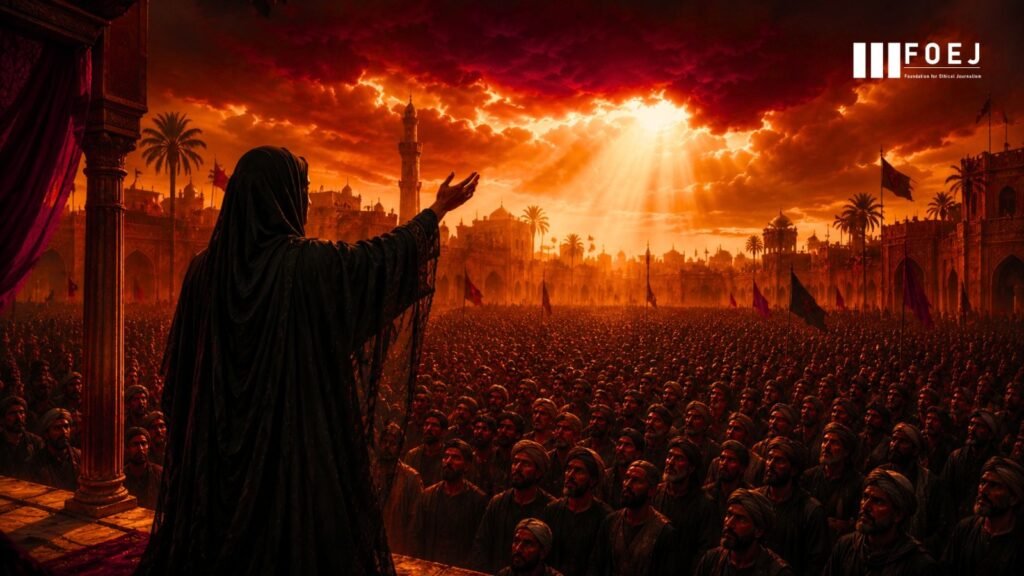
Her speech reversed the atmosphere, shifting public opinion from celebrating Husain’s death at Karbala to sympathizing with the captives, thereby shaking the very foundations of the tyrannical regime.
The army of Yazid believed itself to be victorious because it killed almost all the companions of Husain ibn Ali, and the survivors, including women and children, were taken captive through Kufa and Damascus to celebrate the victory. Lady Zainab’s sermons exposed the limits of the tyrannical regime, declaring, “I saw nothing but beauty.” On the other hand, Ali ibn Husain, through his sermon, proved that the names of his household still echo and are invoked in the Adhan; they are alive.
Karbala endured, and the regime vanished, because truth prevails and falsehood perishes.
Zainab became the ambassador of the message of Karbala, its interpreter and its defender. She narrated the eyewitnesses’ account of the tragedy of Karbala, its aftermath, the captivity, and the illegitimacy of Yazid’s regime, thereby transforming the tragedy into memory, identity, and a symbol of justice.
Husain authored the revolution through sacrifice; Lady Zainab preserved it through narrative.
Ghader Tahmasi Farid, an Iranian poet, writes:
Karbala dar Karbala mimanad agar Zainab na bood.
“Had Zainab not been, Karbala would have remained in Karbala.”