



The United States is currently pushing a massive regional peace framework in Switzerland. This diplomatic drive aims to bind Israel, Lebanon, and Iran to a permanent end to hostilities. However, a deep contradiction threatens to break this diplomatic roadmap before any papers are signed. Washington envisions a comprehensive settlement.
Yet, the physical realities on the ground present a completely different scenario. For Israel, a long-term diplomatic deal with Lebanon is a massive security gamble.The nation views its northern border through the strict calculus of geostrategic topography.
The Illusion of a Paper Ceasefire
Recent U.S.-mediated talks in Washington produced a tentative ceasefire framework between Israel and Lebanon. The conditions of this agreement are highly demanding. Hezbollah operatives must fully evacuate areas south of the Litani River. Meanwhile, the Lebanese Armed Forces must take exclusive military control over designated security zones.
Military planners in Jerusalem see this diplomatic suggestion as highly unstable. They doubt a weak Lebanese army can permanently displace an entrenched group like Hezbollah. A sudden re-infiltration remains a constant threat on the frontier. Therefore, Israeli defense doctrine states that vital national security cannot be outsourced to foreign forces. Physical, geographical dominance is the only reliable guarantee for the state.
The Geostrategic Mandate of Mountain Heights
The main obstacle to this peace deal is the extreme importance of the northern border’s topography. Southern Lebanon is defined by commanding mountain ridges and high-altitude ground. Historically, the forces controlling these heights dominate the entire conflict zone.
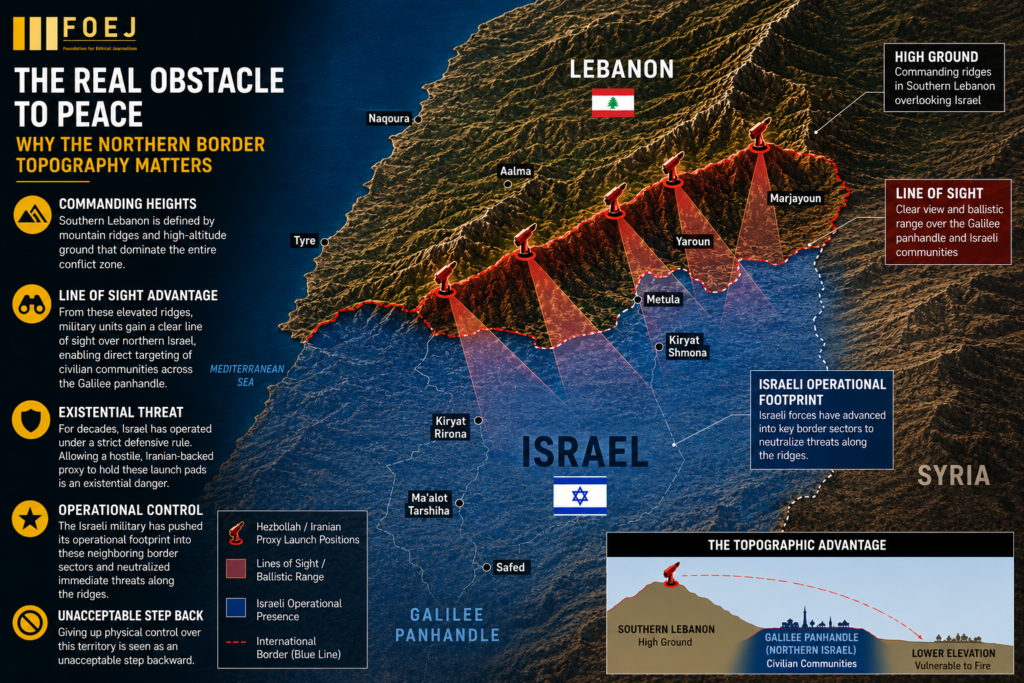
From these elevated ridges, military units gain a clear line of sight over northern Israel. It allows direct ballistic targeting of civilian communities across the Galilee panhandle. For decades, Israel has operated under a strict defensive rule. Allowing a hostile, Iranian-backed proxy to hold these launch pads is an existential danger. The Israeli military has successfully pushed its operational footprint into these neighboring border sectors. They have neutralized immediate threats along the ridges. Consequently, giving up physical control over this territory is seen as an unacceptable step backward.
Historical Precedents: The Golan Heights and Sinai Peninsula
Israel’s focus on retaining strategic geography is visible throughout its history. Past border conflicts provide clear blueprints for how the state handles physical buffers.
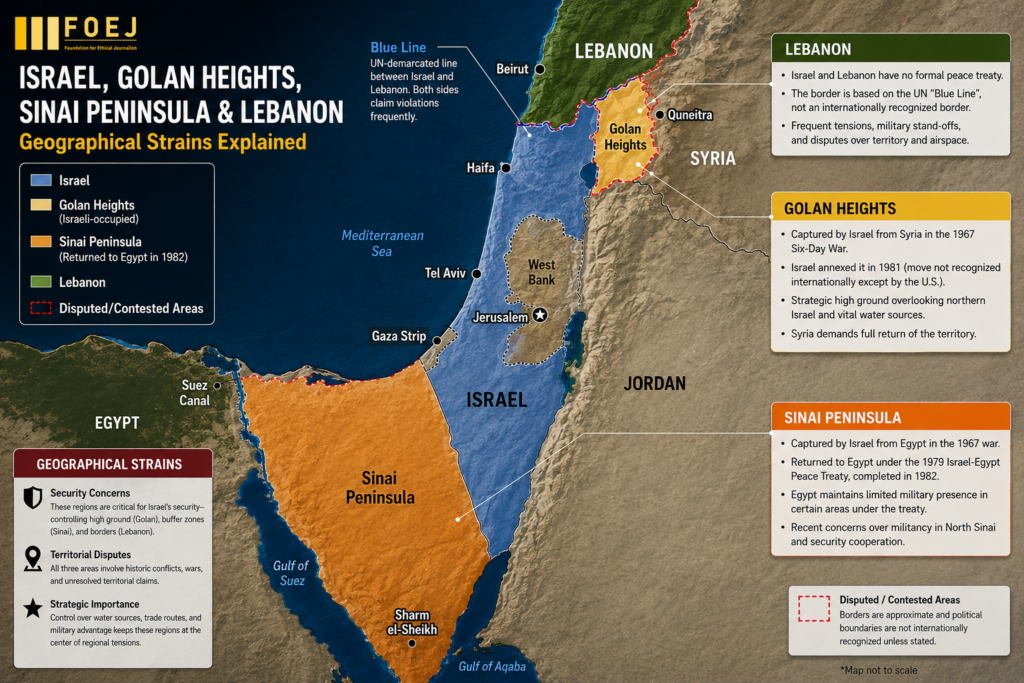
Consider the example of the Golan Heights. Israel captured this volcanic plateau from Syria during the 1967 war. The high ground stopped Syrian forces from shelling Israeli villages in the valley below. It also provided a vital defensive shield against invasion. Despite intense international pressure to return the land for peace, Israel annexed the territory. The move proved that physical dominance matters more to Jerusalem than any signed peace treaty.
The Sinai Peninsula presents a different historical lesson. Israel captured this massive desert expanse from Egypt in 1967. Later, during the 1979 peace treaty Camp David Accords, Israel agreed to a full withdrawal over the condition that the peninsula was divided into distinct zones with limits placed on the number of troops and heavy weaponry each side could station there to ensure demilitarization.
The flat desert plains were easy to demilitarize and monitor with radar systems. Furthermore, Egypt was a sovereign nation with a centralized military that could enforce a treaty. Southern Lebanon has no such stable authority. It remains dominated by fractured, non-state groups.
A Defiant Collision Course with Washington
This uncompromising focus on geography has placed Prime Minister Benjamin Netanyahu on a collision course with Washington. The White House is trying to leverage small truces to force a grand regional settlement. In private letters, U.S. officials told Netanyahu that Israel would have no choice but to comply.
Yet, Israel’s military actions continue to defy these heavy diplomatic warnings. Iran recently fired a warning salvo of eleven ballistic missiles toward Israel. Trump quickly phoned Netanyahu and demanded a halt to counter-escalations. Israel completely ignored the reprimand. Hours later, it launched major airstrikes targeting assets inside Tehran.
Yechiel Leiter, the Israeli Ambassador to the U.S., defended this independent stance. He stated that no self-respecting country would tolerate such ballistic attacks.
Geography Trumps Diplomacy
The blueprint for a comprehensive regional peace deal suffers from a fatal flaw. It is disconnected from the physical realities of West Asian warfare. Diplomats see borders as lines on a map to be negotiated. Israeli strategists see borders as high defensive walls that ensure survival.
Israel has already secured critical positions along its volatile frontiers. It will not trade hard-fought mountain heights for paper guarantees. The high ground remains the ultimate arbiter of security in the region. Therefore, Israel will likely choose military containment over diplomatic compromise with Lebanon.