



Almost every time a woman is murdered, assaulted, or raped, the violence does not end with her death. Instead, a familiar pattern unfolds. Her life is dissected, her choices are scrutinized, and her character questioned. Long before the justice process even starts, society starts asking whether she was “respectable” enough to deserve it. The case of Ishara Ayubi is no different.
Ishara Ayubi, 25, was a software engineer from Sitapur, Uttar Pradesh, working at Optum in Gurugram. She tragically lost her life on July 11 after she was allegedly stabbed to death in her colleague’s flat in Sector 55, Gurugram. The prime suspect, Shreshth Malik, a 25-year-old AI engineer, was later found dead on nearby railway tracks.
But soon, the conversation around her obituary notice took a U-turn. The words “live-in relationship” became glued to the headlines, leading many online to hold Ayubi accountable for the crime committed against her. Pictures of her lifeless body were met with comments such as “The girl is dead, thank God,” “What is not for Allah is not for anyone,” “Hijab pehen ke boyfriend,” “Great job by her boyfriend,” and “Accha hua mar gayi, Jahannam mein jaaye ab.”
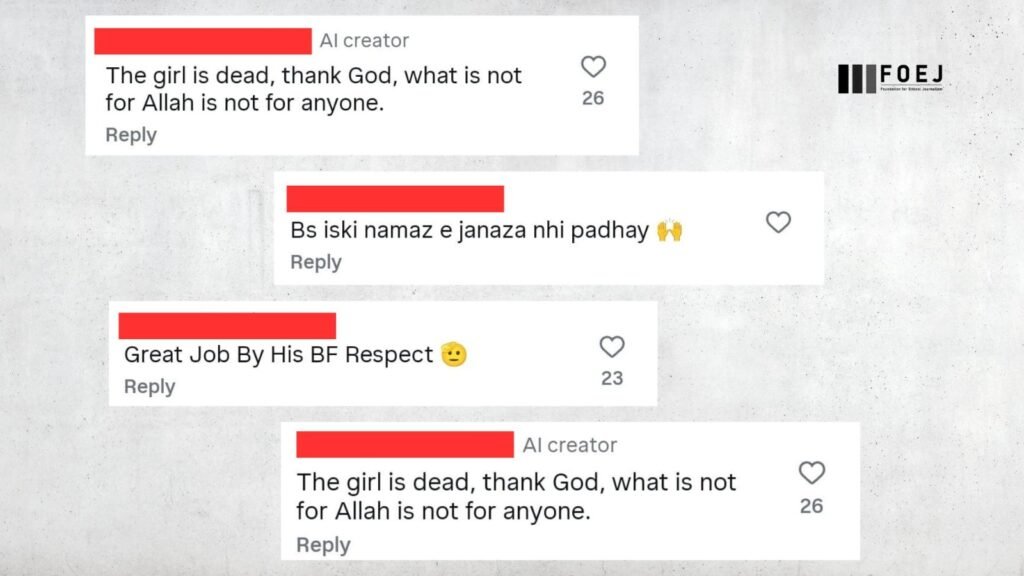
These were far from the most brutal comments. Many were so vile that I chose not to repeat them, not to soften the extent of the hatred, but because I did not want to subject readers to more cruelty than they already have to witness. Or maybe, in some way, I was protecting myself too. As women, every slanderous comment lands heavily on us. We know how easily it could have been directed at any one of us.
What is even more disturbing is how few people cared to know the facts before passing judgment. Friends who knew her described her to me as “the most pious soul” and “the best Muslimah” they had ever met. While talking to them and navigating through the life of Ayubi, a question arose in my heart: Why were any of these explanations necessary in the first place? Isn’t murder alone enough to demand justice?
And even if, for a moment, we assume Ayubi was in a relationship or living with Malik, would that change the justice she deserves? Since when has justice depended on a woman’s relationship status?
Time and again, women have been judged through the lens of their personal choices. Take the alleged rape and murder of a 12-year-old girl in Galwanpora, Budgam district, Jammu and Kashmir. She went missing on the evening of May 23 while on her way to a local madrasa. Her body was recovered from a nearby field the following morning. As news of the crime traveled, so did the language of sympathy. People repeatedly pointed out that she had been carrying the Quran and was on her way to study deen. It was as though her piety made the crime more tragic. But had she not been “pious,” would her rape have been any less horrific? Should a child’s religious devotion determine the compassion she receives?
A few months ago, while reporting on the alleged sexual assault of the first-year engineering student of South Asian University, I encountered that people even blame the victim for going to the deserted area.
Go back a little further, and we find the same questions asked after the Nirbhaya case. The 2012 Delhi gang rape and murder, which is commonly known as the Nirbhaya case, involved a brutal gang rape and murder of a 22-year-old woman identified as Jyoti Singh Pandey in a moving bus on December 16, 2012. She was beaten, gang-raped, and tortured in a private bus while traveling with her friend, Avnindra Pratap Pandey.
Amid one of the most brutal crimes in India’s recent history, a portion of public conversation was fanned towards her choices. Why was she out late at night? Why was she with a male friend? What was she wearing? Being a kid back then, this was the first time I encountered the word rape. The meaning of which, from the public discourse I figured out, was if a woman moves out at midnight, she would meet something brutal. What was more difficult to process was that the statement was fitted strongly in the minds of my fellow mates, as well.
Some of them still believe that the victim should not have moved out in the night, as “this was the invitation towards crime.” Moving forward to 2026, in the murder of Ayubi, the word “invitation” still lingers. A larger section of society, mostly the Muslim men, describes it as an “invitation” because she was a “hijabi” living with a Hindu man.
A woman’s personal choices cannot become the framework through which her right to justice is measured. Whether she was in a relationship or not, whether she made choices others approved of or choices that challenged social expectations, none of these things have any connection to the violence committed against her. A woman should not have to prove that she is religious enough, modest enough, or respectable enough before society recognizes the injustice done to her. Justice cannot become reserved only for women who fit a particular image.
This is also where selective outrage enters the room. Victims are often transformed into symbols. Their pain becomes attached to larger moral narratives. People defend them when their stories reinforce a particular worldview but become uncomfortable when the victim’s life complicates those same beliefs. In the process, the woman herself disappears. Her suffering becomes secondary to the meaning others want to extract from it.
We say that justice is blind, but every time a woman is murdered or raped, we begin by looking at everything except the crime. We examine her clothes, her relationships, her faith, her social media, the hour she stepped outside, and the company she kept. We keep searching for reasons to explain why she was there instead of asking why the perpetrator did what they did.