The 24 hours within which an arrested person must see a magistrate start the moment police or an agency take away their freedom of movement, not when an officer later writes “arrested” on a memo. That is the core of the Supreme Court’s ruling in Sujit Das v. Union of India (SLP (Crl) Nos. 12451–12453 of 2026), delivered on 5 November 2026 by Justices Ujjal Bhuyan and Atul S. Chandurkar.
The Bench made four moves that matter beyond this case:
- One clock, not two. Under Article 22(2), “arrested” and “detained” mean the same thing. There is no lawful “buffer zone” of custody before a formal arrest.
- 24 hours is a ceiling, not an allowance. Under Section 58 BNSS, custody must also be reasonable. An unexplained 18-hour wait failed that test on its own.
- Magistrates must check the real clock. They must find out when liberty was first curtailed, record it, and may refuse remand even inside 24 hours.
- Special statutes bend to Article 21. Once custody is unconstitutional, the strict bail bar in Section 37 of the NDPS Act cannot keep the accused in jail.
Four appellants, accused of carrying 11.03 kg of methamphetamine (“yaba”) tablets in Tripura, were ordered released on bail, subject to conditions set by the Special Court.
The facts: a day lost between custody and paperwork
A search team took the appellants into custody at about 2:00 PM on 29 September 2025, during a drug-smuggling search in Tripura. The agency recorded their formal arrest only the next day, 30 September, and produced them before the Judicial Magistrate at 4:45 PM that day.
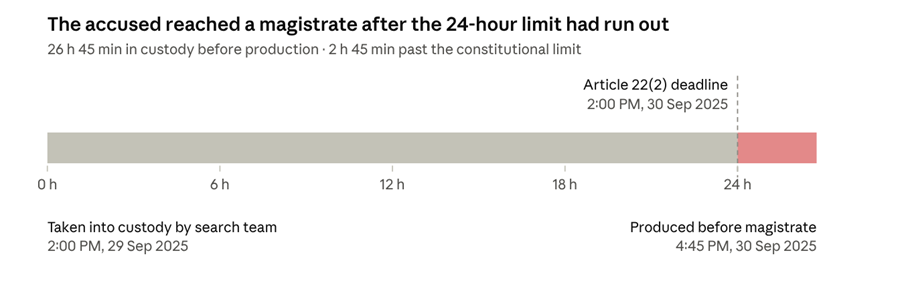
Times as recorded in the judgment, via the source article and LiveLaw · hours counted from 2:00 PM, 29 Sep 2025
The agency argued the 24 hours ran from the formal arrest on 30 September, so production was on time. The accused said the late paperwork was a device to stretch the constitutional limit. Separately, 18 hours passed between the end of the search-and-seizure and the formal arrest, with no explanation offered. The Tripura High Court refused bail on 29 April, relying on the twin conditions of Section 37 of the NDPS Act for commercial quantities.
The holding: “arrested” and “detained” are the same moment
The Court held the arrest took place, for Article 22(2), at 2:00 PM on 29 September, when the appellants were under the search team’s control. Production at 4:45 PM the next day was therefore a clear breach. It made the arrest unconstitutional and all custody after 2:00 PM on 30 September illegal.
Article 22(2) says every person “arrested and detained in custody” must reach the nearest magistrate within 24 hours, excluding travel time. The agency read the two words as two stages: first detention, then arrest, with the clock starting only at the second. The Bench rejected that reading in three steps.
- No detention apart from arrest. The Constitution does not recognise custody divorced from arrest. The clock starts when a person, suspected of an offence, is held and their liberty is effectively curtailed.
- No buffer zone. The Court said clause (2) does not permit a zone where liberty is curtailed for investigation but no arrest is shown. Creating or even contemplating such a zone is unconstitutional.
- Read the Constitution to protect, not to dilute. An artificial line between arrest and detention would hollow out the guarantee. Where two readings are possible, the one that furthers the constitutional purpose wins.
According to LiveLaw’s report, the Bench said the view that the 24 hours begin at formal arrest is contrary to both Article 22(2) and the BNSS. Labelling custody as “interrogation” or “questioning” does not stop the clock.
Section 58 BNSS: 24 hours is the outer limit, not a free window
Even without the constitutional breach, the appellants would have gone free. The Court found the unexplained 18-hour gap between the end of search-and-seizure and the formal arrest was not a “reasonable” period under Section 58 of the Bharatiya Nagarik Suraksha Sanhita, 2023.
Section 58 (the old Section 57 CrPC) sets two separate limits on police custody without a warrant:
| Test | What it requires | Result in this case |
| Reasonableness | No longer than is reasonable in all the circumstances | Failed: 18 hours with no explanation |
| Outer limit | Never beyond 24 hours, excluding travel, without a magistrate’s order under Section 187 | Failed: 26 h 45 min from actual detention |
The Bench stressed that 18 hours in custody without judicial oversight leaves clear room for misuse. Agencies cannot treat the full 24 hours as an unrestricted window for investigation.
A new duty for magistrates
Magistrates can no longer rely on the time printed on the arrest memo. At first production they must:
- ascertain when the person’s liberty was first curtailed;
- record the actual date and time of detention;
- check that the 24-hour limit was met from that moment; and
- refuse remand if the pre-production custody was unreasonable, even when it falls within 24 hours.
Why the clock matters: the hours before a magistrate are the riskiest
The Court tied its reading to a hard fact: custodial violence is real and judicially acknowledged, and the worst abuses happen during investigation. It named the tactics directly: not recording an arrest at all, or calling custody a “prolonged interrogation” to keep a suspect away from a judge.
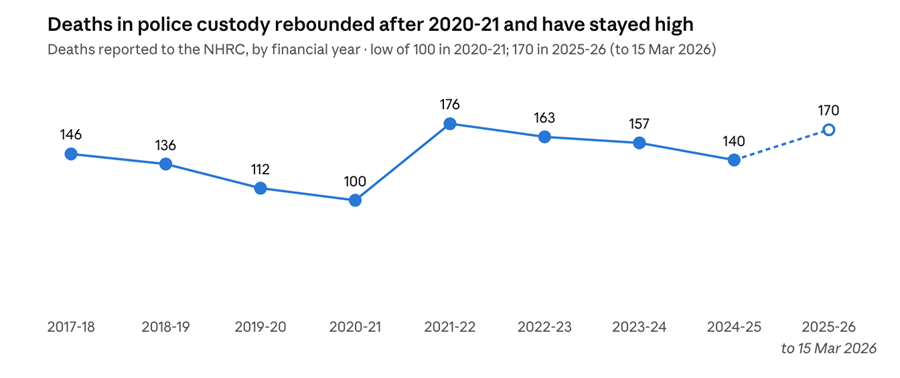
NHRC figures given to Parliament: 2017-18 to 2020-21 via The Wire (Feb 2023) and Deccan Herald; 2021-22 to 2025-26 via The Wire (Mar 2026). 2025-26 is a partial year.
The official numbers support that concern. Government figures put deaths in police custody at 170 in 2025-26 up to 15 March 2026, the second-highest of the last nine years. Earlier answers gave slightly different counts for two years (175 for 2021-22 and 164 for 2022-23); the chart uses the latest figures.
The NCRB’s own series counts far fewer deaths (62 in 2023), which itself points to under-reporting. It also splits deaths by whether the person was on court-ordered remand. In 2023, only about 39% of custodial deaths were in police remand; the rest happened to people held without a remand order, which is exactly the window this judgment narrows. Accountability remains thin: of 2,279 cases registered against state police personnel in 2023, 1,012 were charge-sheeted.