



During a hearing before the Delhi High Court in August, Senior Advocate Arvind Datar made a submission that deserves more attention than it received. His client, Indian Kanoon, had been directed to switch off name-based search for a set of litigants who had successfully invoked India’s newly recognised right to be forgotten. The same judgments, Datar told the Division Bench, remained fully readable, names intact, on SCC Online and Manupatra, and would remain readable on Taxmann if the underlying dispute happened to involve tax. Indian Kanoon, he said, was the only legal database the order actually touched. If that submission survives scrutiny, India’s right to be forgotten is not quite the right its name suggests. It functions as an injunction against whichever two defendants a litigant happened to sue, and nothing more.
The right traces to a judgment delivered by Justice Sachin Datta on 29 May 2026 in Laksh Vir Singh Yadav v. Union of India, disposing of a batch of more than thirty writ petitions filed over nearly a decade. The Court held that the right to be forgotten flows from informational privacy under Article 21, and structured relief around three questions: how the underlying proceeding ended, whether the person held a public role connected to the information, and whether the information remained accurate and relevant. Search engines were directed to de-index the covered judgments from name-based results. Indian Kanoon was directed to disable name-based search for the named petitioners specifically, while keeping every record reachable through case number, citation, or court and date. Litigants were also given the liberty to separately approach the courts that had passed the original orders and seek masking at source. The Ministry of Electronics and Information Technology was tasked with overseeing compliance across intermediaries.
Indian Kanoon did not accept the framework quietly. Its intra-court appeal reached a Division Bench of Justices C. Hari Shankar and Vinod Kumar and has now been argued across three hearings since mid-July. The appeal runs on several planks. One is that the single judge’s standard, information that is no longer relevant or serves no legitimate public purpose, appears nowhere else in Indian law, and will turn every future request into its own contested trial rather than the application of a settled rule. Another is that open justice ordinarily survives once a record becomes part of the public domain, subject to narrow and already-recognised exceptions such as sexual offence cases and juvenile matters, and that writ petitions are the wrong vehicle for expanding that list one litigant at a time. Indian Kanoon has also argued that the single judge read more into the Supreme Court’s privacy ruling in Justice K.S. Puttaswamy than that judgment actually decided, since its observations on a right to be forgotten were incidental to a case about the constitutional status of privacy itself, not a considered ruling on erasing judicial records.
The plank worth dwelling on is narrower and more concrete: the order singles out Indian Kanoon for a burden that no comparable platform carries, restricting its right to conduct business under Article 19(1)(g), while treating it differently under Article 14 from every subscription database that hosts the identical record and was never made a party. The Bench has so far sounded unpersuaded that citation-based search is a workable substitute for name-based search, pointing out that most people do not carry case numbers around with them. It has, even so, declined to grant an interim stay, choosing instead to hear the appeal on its merits. The matter was listed for further hearing on 2 September; no order arising from that hearing had been reported at the time of writing.
Whatever the Division Bench eventually decides, the appeal has already surfaced something that outlasts its own outcome. A right created through Article 226 litigation is, by its nature, a remedy against whichever respondents happen to be named in the writ petition. Justice Datta’s order binds Google and Indian Kanoon because they were parties before the Court. It says nothing about SCC Online, Manupatra, Taxmann, Casemine, the news aggregators that mirror the same reporting, or the smaller scraper sites that copy judgments wholesale and republish them without attribution. None of that is a drafting gap that a more carefully worded order could have closed. It is what happens when a right meant to operate horizontally, across an entire information ecosystem, is built one respondent at a time.
Two litigants with identical facts, acquitted in similar circumstances, could walk away from the same court with entirely different practical protection, depending on which platforms their counsel thought to name, or which ones happened to surface when the petitioner first searched their own name. A prospective employer, a landlord, or a curious neighbour needs only try a different website to find what a court has already ordered erased from view. That is not a coherent constitutional entitlement so much as it is litigation luck, dressed up in the language of Article 21. It also sits oddly with how Justice Datta’s own judgment framed the harm, as a continuing and disproportionate injury to dignity and reputation, an injury that plainly does not stop at the boundary of whichever two websites were sued.
This is a different problem from the one most commentary on the judgment has focused on so far, which is which categories of people qualify for relief: the acquitted, the discharged, parties to settled matrimonial disputes, and those named only incidentally in someone else’s case. That question concerns who gets to knock on the door. The one the appeal has surfaced concerns what happens after the door opens, and it will not go away regardless of how the categories are eventually drawn. Even a litigant who falls squarely within every category the judgment recognises gains only a partial and platform-specific remedy, because the order was never capable of binding the internet at large. For someone rebuilding a career or a reputation after an acquittal, a right that removes their name from two websites while leaving it fully searchable on ten others is not a meaningful improvement on the status quo it was meant to correct.
Indian Kanoon’s own appeal gestures towards the more durable answer, even while arguing against the order that produced it. Redaction, its counsel suggests, should begin at the point a court registry uploads a judgment, not downstream at whichever platform later happens to get sued. Justice Datta’s order already contains the seed of this idea, in the liberty it grants litigants to approach the originating court for masking directly, rather than proceeding only against intermediaries. If registries redacted identifying details before publication, for the categories the judgment itself already defines, acquittals, discharges, quashed proceedings, and settled matrimonial matters, that protection would travel with the judgment wherever it was later hosted, rather than stopping at the door of whichever website happened to lose in court.
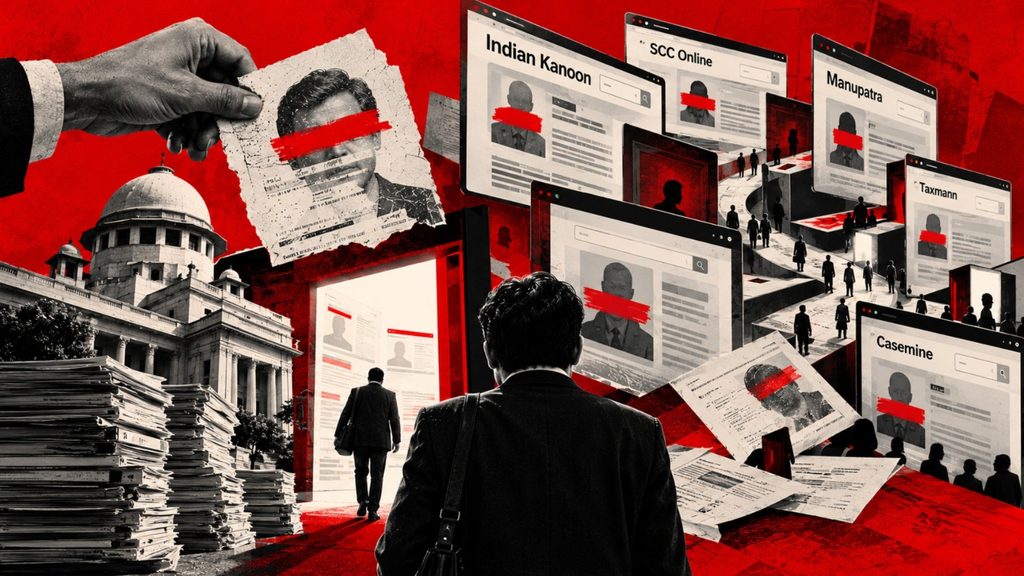
But a registry-level fix only reaches judgments not yet uploaded. Every affected judgment already sitting on SCC Online, Manupatra, and the dozen or so mirror sites that scrape Indian Kanoon and each other would still need a separate mechanism to catch up, and no fix at the point of upload reaches content copied and republished years earlier. Closing that gap needs a rule that binds platforms as a class, whether through an amendment to the Intermediary Guidelines that reaches any platform hosting a judicial record as such, or through a statutory right to erasure, of the kind the Digital Personal Data Protection Act gestures towards, extended to expressly cover court records rather than leaving the question to be litigated afresh each time, against whichever platform a litigant’s lawyer thought to sue.
Until one of those happens, the right to be forgotten in India will keep working the way it worked for the petitioners in Laksh Vir Singh Yadav: real against the specific platforms sophisticated enough, or unlucky enough, to be named as respondents, and simply absent everywhere else carrying the same record. A constitutional right whose reach depends on who happened to be sued is not really a right at all. It is the terms of a settlement that a court happened to write down.


