Jamia Millia Islamia is not merely a university; it represents an ideology, a history, and an identity. More important than its buildings is the thought that built it, more important than its degrees is the purpose for which it was established . Jamia Millia Islamia was founded in 1920, at a time when India was struggling against British colonial rule. Prominent personalities such as Maulana Muhammad Ali Jauhar, Sheikh-ul-Hind Maulana Mahmood Hasan, Hakim Ajmal Khan, and Dr Mukhtar Ahmad Ansari played important roles in its establishment. Jamia Millia Islamia’s Islamic intellectual identity, its founders’ vision of education, and their struggle for India’s independence are fundamental elements of the institution’s history.
That is why, while discussing any issue concerning JMI, its history, ideology, and identity cannot be pushed into the background.An incident from the life of Maulana Muhammad Ali Jauhar is particularly significant in this context. In 1923, the annual session of the Congress was held in Kakinada, with Maulana Muhammad Ali Jauhar presiding over it. During the session, Pandit Vishnu Digambar Paluskar began singing “Vande Mataram,” to which Maulana Muhammad Ali Jauhar objected. Keeping this example in mind, it is important to understand that participating in a movement and remaining committed to one’s religious beliefs are not contradictory.
A person can struggle for the restoration of a students’ union at their university and raise their voice for other student rights. However, this does not mean that they are obliged to accept every symbol or slogan that conflicts with their beliefs.Dr Zakir Husain’s writings are also of exceptional importance when it comes to JMI’s identity. Explaining JMI’s logo and motto, he writes: “The star of Allah-o-Akbar is JMI’s guiding star. It reflects the truth that Allah is the Greatest, and the one who bows only before Him is the one who recognises the truth. After bowing before Him, how can one bow before anyone else?” These are not merely a few words; they explain the concept of Tawhid embedded in JMI’s logo. Dr Zakir Husain’s explanation is still available on JMI’s official website.
The question now is: how can a symbol or slogan that conflicts with Islamic beliefs be considered acceptable at an institution whose logo features the star of Allah-o-Akbar as its guiding symbol and whose motto expresses the idea of bowing only before Allah? This is not a debate about opposing love for one’s country; rather, it concerns the fundamental principle of Tawhid, according to which the right to worship and divinity belongs exclusively to Allah Almighty. For a Muslim, love for the country, service to it, and the protection of the rights of its citizens are important in their own right. However, none of these requires them to compromise their beliefs.
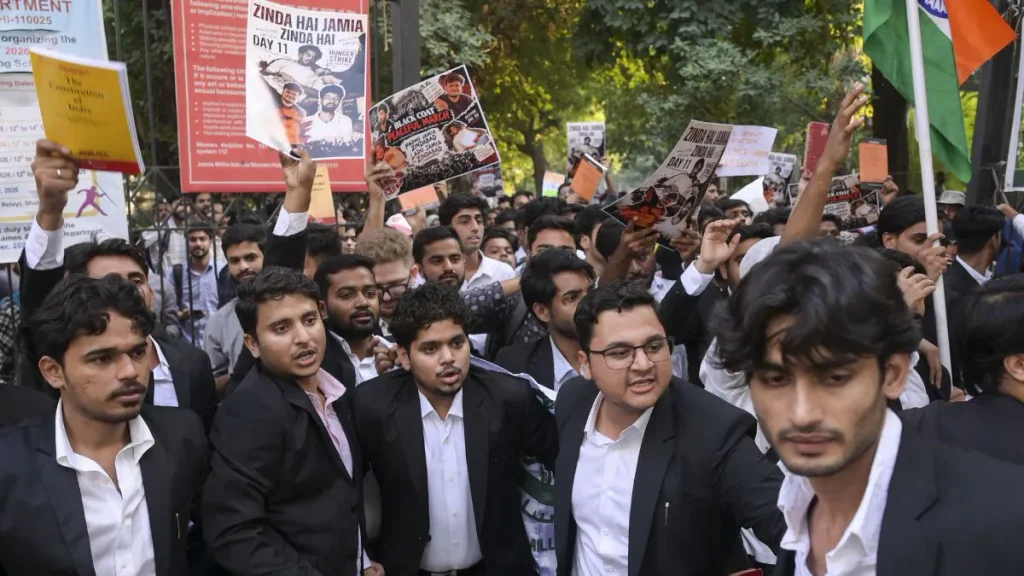
Another question arises here: why must verbal proof of love for India be demanded again and again? When students of India, at one of the country’s central universities, protest for their educational rights, demand the restoration of student representation, and struggle for accountability in educational institutions, is that not an expression of their practical civic responsibility? When students raise their voices for the constitutional rights of citizens, a transparent education system, and democratic representation, what further proof is being demanded of them while their actions are ignored? Love for one’s country is demonstrated not only through slogans but also through protecting the rights of its citizens, struggling for justice, and participating practically in improving society.
It is also necessary to ask in what circumstances and for what purpose slogans such as “Vande Mataram” and “Bharat Mata Ki Jai” are being used in practice. Expressing love for one’s country is one thing, but if these slogans are used on any occasion to question Muslims’ patriotism, defame them, or fuel hatred against them, that conduct deserves criticism. If, in an environment where Muslims are subjected to mob violence, mosques are damaged, or citizens are targeted on the basis of their religious identity, such slogans are used as instruments of pressure, then the matter is no longer merely about national sentiment; it becomes an issue of civil liberties and religious rights. The historical significance of any slogan is one thing, but using it to intimidate a citizen or forcibly pass judgement on their loyalty cannot be justified.
Against this backdrop, it also becomes necessary to condemn the slogans allegedly raised by Raunak Khatri at Jamia Millia Islamia in recent days. If Raunak Khatri raised these slogans without consulting members of his organisation, the NSUI Jamia Millia Islamia unit should clearly condemn his actions. It should present its position on the basis of the video and statement. It would be better if Raunak Khatri himself also issued a clarification and an apology in this matter.
If this does not happen and students’ union elections are held in the future, Raunak Khatri, who was known for helping NSUI win at Delhi University, will now be known for making NSUI lose at Jamia Millia Islamia. If he genuinely supports students’ rights and democratic politics, he should also understand that going to another educational institution and expressing political dominance through slogans about which its students have serious religious reservations is inconsistent with the purpose of student representation. Any attempt to damage JMI’s history and identity will certainly be met by JMI’s students through reasoned argument, political resistance, and democratic struggle.
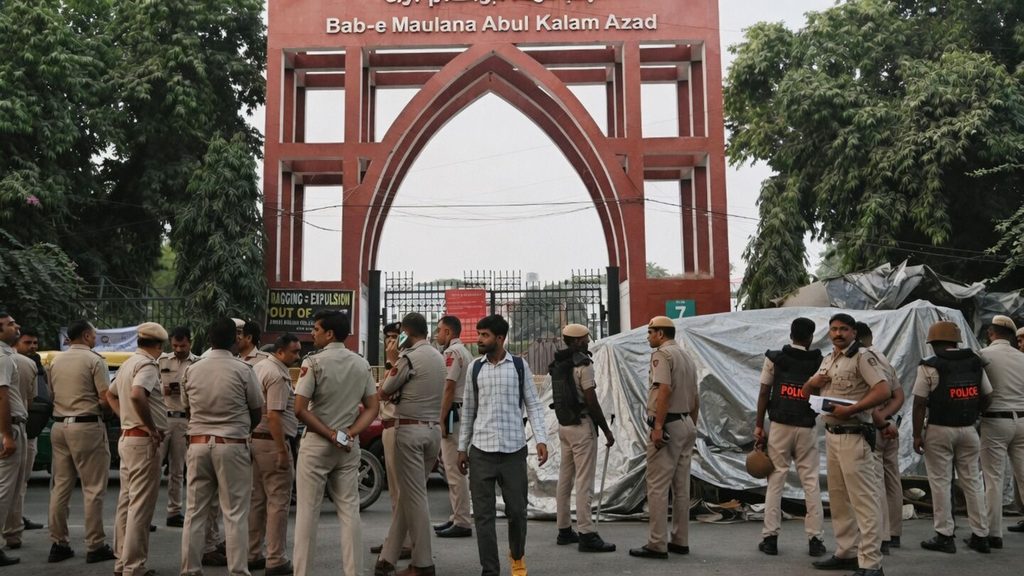
NSUI is the student organisation of the Congress party. It protests for students’ rights, transparent admissions, and administrative accountability. Its activists have also protested over admissions at Jamia Millia Islamia. However, if NSUI speaks about the rights of others, it must apply the same principles to the conduct of its own colleagues and members. Raising one’s voice against injustice suffered by others while remaining silent about the conduct of people within one’s own circle is a contradiction that requires an explanation.
There is another question for NSUI and the Congress. The students’ union at Jamia Millia Islamia was dissolved on 31 March 2006, and regular students’ union elections have not been restored since then. The Congress-led central government remained in power from 2004 to 2014, including the period from 2006 to 2014. If the Congress and its student organisation consider democratic student representation important, the question is why JMI’s students’ union was not restored during that period. NSUI and the Congress should answer this question first. After that, the question concerning the period from 2014 to 2026 can be put to the Bharatiya Janata Party and the ABVP.
Another aspect of NSUI’s conduct is also worth considering. During the protest against “admission Chori,” the office-bearers of the NSUI Jamia Millia Islamia unit allegedly prevented SIO, the Students Islamic Organisation of India, from participating, saying that it belonged to a particular religion. If an organisation is excluded from a struggle for students’ rights merely because of its religious background, such conduct raises questions about the principles of democratic politics and student unity. Jamia Millia Islamia’s own historical and intellectual identity has given fundamental importance to Islamic values and Tawhid. Therefore, an organisation’s religious identity cannot be used as a reason to exclude it from a struggle for students’ rights. If the purpose of a protest is transparency in admissions and the protection of students’ rights, participation should be determined by the demands and principles of the protest, not by an organisation’s religious background. However, if NSUI has a problem with a religious background, I would say, with the utmost respect, that it should leave Jamia Millia Islamia, because JMI’s own background is also religious.
The demand for the restoration of the students’ union is legitimate and important in its own right. JMI’s students also need an elected representative body that can present their problems to the administration, raise its voice for their rights, and ensure their participation in educational matters. But another reality is also attached to this demand: we need our rights, we need a students’ union, and we also need to protect our Islamic identity, our beliefs, and our principles. There is no need to abandon everything else in order to obtain any one of these things. If the restoration of a students’ union requires us to ignore our beliefs, Tawhid, and Islamic identity, we may gain a union but lose much of what Jamia Millia Islamia was established to protect.
The purpose of Jamia Millia Islamia’s establishment was not merely to create an institution, but also to carry forward an educational tradition in which Islamic identity and participation in national life could go hand in hand. If we begin compromising the fundamental principles of our beliefs and identity within our own institution, we must consider what we are protecting and what we are losing. Tawhid is not merely a religious term; it is the foundation of a Muslim’s intellectual and practical life. That is why the principle of Tawhid cannot be ignored when discussing JMI’s identity.
In this struggle, students must also recognise the hypocrites among them. Not everyone who raises the slogan of restoring the students’ union necessarily aims to strengthen Jamia Millia Islamia, preserve its identity, or strengthen the students’ voice. Some genuinely want a union to resolve students’ problems, represent them, and protect their rights, while others raise the demand for its restoration to amplify their own voices, come to power, and secure representation for themselves. These are the very people who speak of principles when dealing with others but forget those principles when it comes to their own colleagues. Those who genuinely speak for students’ rights must also demonstrate that they respect students’ religious identity, intellectual freedom, and collective interests.
Jamia Millia Islamia’s students must decide what the real purpose of their struggle is. Do they merely want to secure an elected position, or do they want to establish a representative body that genuinely becomes the voice of students? Do they want a union simply to come to power, or to resolve students’ problems, hold the administration accountable, and protect educational rights? If the only objective is to acquire political power, students’ sentiments and Jamia Millia Islamia’s identity can be used for that purpose. But if the real objective is student representation, consistency in principles, integrity, and honesty in one’s position are essential.
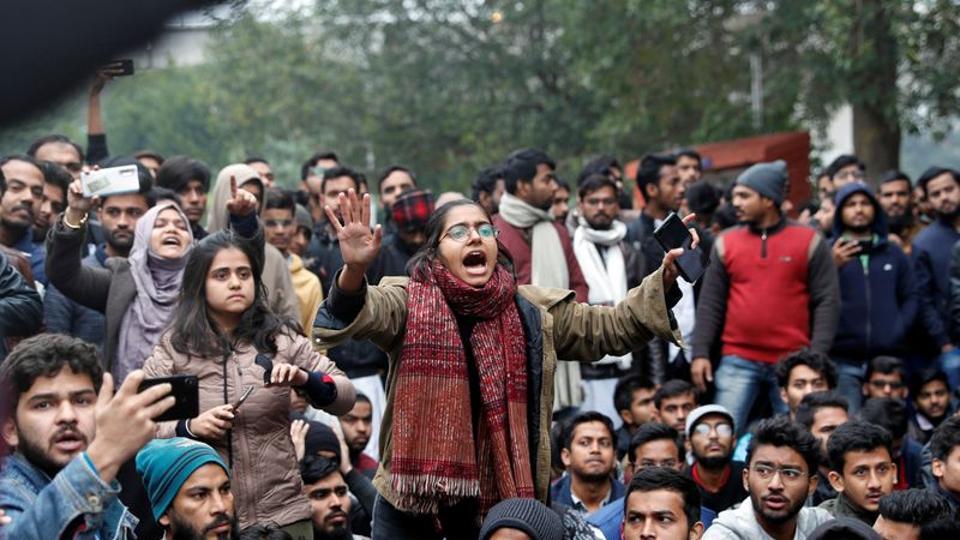
Attempts to damage JMI’s history and identity should be answered not with emotional reactions or threats, but with strong arguments, organised student struggle, and democratic resistance. We need student politics that stands firmly for its rights while also recognising its principles; that demands the restoration of the union but does not allow this demand to become a means of political party dominance; and that expresses national belonging without surrendering the freedom of belief and conscience in its name.
We need a students’ union as well as the protection of our beliefs; we need our rights as well as our identity; we love our country and are also conscious of our accountability before our Allah. There is no need to place any one of these in opposition to another. JMI’s history teaches us that a relationship can be established between education, national belonging, and Islamic identity in which no one is compelled to abandon their fundamental identity. This is the principle on the basis of which the debate surrounding Jamia Millia Islamia’s future, its student politics, and national slogans should move forward.
The views expressed in this article are those of the author and do not necessarily reflect the views of FoEJ Media.